TRANSMISSION // 2611.13825v1
Simulated star clusters settle into a shared shape despite different beginnings
Source published
Dense star clusters with very different starting structures evolved toward similar density profiles in simulations, while black hole binaries supplied energy to their cores. The preprint suggests that a cluster’s present-day shape alone may reveal little about how centrally concentrated it was at birth.
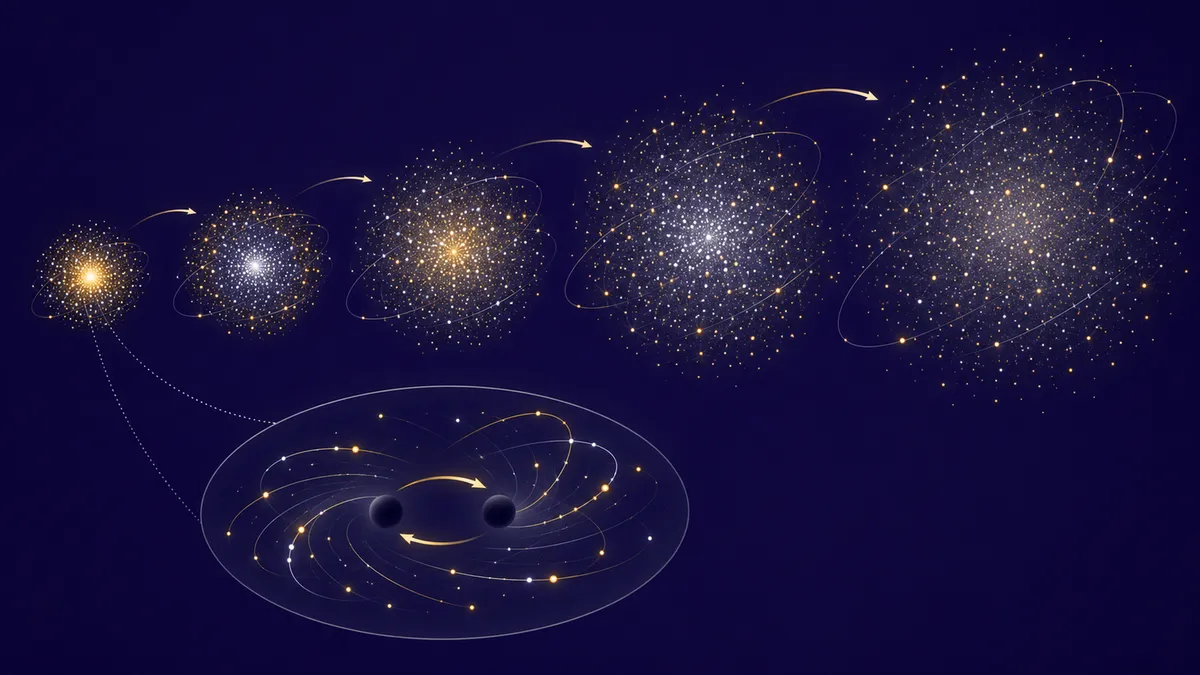
A dense star cluster can spend billions of years rearranging itself through gravitational encounters. New simulations suggest that this reshuffling can erase an important feature of its beginnings: how tightly its stars were packed toward the center. Under the conditions tested, clusters with contrasting initial structures approached a common density profile—but that resemblance did not survive every stage of their evolution.
Globular clusters—dense stellar systems that can contain hundreds of thousands of stars—might seem like natural archives of their own formation. But their present-day appearance is also the product of billions of years of gravitational encounters. A new simulation study suggests that this evolution can make clusters with very different beginnings look remarkably alike.
In a preprint posted to arXiv on November 10, Ambreesh Khurana and Renyue Cen of Zhejiang University report that their model clusters approached a characteristic distribution of mass with distance from the center. For models with the same initial mass and binding energy, this convergence occurred despite large differences in their starting density profiles.
The finding concerns a particular, slowly evolving phase supported by black hole binaries. It is not evidence that every star cluster must reach one universal, permanent shape.
How the researchers modeled the clusters
The team used CMC-COSMIC, software combining a statistical treatment of cluster dynamics with models of stellar and binary evolution. It accounts for repeated weak gravitational encounters, strong interactions involving a few objects, and the gravitational influence of the host galaxy.
Here, “collisional” does not mean that stars continually crash into one another. It refers to the importance of accumulated gravitational encounters, which gradually change stellar orbits—a process called two-body relaxation.
The reference cluster began with 800,000 objects, each either a single star or a binary system, and a total mass of about 480,000 Suns. Five percent of those objects were binaries. Its initial virial radius, a measure of size defined through mass and gravitational binding energy, was one parsec, roughly 3.3 light-years. The cluster followed a circular orbit around a Milky Way model.
The researchers varied the initial concentration using several King profiles, a family of models describing how stellar density falls outward. They also tested alternative starting shapes called EFF profiles, including the Plummer profile. Further simulations changed the initial binary fraction or halved the initial virial radius.
A common shape, sustained by black hole pairs
The clusters initially followed different paths. Some cores contracted, while others expanded. Mass lost as massive stars evolved subsequently drove expansion across the models.
Later, black hole binaries supplied energy through gravitational encounters, supporting the clusters against further core contraction. Astronomers call this “black hole burning,” although it involves orbital energy rather than combustion.
During this phase, models with different starting profiles became increasingly similar. Their inner mass distributions converged within roughly 100 million years, while the outer regions took a few billion years. At 12 billion years, the initially different King models also had closely matching projected number-density profiles and simulated visible-light brightness profiles.
The common mass distribution was approximately described by a King profile with a concentration parameter, W₀, of 6.8. This dimensionless parameter controls the model’s central concentration. The authors selected the matching value by visual comparison, rather than reporting a precision statistical fit.
For the reference model, the virial radius grew from one parsec to about 6.65 parsecs. A more compact model grew from half a parsec to about 3.49 parsecs during its comparable phase: approximately sevenfold expansion in each case. Their shared shape therefore did not imply an identical physical size.
Testing whether the profile returns
To test stability, the researchers ran a separate, deliberately simplified experiment with 100,000 equal-mass point particles and no stellar evolution. Binaries could form dynamically, but none were present initially.
After a model reached its slowly evolving phase, the team redistributed its objects into either a more concentrated or a less concentrated profile, preserving total mass and binding energy. Both altered models moved back toward the unperturbed model’s structure over a few billion years. Ten random-seed realizations of each perturbation showed the same broad behavior.
That supports a tendency to restore the profile under the tested disturbances. It does not demonstrate recovery from every possible disturbance in a realistic cluster.
What the resemblance can—and cannot—tell us
The compact models exposed an important limit. After ejecting nearly all their black holes, they underwent deep core collapse and their profiles diverged. The reported equilibrium is a slowly changing balance, not a frozen final state.
The authors suggest that a statistical tendency toward higher entropy might help explain the convergence, but they do not derive the measured concentration from first principles. The work is a preprint, and its numerical findings have not been established here through observations of real clusters.
If the behavior holds more broadly, a present-day density profile alone may not distinguish a cluster born highly concentrated from one born more diffuse. Other observations could still constrain its origins, including its initial size. The simulations suggest that some structural memories fade—not that every trace of a cluster’s history disappears.
- globular clusters
- stellar dynamics
- black hole binaries
- star cluster simulations
- density profiles
- two-body relaxation
Reviewed cross-references
These connections were reviewed by a model, not independently fact-checked by a human. Similarity does not imply agreement; consult the original papers and the evidence below.
Merging stars could give newborn black holes a faster spin
Shared method: Khurana and Cen and Satish et al. both use the Hénon-type CMC Monte Carlo framework with COSMIC stellar and binary evolution and fewbody encounter integration. Khurana and Cen study density-profile convergence, whereas Satish et al. study stellar mergers and estimate black-hole spins using additional MESA models in post-processing. This is a shared computational method, not independent confirmation of the equilibrium profile; the supplied preprint excerpts do not establish equivalent model assumptions.
Model review: · openai-codex/gpt-6.1-sol
Evidence and provenance
Selected excerpts, not complete papers. PDF extraction can omit figures or damage equations, tables and reading order; sources may be preprints.
2611.13825v1 — Original paper
Excerpt reference:
static/papers/2611.13825v1.md:198-259
Basis: Paper text
Source SHA-256:6cdfc1f4ee6d8c811cd375811d9d977248dbea94bb9a08bf61fcee70f1a8e8ab2607.05495v2 — Original paper
Excerpt reference:
static/papers/2607.05495v2.md:175-233
Basis: Paper text
Source SHA-256:cb0ebcc071f5d148ecfe0f6b7ca6f7f406d3e1442e18278837ee0f0da2494ed62607.05495v2 — Original paper
Excerpt reference:
static/papers/2607.05495v2.md:975-1031
Basis: Paper text
Source SHA-256:cb0ebcc071f5d148ecfe0f6b7ca6f7f406d3e1442e18278837ee0f0da2494ed6
Related reading
Automatically matched by shared topic keywords. These links do not imply that the sources agree or establish a consensus.
Neutron star binaries may get their chance after a cluster’s black holes leave
Source published
Shared keywords: stellar dynamics
How collapsing star clusters could help build early massive black holes
Source published
Shared keywords: stellar dynamics
Stellar Motions Put NGC 3227’s Black Hole at About 12 Million Suns
Source published
Shared keywords: stellar dynamics
Simulated cosmic filaments reveal a shared dark-matter pattern
Source published
Shared keywords: density profiles
Stellar motions sharpen the estimate of M87’s black hole mass
Source published
Shared keywords: stellar dynamics