TRANSMISSION // 2611.13801v1
A two-scale approach to mapping gene regulation
Source published
The scGPL model combines whole-network structure with analysis of individual gene pairs to predict regulatory links from single-cell RNA data. Across seven benchmark datasets, it outperformed tested methods on several reported measures. Incomplete reference networks and dataset-specific testing limit what those results can establish.
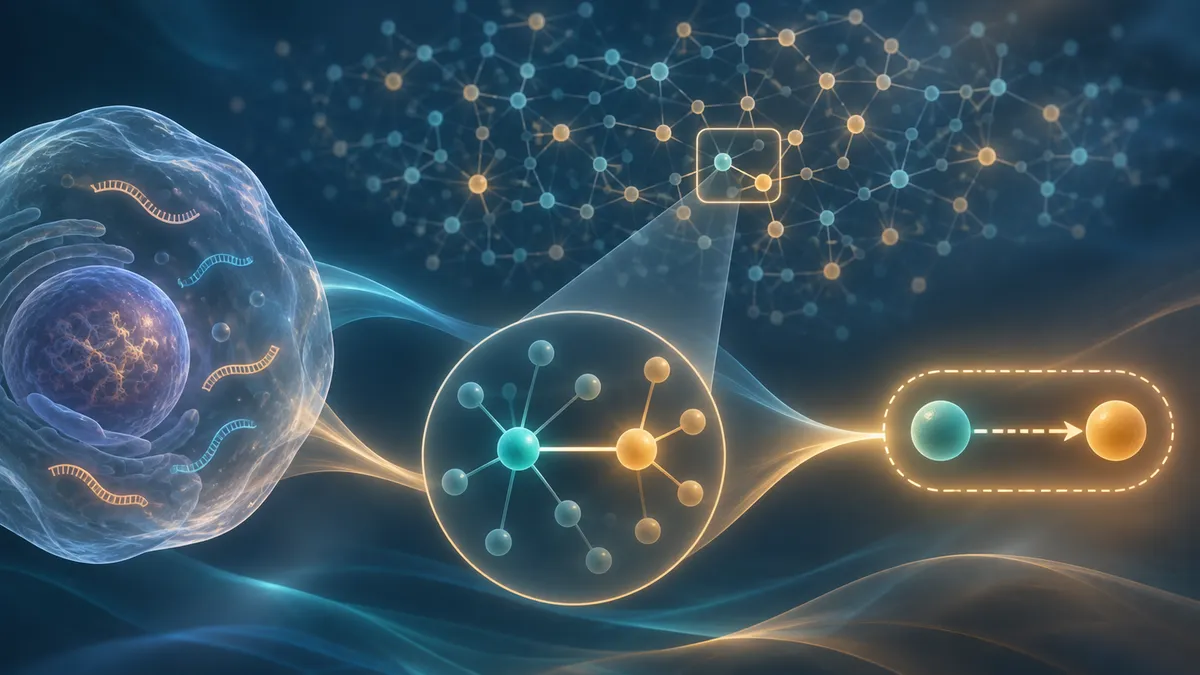
Transcription factors help regulate other genes through networks of interactions. Reconstructing those networks from single-cell RNA sequencing is challenging: expression is measured across many cells, while confirmed regulatory links are scarce. An arXiv preprint introduces scGPL, a model designed to learn both the broad network layout and the local context around candidate gene pairs.
The problem: local links, larger networks
A gene regulatory network (GRN) is often represented as a directed map: an arrow from a transcription factor (TF) to a gene indicates a regulatory relationship. Single-cell RNA sequencing (scRNA-seq) measures gene activity in individual cells and can help researchers infer these links. But expression patterns alone do not establish that one gene regulates another, and experimentally supported network annotations are incomplete.
The authors describe two broad modeling strategies. Graph-based methods learn from a network as a whole, using connections among genes to provide context. The trade-off, they argue, is a risk of overfitting to a single training graph. Pairwise methods assess candidate TF–target pairs individually. This supplies many training examples, but can miss relationships that depend on wider network structure—for example, a chain involving an intermediate gene.
The study introduces scGPL, designed to combine these perspectives. Its central question is whether learning both global network context and pair-specific information can improve predictions of regulatory links.
How the model works
The researchers evaluated scGPL on seven human and mouse scRNA-seq datasets from the BEELINE benchmark. The datasets cover cell types including embryonic stem cells, hepatocytes, dendritic cells, and blood-cell lineages. They compared the model with 13 methods, across several reference-network types, including cell-type-specific ChIP-seq networks and networks assembled from other evidence.
A global branch uses a graph neural network to learn features from the network and expression data. A pairwise branch examines each candidate TF–target pair, combining expression patterns with information from a local network neighborhood. To choose genes for that neighborhood, scGPL iteratively samples nearby nodes using a score based on network connectivity and expression similarity. The model then combines local and global representations to predict whether the pair is a regulatory link.
The evaluation used AUROC, AUPRC, and early precision ratio (EPR). AUPRC is useful when known regulatory links are rare because it measures how well a model ranks positive examples amid many negatives. The main comparison table reports averages over 20 runs with different random seeds.
What the authors report
Across the seven datasets, scGPL had the highest average AUROC and AUPRC among the methods in the main comparison table for both tested gene-set sizes. In the TFs+1000 setting, its average AUPRC was 0.864, versus 0.760 for scGREAT, the strongest baseline by that measure in the comparison. The authors describe this as a 13.7% improvement. Results varied by dataset and metric; the averages do not mean scGPL led on every measure in every dataset.
Ablation tests, which remove or change parts of a model, suggest that combining the global and pairwise branches performed better on average than either branch alone. The authors also report that priority-based local-neighborhood sampling generally improved AUPRC compared with omitting that module or using ordinary breadth-first sampling. These findings support the design within the study’s evaluation setup, but do not establish that the same components will help in every biological setting.
What the results do—and do not—show
The benchmark labels are not a complete catalogue of true regulatory links. The study treats unlisted TF–target pairs as negative examples, while noting that some may represent undiscovered interactions. Consequently, a potentially correct prediction missing from the reference can be counted as wrong. The authors discuss high-ranking unlisted predictions that align with prior literature, but these examples are hypotheses, not experimental confirmation that scGPL discovered new links in the tested datasets.
The evaluation is primarily dataset-specific, rather than a strict test of transferring a model between distinct biological systems. The authors identify cross-dataset generalization, including prediction involving unseen genes, as an open challenge. Dynamic sampling also adds computational overhead, and the model relies on existing network information for structural context.
This work is an arXiv preprint. The supplied manuscript includes production placeholders, such as an unspecified publication year, so publication details should be treated cautiously. The reported benchmarks show how scGPL performed under the authors’ datasets, splits, and metrics; they do not show that predicted links are causal or experimentally validated. The authors list code on GitHub and versioned materials on Zenodo for further examination and reproduction.
- gene regulation
- single-cell RNA sequencing
- gene regulatory networks
- machine learning
- graph neural networks
- arXiv preprint
Related reading
Automatically matched by shared topic keywords. These links do not imply that the sources agree or establish a consensus.
When more data hurts: a benchmark tests how AI combines images, text and changing networks
Source published
Shared keywords: graph neural networks
Seizure-detection AI learns to handle different electrode layouts
Source published
Shared keywords: graph neural networks
Chem World tests whether chemistry-aware AI can predict properties across molecules and mixtures
Source published
Shared keywords: machine learning
Forecasting a changing network by predicting its shape first
Source published
Shared keywords: graph neural networks
A promising quantum optimization strategy loses its edge when noise enters
Source published
Shared keywords: graph neural networks