TRANSMISSION // 2611.13771v1
A lost planet could explain Barnard’s Star’s unusual orbital pattern
Source published
Barnard’s Star’s four known planets may be the survivors of an originally five-planet system, according to a new simulation study. Researchers propose that two former planets collided and merged to create the present-day planet c, disrupting an earlier pattern of coordinated orbits. They tested four evolutionary scenarios: two starting with four planets and two starting with five. Within the tested conditions, neither four-planet scenario reproduced the observed orbital configuration. Both five-planet scenarios offered possible routes, with the collision triggered either by billions of years of tidal evolution or by gravitational interactions with the young system’s gas disk. The disk-driven scenario produced the proposed merger more frequently, but required the gas to disperse at an appropriate time. Crucially, merger frequencies are not probabilities that either history actually occurred, and the simulations do not establish that a fifth planet existed. The work, posted as an arXiv preprint, identifies possible histories and suggests that future measurements of the innermost planets’ orbital coordination could help distinguish them.
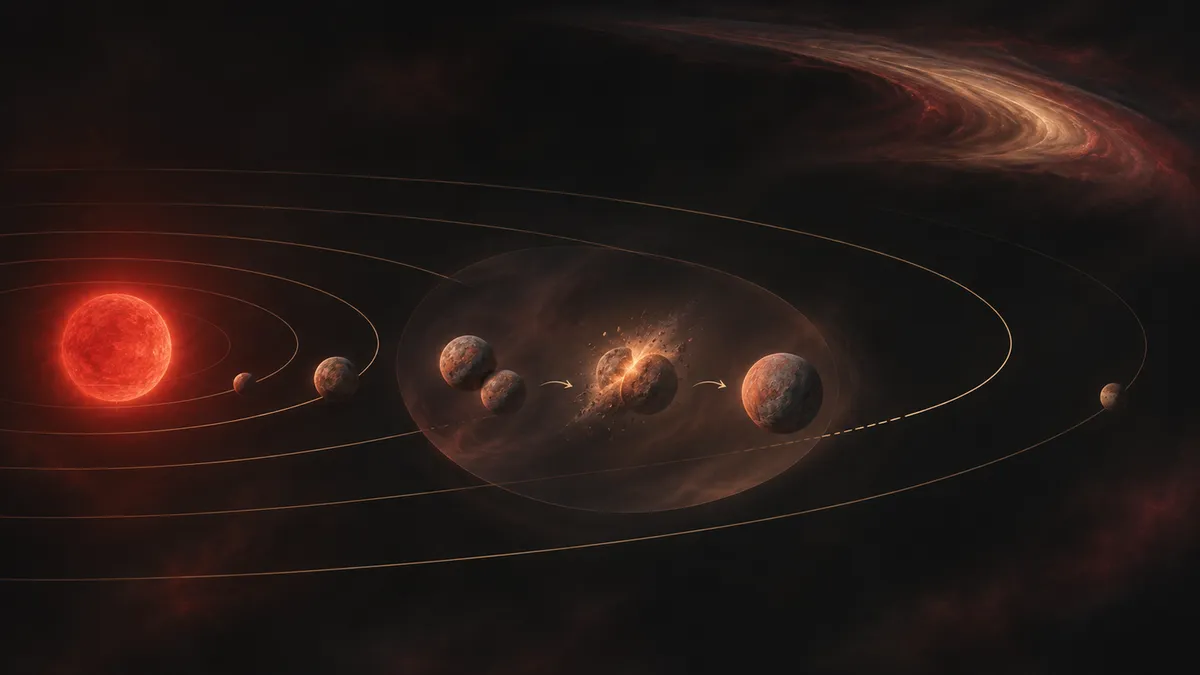
The four planets around Barnard’s Star have an orbital pattern that looks partly organized and partly disrupted. A new preprint explores whether that pattern records a planetary collision: two worlds merging into one, leaving behind a broken chain of gravitationally coordinated orbits.
Barnard’s Star, the nearest single star to the Sun, hosts four known planets with measured minimum masses below Earth’s. A new study by Tian Yi and colleagues asks whether their tightly packed orbits preserve evidence of a fifth planet—not one waiting to be discovered, but one that disappeared in a merger.
Their computer simulations identify two possible routes to that outcome. Neither demonstrates that the collision happened, but both offer explanations for an otherwise awkward orbital pattern.
An incomplete orbital rhythm
From the star outward, the planets are named d, b, c and e. They complete their orbits in approximately 2.34, 3.15, 4.12 and 6.74 days.
The inner pair’s orbital periods lie near a 4:3 ratio: the inner planet makes roughly four circuits while its neighbor makes three. Planets b and e, despite having c between them, lie relatively near a 2:1 ratio. Planet c does not fit neatly into a sequence of neighboring low-order resonances.
An orbital resonance is more than a numerical resemblance. It involves a repeating relationship between planets’ orbital positions that can organize their gravitational interactions. Three planets can also participate in a shared resonance, even when individual pairs are no longer resonant. Near-integer period ratios alone do not establish that these relationships exist today.
The researchers propose that the system began with five planets linked in a resonant chain. Two intermediate planets, labeled c1 and c2, subsequently merged into the present planet c, breaking some links while leaving traces of others.
Testing four possible histories
The team used REBOUND and its REBOUNDx extension to simulate the planets’ mutual gravity, supplemented with models of tidal dissipation and gas-disk forces. They first assembled resonant chains through simulated migration, then followed their subsequent evolution.
Two scenarios began with only four planets and required no collision. In one, tides dissipated energy and increased orbital period ratios over billions of years. Among 100 simulations, 90% lost the relevant resonant configuration before reaching the observed ratios. The remainder stayed too close to exact resonance to reproduce the measured offsets.
The other four-planet scenario used an outward-moving inner edge of the young star’s gas disk to carry planets outward. None of the 18 tested runs reproduced all three neighboring period ratios. The outermost planet, e, was too low in mass to keep pace effectively with the retreating edge. The authors note that a differently tuned disk-dispersal history might improve agreement, so this result does not exclude every four-planet origin.
Two routes to a merger
The five-planet models were more promising.
In the first, the resonant chain survived the disappearance of the gas disk. Tidal evolution then gradually changed the planets’ relative spacing over billions of years, eventually breaking the resonance and allowing their paths to cross.
Of 75 simulations, nine produced the intended c1–c2 merger. Five—6.7% of the total—left four planets that remained stable for a further 10 million simulated years. Their period ratios generally approached the observations, although the outermost pair tended to end up somewhat too widely separated.
The second route operated while the gas disk still existed. Planet e remained near its inner edge, while planets farther inside the largely cleared cavity still felt gravitational pulls from the exterior gas. These interactions, called Lindblad torques, removed orbital angular momentum and drove inward migration, most strongly affecting c2.
That uneven forcing disrupted the chain. Of 232 runs, 110 produced the intended merger and a four-planet system surviving at least 10,000 years. This roughly 47% merger frequency is not an exact-match rate or a probability of the system’s actual history. Matching the observed configuration also required the disk to disperse near the right moment, stopping further migration.
A possible history, not a recovered event
The results depend on assumed starting chains, uncertain planet masses and simplified tidal and disk prescriptions. Radial-velocity observations measure minimum masses; the true masses depend on orbital inclination. The two merger scenarios also received different post-merger stability checks, limiting direct comparisons of their success rates.
A broader search identified 14 compact four-planet configurations with similar broken-chain patterns. Ten had the third planet as the apparent break. That resembles the proposed disk-driven outcome, but does not establish a shared collision history.
One potential discriminator lies in the inner pair. None of the five long-lived tidal-merger outcomes retained its two-planet 4:3 resonance, whereas 34 of the 110 disk-driven merger outcomes did. Future measurements establishing that resonance could therefore favor the disk-driven route over the stable tidal outcomes sampled here.
Posted to arXiv on November 10, 2026, the preprint supplies testable possibilities—not observational proof of a vanished planet.
- Barnard’s Star
- exoplanets
- orbital resonance
- planetary collisions
- planetary migration
- protoplanetary disks
- N-body simulations
Reviewed cross-references
These connections were reviewed by a model, not independently fact-checked by a human. Similarity does not imply agreement; consult the original papers and the evidence below.
A 44-second timing wobble hints at a hidden planet beside TOI-2109 b
Shared method: Yi et al. use N-body simulations to test whether a five-planet resonant chain and a merger can reproduce Barnard's Star's four-planet architecture; Parthasarathy et al. use N-body transit-timing modelling to test an additional companion near the 7:3 commensurability in TOI-2109. Both test additional-planet hypotheses through gravitational multi-planet dynamics, but one reconstructs a lost planet and the other fits a possible surviving companion. The TOI-2109 fit assumes circular, coplanar orbits and requires confirmation; these selected excerpts do not establish a common formation history.
Model review: · openai-codex/gpt-6.1-sol
Evidence and provenance
Selected excerpts, not complete papers. PDF extraction can omit figures or damage equations, tables and reading order; sources may be preprints.
2611.13771v1 — Original paper
Excerpt reference:
static/papers/2611.13771v1.md:160-220
Basis: Paper text
Source SHA-256:2503be6088a0bbad6c19a164be9e8e4098e76c23d4a60ff8bbed946ef93b018b2611.13771v1 — Original paper
Excerpt reference:
static/papers/2611.13771v1.md:1221-1272
Basis: Paper text
Source SHA-256:2503be6088a0bbad6c19a164be9e8e4098e76c23d4a60ff8bbed946ef93b018b2611.13505v1 — Original paper
Excerpt reference:
static/papers/2611.13505v1.md:1338-1419
Basis: Paper text
Source SHA-256:4accc24a1bd765b94135061fee42bdb20cda625efa0a6ddaf4aaf53798f24f162611.13505v1 — Original paper
Excerpt reference:
static/papers/2611.13505v1.md:1517-1627
Basis: Paper text
Source SHA-256:4accc24a1bd765b94135061fee42bdb20cda625efa0a6ddaf4aaf53798f24f16
Related reading
Automatically matched by shared topic keywords. These links do not imply that the sources agree or establish a consensus.
Five simulated giant planets migrate inward—but their shared destination is not a universal rule
Source published
Shared keywords: planetary migration, protoplanetary disks
A 44-second timing wobble hints at a hidden planet beside TOI-2109 b
Source published
Shared keywords: orbital resonance
When a gravitational wave meets a binary’s rhythm
Source published
Shared keywords: orbital resonance
A proposed Webb survey would map dust, ice and shadows in planet-forming disks
Source published
Shared keywords: protoplanetary disks
Models of young planet-forming disks struggle to explain low-mass disks
Source published
Shared keywords: protoplanetary disks