TRANSMISSION // 2611.13770v1
Fitting hidden companions to Gaia’s stellar wobbles
Source published
The ExoPlanetLab preprint presents software for reconstructing companion orbits from Gaia measurements and other observations. Tests recover known systems and simulated signals, while exposing limits in period uncertainties, noise modelling and multi-companion fits.
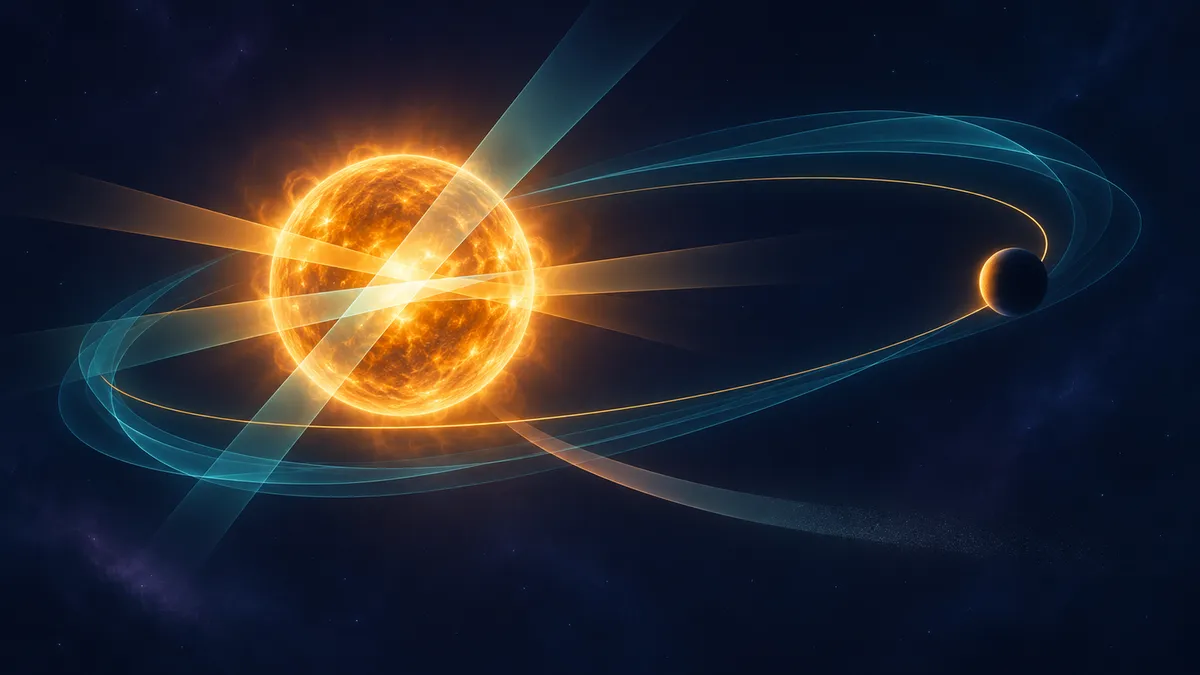
An unseen companion can reveal itself by making a star wobble. But reconstructing its orbit requires separating that motion from the star’s ordinary movement, the effects of Earth’s orbit and measurement errors. A new preprint introduces ExoPlanetLab, an open-source package designed to make those distinctions using Gaia observations, optionally combined with other measurements.
Part of the wobble is already missing
Gaia measures stellar positions along a scanning direction that changes between observations. A sequence of these measurements—called epoch astrometry—can reveal motion caused by an orbiting planet, brown dwarf or another star.
The difficulty is that the supplied measurements have already undergone processing. A single-star model accounts for position, proper motion—the star’s apparent travel across the sky—and parallax, its apparent displacement as Earth orbits the Sun. The remaining differences between observations and that model are called residuals.
An unseen companion complicates this subtraction. Some orbital motion resembles ordinary stellar movement, so the single-star fit absorbs it. That is especially important when observations cover only a short arc of a long orbit.
In the ExoPlanetLab preprint, David Hobbs describes software that removes the corresponding component from a proposed orbit before comparing it with the residuals. Otherwise, the model and data describe different things.
The paper demonstrates the consequences using Gaia DR4 pre-release observations. For Gaia-4 and Gaia BH3, a published orbit compared directly with the residuals fits worse than assuming no companion. Applying the matching subtraction reverses that result.
Combining different views of an orbit
ExoPlanetLab uses Bayesian inference: it combines how well a model explains measurements with prior assumptions about possible orbits, producing a distribution of plausible answers rather than one best-fitting curve.
It can combine Gaia measurements with radial velocities, which measure motion toward or away from us. These observations complement the sideways motion traced by astrometry. Together they can better constrain orbital orientation and companion mass.
The package also accepts relative astrometry: measurements of a separately resolved companion’s position beside its host. This links the companion’s relative orbit to the movement of the unresolved system’s centre of light.
Another central choice concerns measurement errors. In the pre-release data, a small fraction of individual detector measurements lie much farther from the model than ordinary bell-shaped, or Gaussian, noise predicts. Simply increasing every measurement’s uncertainty does not describe that pattern well.
The default model instead uses a Student-t distribution, which allows more extreme deviations and reduces their influence. Because outliers also distort the original single-star fit, this robust approach returns to the underlying positions and repeatedly refits the single-star terms alongside each proposed orbit.
What the tests recovered
The author inserted 180 simulated companions into the observing schedules, scan directions and uncertainty patterns of five pre-release sources. All fits converged, and every injected signal with a total signal-to-noise ratio of at least ten was detected in that campaign. This ratio measures the strength of the modelled orbital signal relative to measurement noise.
However, detection did not guarantee perfectly calibrated uncertainty. Among the detected systems, only 90% of true orbital periods fell inside their nominal 95% credible intervals. The other fitted parameters generally performed better. Periods close to the observation span could be overestimated, while weak, highly elongated orbits tended to appear rounder and smaller.
Thirty separate companion-free simulations produced no false detections under the adopted model-comparison rule. That is encouraging but not a precise estimate of reliability: the paper explicitly notes that such a small sample cannot exclude a false-positive rate of several percent.
Real-data checks used three systems with published orbits. Gaia BH3’s fitted parameters agreed with published solutions within 1.4 combined standard deviations. For HD 114762, the Student-t treatment brought the period and orbital elongation inferred from astrometry into close agreement with radial-velocity measurements. Gaia-4 retained differences of roughly two to three standard deviations in period and orientation from a published solution based on earlier DR3 data.
Simulated relative-position measurements supplied another useful constraint. Across detected systems in a paired campaign, adding eight such measurements reduced the median period-interval width to 27% of its previous value.
Where the evidence stops
These results validate a tool, not a new catalogue of planets. The real orbital tests involve only three previously studied, strong-signal systems. Relative astrometry was tested only on simulations, and the multi-companion experiments cover a limited selection of configurations.
The noise model treats detector measurements as independent; the origin of the observed extreme errors remains unidentified. Fits with several companions can also remain trapped near their starting orbital periods, requiring comparisons between different starting configurations.
Computing cost is another constraint: fitting one companion and evaluating its statistical support takes about one processor-core hour for a source with roughly 600 measurements. The cost rises steeply with additional companions.
The preprint’s practical contribution is therefore both a fitting method and a set of cautions: reconstruct what Gaia’s processing removed, account for extreme errors, and test whether the data justify an orbit rather than merely a curved trajectory.
- Gaia
- ExoPlanetLab
- astrometry
- orbital inference
- Bayesian statistics
- radial velocities
- exoplanets
Reviewed cross-references
These connections were reviewed by a model, not independently fact-checked by a human. Similarity does not imply agreement; consult the original papers and the evidence below.
Three kinds of observations refine the orbit and masses of V819 Herculis
Shared method: Hobbs and Akar and Baştürk jointly fit astrometry and radial velocities with a Bayesian Keplerian orbit model, coupling sky-plane geometry to line-of-sight motion; both also fit additive jitter terms. Akar and Baştürk additionally use eclipse timings for V819 Herculis, whereas ExoPlanetLab targets Gaia epoch residuals and tests relative astrometry only in simulations. This is a methodological connection, not independent validation of ExoPlanetLab's reported precision.
Model review: · openai-codex/gpt-6.1-sol
Evidence and provenance
Selected excerpts, not complete papers. PDF extraction can omit figures or damage equations, tables and reading order; sources may be preprints.
2611.13770v1 — Original paper
Excerpt reference:
static/papers/2611.13770v1.md:16-74
Basis: Paper text
Source SHA-256:5ba619768998231d6bc9512ad8c6068b5184c2ca98bf123e973555b75f0051872611.13770v1 — Original paper
Excerpt reference:
static/papers/2611.13770v1.md:633-712
Basis: Paper text
Source SHA-256:5ba619768998231d6bc9512ad8c6068b5184c2ca98bf123e973555b75f0051872611.09551v1 — Original paper
Excerpt reference:
static/papers/2611.09551v1.md:15-67
Basis: Paper text
Source SHA-256:a8d8d8e910107b80a19fcfd1c797b69987b84ca7d8b1d3728f94f99c32a1bb952611.09551v1 — Original paper
Excerpt reference:
static/papers/2611.09551v1.md:893-1045
Basis: Paper text
Source SHA-256:a8d8d8e910107b80a19fcfd1c797b69987b84ca7d8b1d3728f94f99c32a1bb95
Gaia and Hipparcos map possible companions around 100,000 stars
Shared method: Hobbs and Thompson et al. use Bayesian orbital models allowing zero or multiple companions rather than assuming every astrometric signal has a single companion. ExoPlanetLab selects companion counts using evidences from fixed-count fits, while Thompson et al. marginalize over zero to three companions. The shared treatment of uncertain companion multiplicity uses different data: Gaia DR4-like epoch astrometry for ExoPlanetLab versus Hipparcos/Gaia DR2/DR3 catalog constraints and excess-noise information for Thompson et al.; these excerpts do not establish equivalent detection performance.
Model review: · openai-codex/gpt-6.1-sol
Evidence and provenance
Selected excerpts, not complete papers. PDF extraction can omit figures or damage equations, tables and reading order; sources may be preprints.
2611.13770v1 — Original paper
Excerpt reference:
static/papers/2611.13770v1.md:2040-2107
Basis: Paper text
Source SHA-256:5ba619768998231d6bc9512ad8c6068b5184c2ca98bf123e973555b75f0051872611.13770v1 — Original paper
Excerpt reference:
static/papers/2611.13770v1.md:16-74
Basis: Paper text
Source SHA-256:5ba619768998231d6bc9512ad8c6068b5184c2ca98bf123e973555b75f0051872611.12841v1 — Original paper
Excerpt reference:
static/papers/2611.12841v1.md:193-281
Basis: Paper text
Source SHA-256:ef58aa5fa76432a1c3ce57d2e67d3142cd0674335137af29d0749439ab07d33b2611.12841v1 — Original paper
Excerpt reference:
static/papers/2611.12841v1.md:1706-1770
Basis: Paper text
Source SHA-256:ef58aa5fa76432a1c3ce57d2e67d3142cd0674335137af29d0749439ab07d33b
Related reading
Automatically matched by shared topic keywords. These links do not imply that the sources agree or establish a consensus.