TRANSMISSION // 2611.13717v1
Stellar pulsations help weigh both stars in HD 70510
Source published
Combining TESS observations of stellar vibrations with Gaia’s binary orbit, researchers estimate the masses of two stars that do not eclipse each other. The preprint’s precision depends on identifying the pulsations correctly and on the adopted stellar models.
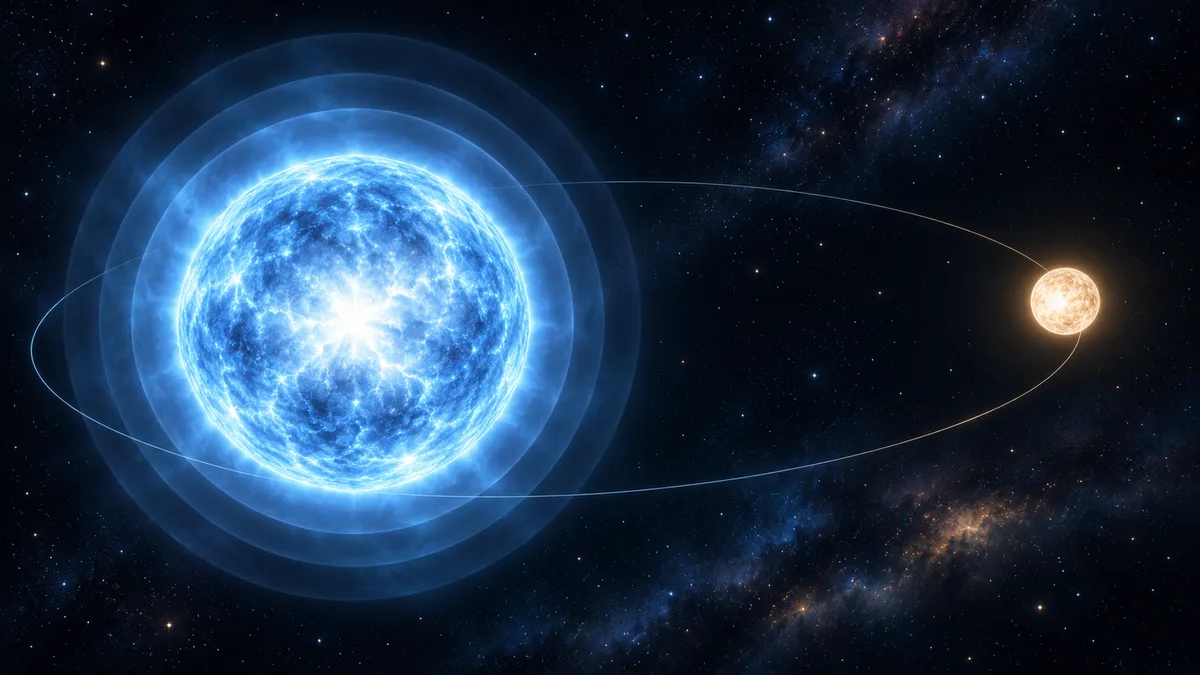
Two stars can reveal how they orbit one another without revealing their actual masses: the missing information is the angle from which we see their orbit. For the binary HD 70510, researchers have used one star’s regular pulsations to help resolve that ambiguity. Their analysis estimates masses of about 1.59 and 1.12 times the Sun’s mass, while separating the contributions of two stars whose light arrives blended together.
Why the orbit is not enough
HD 70510 is a double-lined spectroscopic binary, meaning astronomers can track spectral features from both stars as they move toward and away from Earth. Gaia’s measurements establish a roughly 42.23-day, eccentric orbit and show that the companion has about 72% of the primary star’s mass.
But these observations measure only the velocities along our line of sight. Without knowing the orbital inclination, astronomers cannot turn them into unique component masses. Eclipses can help constrain that geometry in some binaries, but none are evident in the available TESS observations of HD 70510.
In their preprint, Chenglong Lv and colleagues instead use asteroseismology: estimating a star’s properties from its oscillations. An independently estimated mass for one component supplies the missing scale for the binary orbit.
Five vibrations and two clocks
The team analyzed nine observing sectors from NASA’s Transiting Exoplanet Survey Satellite, retaining nearly 148,000 brightness measurements across an elapsed span of 2,257 days. They extracted pulsation frequencies from three consecutive sectors, avoiding the complicated pattern produced by combining observations separated by years.
Five strong peaks, ranging from about 22 to 47 cycles per day, form a sequence consistent with radial pulsations. In these oscillations, the star expands and contracts. The researchers interpret the sequence as the fundamental radial mode followed by four successive overtones—different patterns of vibration within the star.
Their stellar models favor that interpretation over two alternatives in which the sequence begins at a higher overtone. The same five peaks also recur in the other observing campaigns.
A separate timing analysis addresses another essential question: which star is pulsating? As a pulsating star moves around its orbit, its light travels a slightly longer or shorter distance to Earth. Its brightness cycles therefore appear delayed or advanced, providing a clock for tracking orbital motion.
Two isolated, stable pulsations showed timing variations consistent with the direction and approximately one-minute amplitude expected for Gaia’s primary component. These were not simply the five radial modes used for stellar modeling. The two sets of pulsations serve different purposes: one constrains stellar structure, while the other associates the observed pulsations with a particular star.
The timing does not independently improve Gaia’s orbit. Gaps between TESS campaigns leave several possible orbital periods in the timing-only analysis, and orbital agreement was considered when selecting the final clocks.
Accounting for both stars’ light
The researchers compared the radial frequencies with 6,300 stellar models, combining evolutionary calculations from MESA with pulsation calculations from GYRE. They also modeled the unresolved brightness measured by Gaia and the infrared 2MASS survey as the sum of two stars of the same age and composition.
That distinction matters. The cooler companion supplies about 14% of the combined light in Gaia’s blue band, rising to roughly 28% in the infrared band examined. Treating all that light as coming from the pulsator could bias its inferred properties.
Combining the stellar fit with Gaia’s orbit and its correlated uncertainties gives a primary mass of 1.594 solar masses, with a statistical uncertainty of 0.026 solar masses in either direction. Its radius is about 1.48 times the Sun’s, and its surface temperature is near 7,700 kelvin.
The companion’s inferred mass is 1.121 solar masses, with a statistical interval extending about 0.028 below and 0.029 above that value. Its temperature is approximately 5,950 kelvin. The inferred orbital inclination is about 82 degrees, consistent with the absence of eclipses.
Precision with conditions
These intervals do not capture every uncertainty in the underlying physics. They depend on the radial-mode identification, the adopted stellar models, and the construction of the combined-light model.
Distance is another concern. Gaia’s single-source astrometric fit is poor for this unresolved binary. The team pragmatically enlarged its parallax uncertainty and combined it with Hipparcos measurements. Omitting Hipparcos shifted the primary mass upward and broadened its high-mass tail.
The estimated age—171 million years, with a statistical interval of roughly 72–283 million years—is less secure than the mass and radius. Tested treatments of rotation changed the age by as much as 80 million years, while leaving mass and radius comparatively stable.
The result demonstrates a route to component masses without eclipses, rather than a model-independent weighing. Component-specific spectroscopy could test the temperatures, composition and light ratio that underpin the interpretation.
- asteroseismology
- HD 70510
- binary stars
- delta Scuti stars
- TESS
- Gaia
- stellar masses
Reviewed cross-references
These connections were reviewed by a model, not independently fact-checked by a human. Similarity does not imply agreement; consult the original papers and the evidence below.
Red giants’ individual vibrations sharpen estimates of their ages
Shared method: Both studies fit individual oscillation frequencies to stellar-evolution model grids to infer stellar parameters: Lv et al. use five low-order radial modes with a two-star SED for the young delta Scuti primary of HD 70510, whereas Grossmann et al. model roughly 100 near-solar-mass Kepler red giants. This is a shared inference method, not independent validation of HD 70510's masses or a basis for transferring the red-giant age-precision improvement; both studies limit their quoted uncertainties by adopted modeling assumptions.
Model review: · openai-codex/gpt-6.1-sol
Evidence and provenance
Selected excerpts, not complete papers. PDF extraction can omit figures or damage equations, tables and reading order; sources may be preprints.
2611.13717v1 — Original paper
Excerpt reference:
static/papers/2611.13717v1.md:716-780
Basis: Paper text
Source SHA-256:cee969cc20e11aa288344dfc84f316e0857b908786b8dc8b330017a3641aea282611.13717v1 — Original paper
Excerpt reference:
static/papers/2611.13717v1.md:12-56
Basis: Paper text
Source SHA-256:cee969cc20e11aa288344dfc84f316e0857b908786b8dc8b330017a3641aea282611.09835v1 — Original paper
Excerpt reference:
static/papers/2611.09835v1.md:18-66
Basis: Paper text
Source SHA-256:93c3f98c78f87eee360a70e9f386a5ee8ac10fe9efbd7ddd488abdeaa43b7e282611.09835v1 — Original paper
Excerpt reference:
static/papers/2611.09835v1.md:1238-1291
Basis: Paper text
Source SHA-256:93c3f98c78f87eee360a70e9f386a5ee8ac10fe9efbd7ddd488abdeaa43b7e28
Related reading
Automatically matched by shared topic keywords. These links do not imply that the sources agree or establish a consensus.
Stellar pulses point to two binaries—and spectra confirm the motion
Source published
Shared keywords: binary stars
Neutron star binaries may get their chance after a cluster’s black holes leave
Source published
Shared keywords: binary stars
Weighing a magnetic white dwarf through hot gas and a companion’s motion
Source published
Shared keywords: binary stars, stellar masses
Close companions are unlikely to explain most slow-spinning stars in open clusters
Source published
Shared keywords: binary stars
Stellar Accelerations and Jerks Could Help Gaia Find Hidden Black Holes
Source published
Shared keywords: binary stars