TRANSMISSION // 2611.13687v1
How an Audio Codec Could Help AI Tell Where Sounds Come From
Source published
AURA tests whether a general-audio codec can support both sound recognition and spatial reasoning. Its authors find that spatial cues remain in the codec’s frozen features, but a language model needs help comparing audio channels and linking directions to the sound named in a question. On a simulated benchmark, AURA performs competitively with dedicated spatial-audio systems. The evidence is promising but limited, and the paper is an arXiv preprint marked under review.
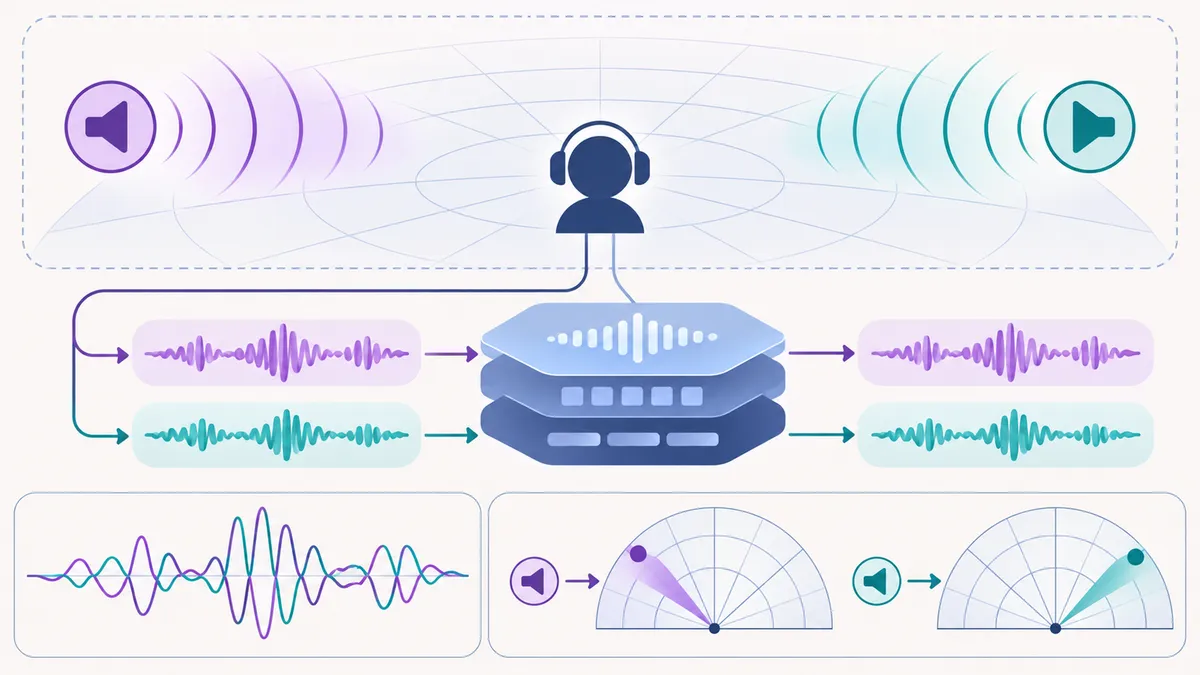
A busy room asks listeners to do two things at once: recognize sounds and work out where each comes from. An AI might detect music and speech in the same recording yet confuse which is on the left. AURA asks whether a general-audio codec already contains useful spatial clues—and what helps a language model use them.
Finding spatial clues in audio
People use differences between the sounds arriving at their two ears to judge whether a source is to the left or right. Other directional clues can be present within each ear’s signal. AI systems often handle spatial audio with a specialized encoder, separate from the machinery used to understand sound meaning.
In this preprint, Boyan Han and colleagues test another possibility: can a general-audio codec, trained without spatial supervision, provide information about both sound identity and location? They examine X-Codec, which compresses audio into layers of discrete representations. In controlled comparisons, they change factors such as the simulated room response while holding the sound source fixed. They also use linear probes—simple classifiers that test whether a property can be read from frozen features.
The authors report that the codec’s representations respond to spatial and room-related changes. Shallower layers are more influenced by sound content; deeper layers become more sensitive to differences between the ears, room acoustics and reverberation. This is a tendency, not a strict division: neither group of layers represents only one kind of information. Linear probes could recover spatial attributes, and using both channels helped most with left-right judgments. But information a probe can detect is not necessarily information a language model can use on its own.
Why retained information may be hard to use
The researchers trained a language model to answer questions about scenes containing two sound sources. In the initial setup, the audio included both sources, but the answer described only the source named in the question. The model’s left-right predictions were at chance. On other directional axes, its performance depended on whether the sources were on the same or opposite sides: same-side answers could be correct by reading the scene’s shared direction, without identifying which source was queried. On opposite-side questions, where the model had to bind a direction to the queried sound, accuracy was at chance.
The authors test two proposed explanations in a controlled 2-by-2 experiment. The first is a mismatch between audio and text: one source in the audio lacks a corresponding description. The second is that the original feature layout leaves the model to compare the two channels to recover left-right information. The researchers tested each proposed remedy separately and in combination, keeping the codec, language-model backbone, training samples and optimization procedure the same.
One remedy asked the model to describe both sources before answering. The other added explicit features representing the difference between the left and right channels. Either change lifted left-right accuracy above the original level. But on opposite-side questions, where source-specific binding matters, substantial improvement required both changes together. This supports the authors’ explanation in this experiment; it does not show that the same account applies to every spatial-audio task.
What AURA adds—and what remains uncertain
AURA combines these ideas. It groups codec layers into content-oriented and acoustics-oriented bands, adds features for the difference between channels, and trains the model to describe the scene before answering. For questions about relations between sources, its training also includes an explicit comparison of their positions. The codec and main language-model backbone stay frozen; a projector and low-rank adaptation modules are trained.
On SpatialSoundQA, a benchmark built from audio rendered with simulated room acoustics, AURA’s dual-source direction accuracy was 48.21%. The strongest compared dedicated system scored 37.90%, a difference of 10.31 percentage points. AURA used about 40% as many trainable parameters as that comparison system. These results apply to this benchmark, not to real-world hearing in general. AURA ranked second on single-source direction accuracy and relation-distance accuracy, and best on the other four reported SpatialSoundQA metrics.
The authors also report higher scores than the evaluated spatial-specialist systems on three general-audio benchmarks. General-purpose audio models scored higher on those benchmarks. These results describe the systems tested, not a universal ranking of model capabilities.
The main spatial question-answering evaluation uses simulated scenes from one benchmark. The authors also test real binaural recordings with linear probes, showing that spatial information can be read from codec features in that setting; this is not the same as demonstrating broad real-world question-answering performance. The authors note that available alternative datasets may share SpatialSoundQA’s sources or simulator rather than provide an independent test. Comparisons also have limits: systems differ in design, and one dedicated baseline was reconstructed by the authors because a complete checkpoint was unavailable.
AURA’s contribution is a demonstration that a general-audio codec can retain spatial cues, and that feature presentation and training descriptions can make those cues more useful for answering questions. Whether the approach transfers to varied recording hardware, moving sources and everyday environments remains to be tested. The source is an arXiv preprint marked under review; its findings have not yet been established through completed peer review.
- spatial audio
- audio-language models
- binaural sound
- machine learning
- preprint
Reviewed cross-references
These connections were reviewed by a model, not independently fact-checked by a human. Similarity does not imply agreement; consult the original papers and the evidence below.
AudioSphere learns sound identity and direction through masked audio training
Supporting evidence: The AURA preprint reports that a frozen general-audio codec can support dual-source direction answering, while the AudioSphere paper reports direction-of-arrival estimation and sound-event localization using frozen Ambisonics features. These findings are compatible for the bounded proposition that learned audio representations can retain useful spatial cues, but the input formats, models and tasks differ, so this is not a direct replication or a claim of independently verified consensus.
Model review: · openai-codex/gpt-6-luna
Evidence and provenance
Selected excerpts, not complete papers. PDF extraction can omit figures or damage equations, tables and reading order; sources may be preprints.
2611.13687v1 — Original paper
Excerpt reference:
static/papers/2611.13687v1.md:2325-2349
Basis: Paper text
Source SHA-256:8af4cc5301063d444bec1a07dfaff1844a013ce22e9aebfb2c9d848079343b392611.09275v1 — Original paper
Excerpt reference:
static/papers/2611.09275v1.md:13-87
Basis: Paper text
Source SHA-256:5fd26fafd6054aa6aa0a6acff68caa914f810786aa11f0163a6f6af134bfcfb02611.09275v1 — Original paper
Excerpt reference:
static/papers/2611.09275v1.md:881-942
Basis: Paper text
Source SHA-256:5fd26fafd6054aa6aa0a6acff68caa914f810786aa11f0163a6f6af134bfcfb0
Using two-channel hearing to identify which object is making a sound
Supporting evidence: The AURA preprint reports that exposing the inter-channel difference helps left/right reading and that queried-source binding improves when combined with scene supervision. BiSID-AVS reports using binaural spatial cues to distinguish sounding objects from same-class visual candidates. These findings are compatible for the limited proposition that binaural cues can help resolve source-related ambiguity, but the systems and outcomes differ: audio question answering versus audio-visual segmentation on separate benchmarks.
Model review: · openai-codex/gpt-6-luna
Evidence and provenance
Selected excerpts, not complete papers. PDF extraction can omit figures or damage equations, tables and reading order; sources may be preprints.
2611.13687v1 — Original paper
Excerpt reference:
static/papers/2611.13687v1.md:15-47
Basis: Paper text
Source SHA-256:8af4cc5301063d444bec1a07dfaff1844a013ce22e9aebfb2c9d848079343b392611.06074v1 — Original paper
Excerpt reference:
static/papers/2611.06074v1.md:13-74
Basis: Paper text
Source SHA-256:b19e085187e61087f9c1a44fdda51959082bff9cfc02154a35402421f98371972611.06074v1 — Original paper
Excerpt reference:
static/papers/2611.06074v1.md:1001-1106
Basis: Paper text
Source SHA-256:b19e085187e61087f9c1a44fdda51959082bff9cfc02154a35402421f9837197
Related reading
Automatically matched by shared topic keywords. These links do not imply that the sources agree or establish a consensus.
AudioSphere learns sound identity and direction through masked audio training
Source published
Shared keywords: spatial audio
One Energy Lens for Many Kinds of Machine Learning
Source published
Shared keywords: machine learning
Machine learning connects atomic physics to simulations of stellar winds
Source published
Shared keywords: machine learning
PHISHREV+ uses explicit rules to reconsider phishing alerts
Source published
Shared keywords: machine learning
Satellite links detect rain better when neighboring receivers share information
Source published
Shared keywords: machine learning