TRANSMISSION // 2611.13625v1
Quantum packets take two routing hops without rewriting their address
Source published
A laboratory experiment routes quantum-key-distribution packets to three receivers while preserving their original classical headers. QKD remains capable of generating secret keys after two routing hops, but optical losses, noise and stability still limit the approach.
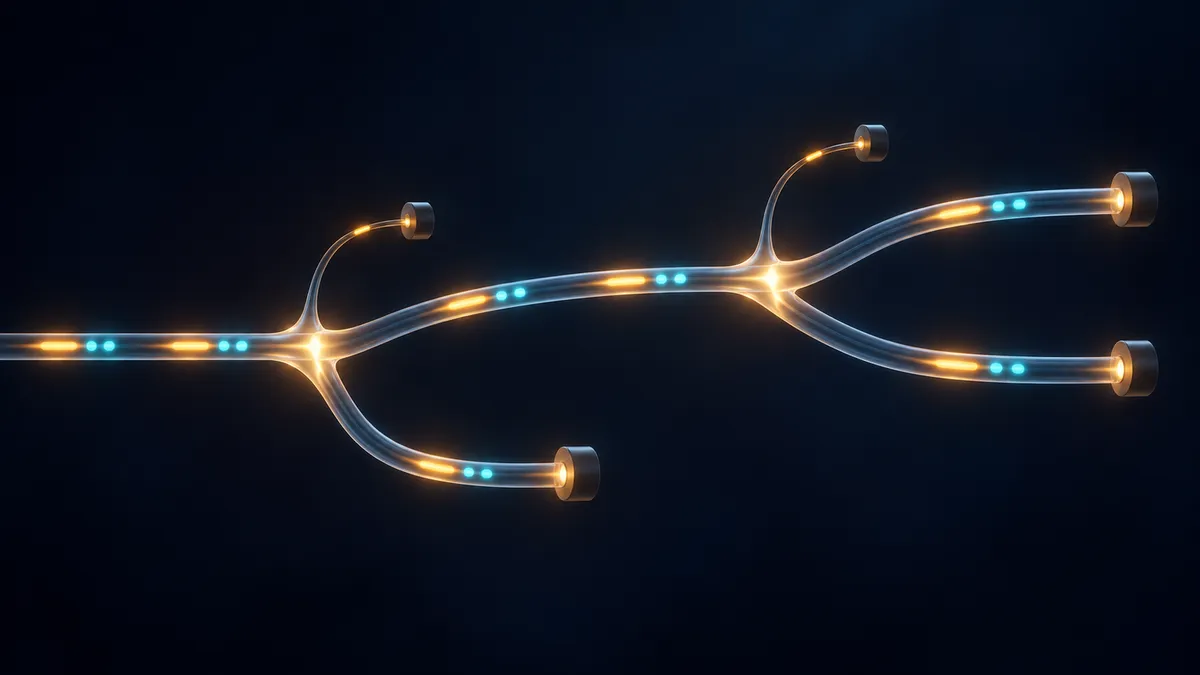
Can a quantum network read a packet’s destination without reading its quantum contents? An optical-fiber experiment demonstrates that separation across two successive routers.
A quantum network needs more than a connection between two fixed endpoints. It also needs ways to send information toward different destinations without measuring the quantum states carrying it. The practical question is how a router can read an address while leaving the quantum contents available to the intended receiver.
In a preprint posted on November 10, Tae Yeong Park and colleagues report a laboratory demonstration using two successive optical-fiber routers and three receivers. Their packets combine a readable classical address with a weak optical quantum payload. Crucially, the routers forward the original address signal rather than replacing it at each stop.
Read a little, forward the rest
Earlier quantum-packet routing demonstrations described in the paper detected the classical header and generated a replacement for the next link. That requires a suitably controlled light source at each routing node. This experiment instead takes a small sample of the existing header.
The address and quantum payload use different wavelengths and occupy separate time slots. Inside each router, a fiber Bragg grating—a wavelength-selective structure in the fiber—reflects about 10% of the classical header toward a photodiode. Electronics decode that sample and set an optical switch. The remaining roughly 90% of the header continues onward with the quantum payload.
A kilometer-long fiber delay gives the control electronics time to act before the packet reaches the switch. That adds about five microseconds per router. The switch itself can change outputs in approximately 500 nanoseconds; these are distinct timing measures, not interchangeable claims about total routing speed. The seven-bit header lasts 3.5 microseconds and contains a preamble, destination address and parity check.
The router therefore makes its decision from ordinary classical information. It does not need to measure the quantum state to discover where the packet should go.
Two routers, three destinations
The first router could send a packet directly toward one receiver or onward to the second router. That second router selected between two more receivers. Consequently, the first receiver’s packets crossed one router, while the other two receivers’ packets crossed two.
Everything was assembled in a laboratory. Fiber spools of 20, 10 and five kilometers were inserted before the respective receivers to test transmission over different distances; this was not a deployed network connecting three remote sites.
The team first cycled short packets of weak light pulses among the destinations. Photon detections appeared at the selected receivers in the expected sequence, demonstrating packet-by-packet switching. They then tested whether routed packets could support quantum key distribution, or QKD: a protocol for establishing shared secret keys rather than transmitting an encrypted message itself.
Their implementation used time-bin qubits, with quantum states encoded in the relative phase between earlier and later light pulses. It followed the BB84 protocol with weak and vacuum decoy states. These deliberately varied pulse intensities support the security analysis when the source emits weak coherent pulses rather than ideal single photons.
From detected bits to secret keys
Each QKD payload lasted one second and contained ten million time-bin qubits. In alternating-destination trials, the intended receiver typically obtained 4,000–5,000 sifted bits per packet. Sifted bits are an intermediate result, not the final secret key: error correction and privacy amplification still have to remove errors and reduce potential information leakage.
The average quantum bit error rate across the receivers was 3.4%. Comparing operation with the classical-header laser on and off gave an error-rate difference of 0.14 percentage points, which the authors attribute to scattering from residual classical light.
After processing accumulated blocks of 1.5 million bits and accounting for finite-key effects, the researchers report secret key rates of 35–270 bits per second across the one-hop and two-hop cases. Positive rates show that the routed signals remained usable for this QKD implementation under the paper’s security analysis. They do not establish a general-purpose quantum internet.
What limits more hops?
Every router introduced an average quantum-signal loss of 2.8 decibels. Such losses accumulate, leaving fewer detections available for key generation. The classical header also weakens at each tap, eventually becoming too faint to decode without additional measures.
Noise and stability remain concerns. Separating header and payload in wavelength and time reduced unwanted scattering, but imperfect optical extinction still allowed leakage. One receiver produced unexpectedly low secret key rates; the cause was unresolved, with fiber birefringence and temperature instability suggested as possibilities during its 1.6-hour collection period.
The preprint demonstrates a specific capability: forwarding useful QKD packets through successive routers without regenerating their headers. More hops, field operation and protocols distributing entangled photons remain extensions to test, not outcomes already demonstrated.
- quantum networks
- quantum routing
- quantum key distribution
- optical fiber
- BB84
- time-bin qubits
Related reading
Automatically matched by shared topic keywords. These links do not imply that the sources agree or establish a consensus.
Before quantum keys, Sweden’s fiber links need a checkup
Source published
Shared keywords: optical fiber, quantum key distribution
Can quantum key distribution stay secure when devices remember?
Source published
Shared keywords: quantum key distribution
Circular gratings guide photons from telecom quantum dots
Source published
Shared keywords: quantum networks
Two parity checks can filter errors in paired-state quantum keys
Source published
Shared keywords: quantum key distribution
When a quantum key begins with incomplete clues
Source published
Shared keywords: quantum key distribution