TRANSMISSION // 2611.13615v1
A smaller controller helps AI agents reuse advice with less overhead
Source published
Synapse-Control replaces generated failure diagnoses with a lightweight classifier that scores specific suggestions against an agent’s current state. In tests on two simulated task environments, it reduced auxiliary control time compared with a diagnosis-based system and completed more attempts than an unassisted baseline. Its benchmark scores were slightly below the comparison system’s, and the results come from a preprint.
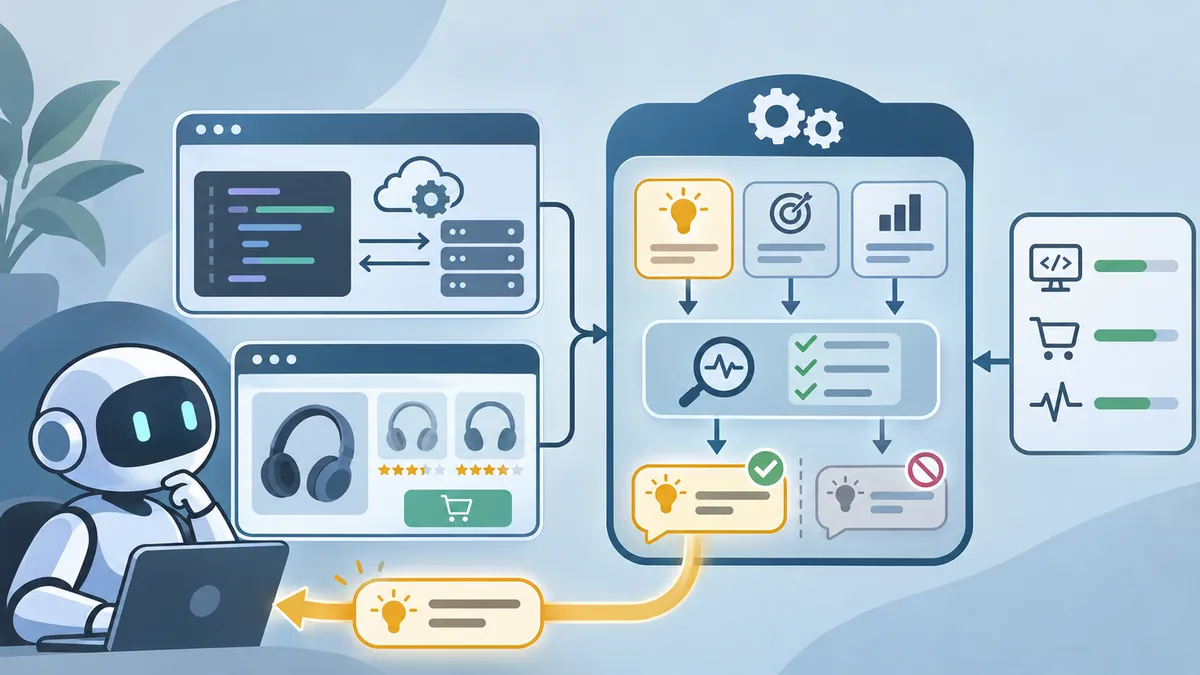
When an AI agent repeatedly uses tools, it may benefit from lessons learned during earlier attempts. But choosing a lesson can require extra model calls, and topical relevance alone does not guarantee that advice is useful now. Synapse-Control asks whether a runtime can judge a short list of concrete suggestions against the agent’s visible state without first generating a verbal diagnosis.
An agent using tools must decide what to do and respond to what happened in earlier steps. Reusing experience—such as a reminder about a required API argument—can help. But a recovery system may spend time generating a diagnosis before retrieving advice. And a lesson about the right tool or task can still be unnecessary or conflicting in the current state. The distinction is between topical relevance and present suitability.
Synapse-Control separates advice management from task execution. The main model, called the actor, still plans and takes actions. A lightweight control plane looks for situations where intervention may be needed, evaluates candidate advice, and governs whether to pass a hint to the actor.
How the control system works
Rules first use execution evidence to check for a possible need for advice—for example, a rejected API call, repeated unchanged results, or a visible gap in required information. If this deterministic check is triggered, rules shortlist up to five suggestions. A 1.7-billion-parameter classifier scores each suggestion against the current state as helpful, irrelevant, or harmful. The classifier was fine-tuned using labels from a larger model; it assesses candidate advice rather than generating a verbal diagnosis. A suggestion must pass a suitability threshold, and further delivery checks apply.
The reusable instructions are deliberately narrow. “Micro-contracts” capture local interface constraints, such as required arguments or valid options, rather than prescribing a complete sequence of actions. The actor remains responsible for choosing how to accomplish the task.
A Prompt Value Table records what advice has already been delivered and feedback about what followed. It uses evidence changes, cooldowns, and a token budget to limit repeated hints. Advice is offered as a temporary prompt for the next action, while the resulting actions and observations remain in the task history. The existing recovery host continues to handle verification and updates to reusable lessons.
What the tests found
The authors tested Synapse-Control on AppWorld, a benchmark for stateful API programming, and WebShop, a simulated shopping environment. They compared it with an unassisted agent (Base) and Sentry, a system that generates diagnoses before selecting advice. Each method had 1,308 registered attempts: 1,008 in AppWorld and 300 in WebShop. The primary comparison used the same actor and task workload. Some AppWorld attempts were not scored, but completion and cost totals include all registered attempts.
Synapse-Control completed 270 attempts, compared with 256 for Sentry and 208 for Base—29.8% more completions than Base on this workload. That count should not be confused with mean benchmark score: Synapse-Control’s mean scores were slightly below Sentry’s in both benchmarks. In a separate comparison matching the knowledge available to the systems, Synapse-Control’s success rate was higher in AppWorld but lower in WebShop than the generative control’s.
The clearest efficiency result concerns auxiliary control time: compared with Sentry, it fell by 50.2% in AppWorld and 51.0% in WebShop. Synapse-Control replaced 4,987 generative diagnosis calls. Total task time was also lower than Sentry’s in the primary comparison, but the reduction varied: 5.0% in AppWorld and 21.4% in WebShop.
A component test points to the role of delivery history. When the Prompt Value Table’s history checks were removed, repeated guidance deliveries rose from 23 to 65 in AppWorld and from 2 to 6 in WebShop. The classifier also achieved high precision on held-out micro-contract candidates against teacher-provided usefulness labels. Those test results concern agreement with labels, not proof that each suggestion improves task outcomes. In the Contract-candidate tests, 50 of 76 AppWorld candidates were accepted, and one of those 50 accepted candidates was labeled harmful; in WebShop, 108 of 150 candidates were accepted, with none of those accepted candidates labeled harmful. Other mixed-content tests included harmful acceptances.
What remains uncertain
These are results from two benchmark environments, not evidence that the approach will work equally well across everyday software or other domains. The experiments use a particular actor model and domain-specific interface resources. Porting the system requires adapting observations, providing local interface facts, and calibrating the controller. The authors estimate that organizing one domain’s templates takes a few person-hours, but the evaluation does not establish the effort or reliability of onboarding arbitrary real-world systems. Offline labeling and training also add costs not captured by online control-time measurements.
The paper is an arXiv preprint and may not have undergone peer review. Independent replication and testing in other settings would help establish how broadly the findings apply. The supported takeaway is narrower: in these AppWorld and WebShop workloads, the system reduced measured auxiliary control time relative to Sentry, while its completion counts and benchmark scores did not uniformly outperform that comparison.
- AI agents
- language models
- runtime control
- experience reuse
- tool use
- agent reliability
- preprint
Reviewed cross-references
These connections were reviewed by a model, not independently fact-checked by a human. Similarity does not imply agreement; consult the original papers and the evidence below.
LiveAsset turns user corrections into reusable checks for AI agents
Supporting evidence: Both papers report improved outcomes when a runtime layer governs how agents use reusable guidance: Synapse-Control reports 270 successes versus 208 for Base across AppWorld and WebShop, while LiveAsset reports higher fulfillment of learned requirements than its compared baselines. This supports only the bounded observation that runtime guidance mechanisms can help in their tested settings; the systems, tasks, metrics, and baselines differ, so the results are not a direct comparison.
Model review: · openai-codex/gpt-6-luna
Evidence and provenance
Selected excerpts, not complete papers. PDF extraction can omit figures or damage equations, tables and reading order; sources may be preprints.
2611.13615v1 — Original paper
Excerpt reference:
static/papers/2611.13615v1.md:1021-1109
Basis: Paper text
Source SHA-256:cae9e33a7c01c87292934eaae8831ca937489665d40f318af3744db5f1e20aa92611.11560v1 — Original paper
Excerpt reference:
static/papers/2611.11560v1.md:13-124
Basis: Paper text
Source SHA-256:e237af5f9c5e3da32da6094d82dc781a6b34c6fb6366738264409d8dd6882b22
Related reading
Automatically matched by shared topic keywords. These links do not imply that the sources agree or establish a consensus.
LIBRA tests tool connections to help AI agents find missing prerequisites
Source published
Shared keywords: ai agents
LiveAsset turns user corrections into reusable checks for AI agents
Source published
Shared keywords: ai agents
AI agents remember useful lessons—but struggle to keep them current
Source published
Shared keywords: ai agents
When AI Agents Agree, Their Majority Can Still Be Wrong
Source published
Shared keywords: ai agents
Can an AI agent remember a correction at the right moment?
Source published
Shared keywords: ai agents, language models, tool use