TRANSMISSION // 2611.13572v1
A market-wide clue helps a stock-learning AI separate shared shocks from individual signals
Source published
A new self-supervised model uses other stocks’ future movements during training to help learn how each stock responds to market-wide changes. Tests on Chinese equities show improvements over a per-stock baseline, especially for risk, liquidity and market exposure. The evidence is historical and market-specific, and does not establish that the method will work in live trading or elsewhere.
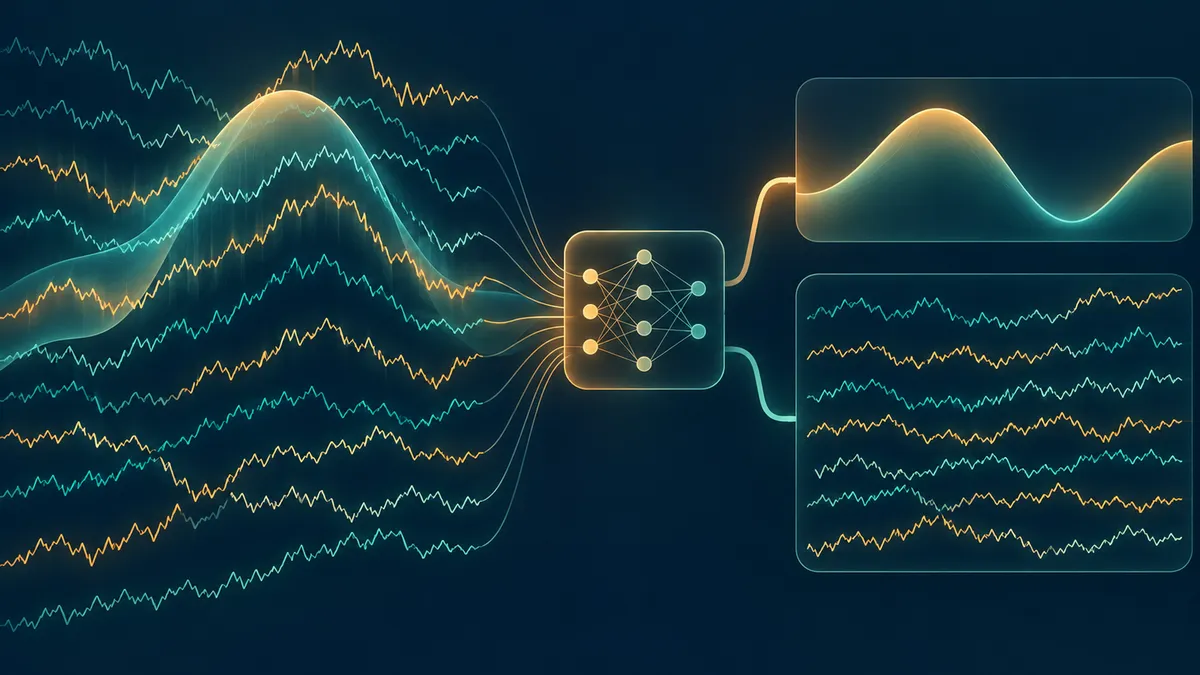
A stock’s price can move because of company-specific news—or because the whole market moves. If a learning system sees only one stock’s history, a sudden market-wide shock may look like noise. Could information from other stocks help the system learn a stock’s sensitivity to those shocks, without requiring other stocks when it is later used?
The challenge: learning from a shared jolt
Financial data contain both individual signals and market-wide movements. A broad shock can affect many stocks at once, but its timing may not be predictable from any one stock’s past. A model trained to predict each stock independently can therefore treat part of that movement as unavoidable error. It may also get little training signal about how strongly that particular stock responds to the shared movement—its market exposure.
In Market-Conditioned JEPA, Yuqi Wang and colleagues propose a way to make that shared movement useful during training. Their method, MC-JEPA, builds on a joint-embedding predictive architecture, or JEPA. Rather than trying to reproduce future price data directly, a JEPA learns to predict a representation of future data. The researchers’ theoretical analysis uses a simplified latent-factor model: future outcomes combine an asset-specific component, exposure to a common factor, and residual noise. Under that model, a predictor that also knows the realized common factor needs information about the asset’s exposure to predict well.
Training with peers’ future representations
The team trained on minute-level open, high, low, close and volume data for Chinese A-share stocks. For each stock being scored, MC-JEPA estimates a market condition by averaging future target representations from other stocks in the same training panel. The stock itself is excluded, so its own future target cannot simply be copied into the condition. The model routes this market signal through factor loadings derived from that stock’s representation.
This future information is available only during training. At evaluation and inference, the retained encoder uses the individual stock’s own historical window; it does not require peer stocks or future observations. The authors trained on data before July 2022, selected settings using a later validation period, and evaluated frozen representations on 2023–2025 data. They used ridge-regression probes to test nine outcomes, including returns, market exposure, risk and liquidity. They also compared methods in a historical long-only backtest.
Where the gains appeared
Against a per-stock JEPA trained in the same setup, MC-JEPA scored higher on all nine headline targets. Improvements were strongest and most consistent for exposure, risk and liquidity; paired statistical tests found gains significant at the 5% level on seven of the nine targets. MC-JEPA had the highest reported RankIC—a measure of how well predictions rank stocks—on the liquidity targets and on several return horizons. The picture was not uniformly best across every comparison: for 20-day returns, for example, TS2Vec scored higher in the reported table.
In the historical backtest, which selected a small group of stocks from the CSI 300 universe and included specified trading costs, MC-JEPA had the strongest reported annualized excess return and Sharpe ratio, and the lowest maximum drawdown among the listed methods. This is a result from a particular simulated strategy and historical period, not evidence of future profits.
Ablations help clarify what may matter. Training with panels but without the aligned market condition did not reproduce the same gains. A condition taken from a different date also failed to reproduce the return and exposure improvements, supporting the authors’ interpretation that alignment with the target period matters. In a separate synthetic experiment, where the researchers controlled the factor structure, conditioning improved recovery of both exposure and the asset-specific component.
What remains uncertain
The theoretical result assumes a linear factor model and access to the true factor; the real-data method instead estimates a market condition from other stocks’ future representations. The authors report that this condition removed only a modest share of prediction error on real data, so denoising alone may not explain the observed results. Their chosen model uses one factor, although tests with more factors suggest trade-offs: additional factors can help some risk and liquidity measures while hurting return prediction.
All real-market experiments concern Chinese A-share equities at one bar frequency. The authors note that market features such as retail participation, daily price limits and settlement rules could affect the results. Whether the approach transfers to other markets, asset classes or frequencies remains untested. The work is an arXiv preprint, not a peer-reviewed publication; its reported comparisons and backtest should be treated as evidence to examine and replicate, not as a settled assessment or investment recommendation.
- financial machine learning
- self-supervised learning
- market factors
- equities
- time series
Reviewed cross-references
These connections were reviewed by a model, not independently fact-checked by a human. Similarity does not imply agreement; consult the original papers and the evidence below.
S-JEPA learns several possible answers to a hidden image region
Shared method: Both papers use joint-embedding predictive architectures to learn representations by predicting target embeddings rather than reconstructing raw inputs. The methods differ substantially: MC-JEPA conditions financial-series prediction on a leave-one-out market signal during training, while S-JEPA uses a stochastic latent variable for masked-image prediction; this connection is methodological, not evidence of comparable results.
Model review: · openai-codex/gpt-6-luna
Evidence and provenance
Selected excerpts, not complete papers. PDF extraction can omit figures or damage equations, tables and reading order; sources may be preprints.
2611.13572v1 — Original paper
Excerpt reference:
static/papers/2611.13572v1.md:66-108
Basis: Paper text
Source SHA-256:fe6f9e5aa893713ac5aae16d97975eda79477e1d36ae3817888ab9486e9c1ffd2611.09302v1 — Original paper
Excerpt reference:
static/papers/2611.09302v1.md:13-77
Basis: Paper text
Source SHA-256:a84447b581e019ee228eb3c95eec6adbf89ee206c34ddda717cc1aaa72f2a955
LEF-JEPA targets object structure without preserving every visual detail
Shared method: Both papers build on JEPA-style latent prediction for self-supervised representation learning. MC-JEPA adds market conditioning for per-asset financial representations, whereas LEF-JEPA adds target-guided latent recovery and energy-based supervision for spatial image representations; their reported evaluations concern different domains and tasks.
Model review: · openai-codex/gpt-6-luna
Evidence and provenance
Selected excerpts, not complete papers. PDF extraction can omit figures or damage equations, tables and reading order; sources may be preprints.
2611.13572v1 — Original paper
Excerpt reference:
static/papers/2611.13572v1.md:66-108
Basis: Paper text
Source SHA-256:fe6f9e5aa893713ac5aae16d97975eda79477e1d36ae3817888ab9486e9c1ffd2611.08989v1 — Original paper
Excerpt reference:
static/papers/2611.08989v1.md:13-86
Basis: Paper text
Source SHA-256:5d37e98a57c97fe75a16310ce8a15cfffa942815b48529667e7359a1cb1f4098
Related reading
Automatically matched by shared topic keywords. These links do not imply that the sources agree or establish a consensus.
Learning from unlabelled smart-glasses signals improves facial-expression recognition
Source published
Shared keywords: self supervised learning
LEF-JEPA targets object structure without preserving every visual detail
Source published
Shared keywords: self supervised learning
S-JEPA learns several possible answers to a hidden image region
Source published
Shared keywords: self supervised learning
Preserving MRI’s hidden phase signal could improve accelerated brain imaging
Source published
Shared keywords: self supervised learning
AudioSphere learns sound identity and direction through masked audio training
Source published
Shared keywords: self supervised learning