TRANSMISSION // 2611.13542v1
A faster way to weigh dark matter halos in simulated universes
Source published
OASIS estimates which simulated dark matter particles are orbiting a halo using their positions and velocities at a single moment. A new preprint reports roughly 9% scatter against a particle-tracking method, offering a computational shortcut with limitations during mergers and in poorly centered halos.
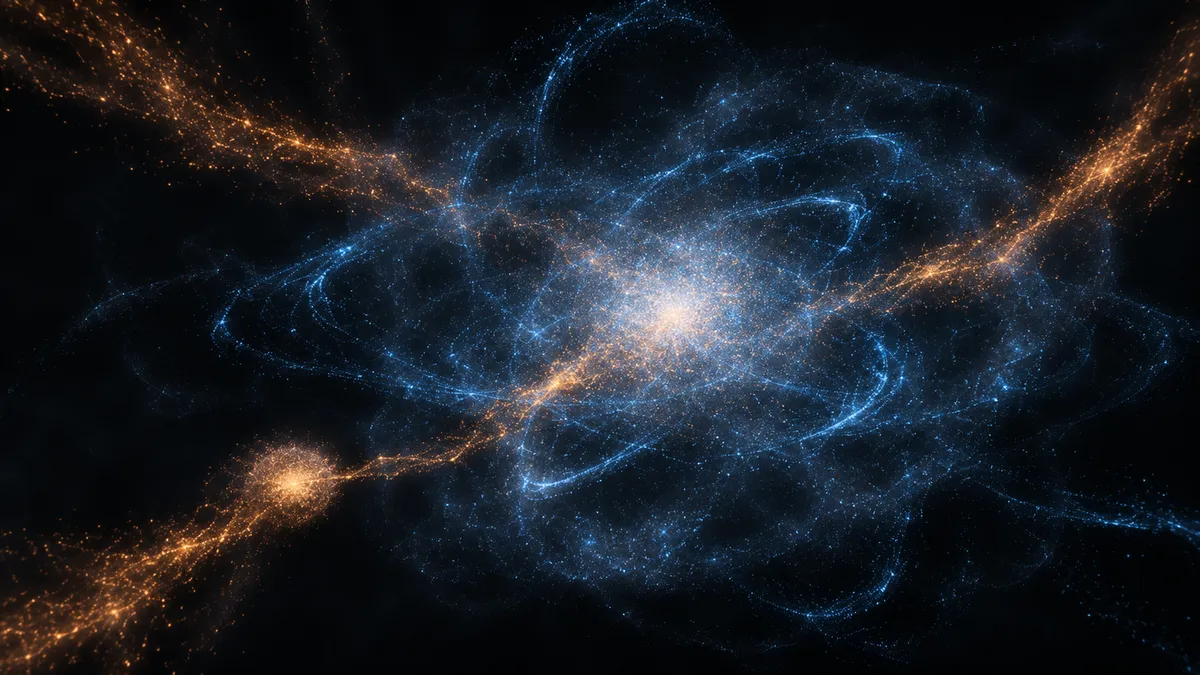
Where does a dark matter halo end? Drawing a sphere around a dense region is convenient, but it mixes particles already orbiting the halo with others arriving for the first time. A new algorithm tries to separate those populations without following their entire histories.
The boundary matters because changing which particles belong to a halo changes its measured mass—and therefore the predicted abundance of halos of different sizes. In a November 10 preprint, Bayli Hayes and colleagues introduce OASIS, short for Orbiting-mass ASsIgnment Scheme, to make a motion-based definition practical across large cosmological simulations.
Their starting point is a definition developed in earlier work: a halo consists of particles orbiting the gravitational potential they collectively generate. Unlike a spherical density boundary, this definition distinguishes orbiting material from first-time arrivals and does not require the halo itself to be spherical.
The difficulty is knowing a particle’s history. Tracking methods can establish whether it has already passed through its closest approach to a halo’s center. But reading trajectories across many simulation outputs requires substantial computation and specialized software. OASIS instead uses one snapshot containing particle positions and velocities. It post-processes an existing catalog from the ROCKSTAR halo finder rather than finding every structure from scratch.
The shortcut rests on an energy difference. At the same distance from a halo’s center, particles already orbiting generally have lower kinetic energies than particles falling in. The populations overlap, so this is not an exact identification rule. Nevertheless, the authors find that cuts based on speed and distance can separate them well enough to estimate total orbiting masses.
OASIS treats inward-moving and outward-moving particles separately, scaling distances and speeds to the size and mass of each candidate halo. Its thresholds can be calibrated from the simulation itself or taken from the authors’ fitted prescription. Across the tested simulations, the main cosmological dependence of these cuts is on the matter-density fraction at the epoch being analyzed. A curved correction near halo centers recovers fast, inward-moving particles that a simpler straight cut would miss.
Smaller structures create another problem: their internal particle motions can make the initial cut classify part of a structure as orbiting a larger neighbor and part as falling toward it. OASIS applies a correction that gives particles associated with a smaller structure a shared classification. It then resolves competing assignments so that each particle belongs to at most one halo. This bookkeeping matters: assigning a neighboring structure to a larger halo can substantially alter both objects’ reported masses.
The researchers tested the results against an earlier classification based on accretion histories and against SPARTA, a particle-tracking algorithm. Compared with SPARTA, the halo mass-ratio distribution peaked near 0.979, with about 8.6% scatter. That is agreement in total halo mass, not evidence that roughly 91% of individual particles receive the correct label.
For scale, the authors report that post-processing a Quijote simulation containing just over a billion particles took approximately ten minutes on a machine with 16 cores and 32 threads. This is catalog-processing time, not the time needed to run the simulation.
They then used OASIS catalogs from the Erebos and Quijote simulation suites to investigate how halo abundance depends on mass and cosmology. When expressed in a rescaled form designed for comparing different cosmologies, the present-day abundance curves agreed at roughly the 5% level across the parameter groupings examined. Statistically significant differences remained, but the authors caution that systematic differences of approximately 2–4% in dynamical halo masses, seen in comparisons between classification methods, could plausibly account for the apparent departures from universality. The analysis therefore does not establish that these departures reflect physical cosmology dependence rather than mass-assignment systematics. Nor does approximate universality mean every cosmology produces the same raw halo counts.
A modified Press–Schechter model described much of the abundance pattern with a fitted collapse threshold near 1.54, but became biased at high masses. The simpler, unmodified description also failed at low masses across the broader range examined here.
The tradeoff is speed versus historical detail. Major mergers, disagreements over whether a neighbor is independent, and incorrect centers in the input catalog can produce large mass discrepancies. The authors recommend dedicated particle tracking for detailed dynamics or accurate structure classification. Their cosmology tests also stay within flat cosmological-constant models with cold dark matter and zero neutrino mass in the Quijote sample. This preprint presents a useful simulation shortcut—not a direct observation of dark matter or a demonstration that its approximations work in every cosmology.
- dark matter
- dark matter halos
- OASIS
- cosmological simulations
- halo mass function
- particle dynamics
- Quijote
- Erebos
Related reading
Automatically matched by shared topic keywords. These links do not imply that the sources agree or establish a consensus.
Reading the early universe through the cosmic web
Source published
Shared keywords: cosmological simulations, dark matter halos
Simulated cosmic filaments reveal a shared dark-matter pattern
Source published
Shared keywords: cosmological simulations, dark matter, dark matter halos
Self-interacting dark matter deepens a galactic bar puzzle in simulations
Source published
Shared keywords: cosmological simulations
Could dark matter’s hidden properties change the cosmic web?
Source published
Shared keywords: cosmological simulations, dark matter
A giant galaxy’s stellar layers preserve clues to its dark halo’s past
Source published
Shared keywords: dark matter halos