TRANSMISSION // 2611.13506v1
Fading radio lobes suggest a black hole disrupted its galaxy group’s cool core
Source published
X-ray observations of IC 2476 reveal a compact cool core, unusually high surrounding gas entropy and a possible cavity beneath a fading radio lobe. A preprint interprets these features as lasting damage from past black-hole activity, while an unexpectedly low iron abundance remains uncertain.
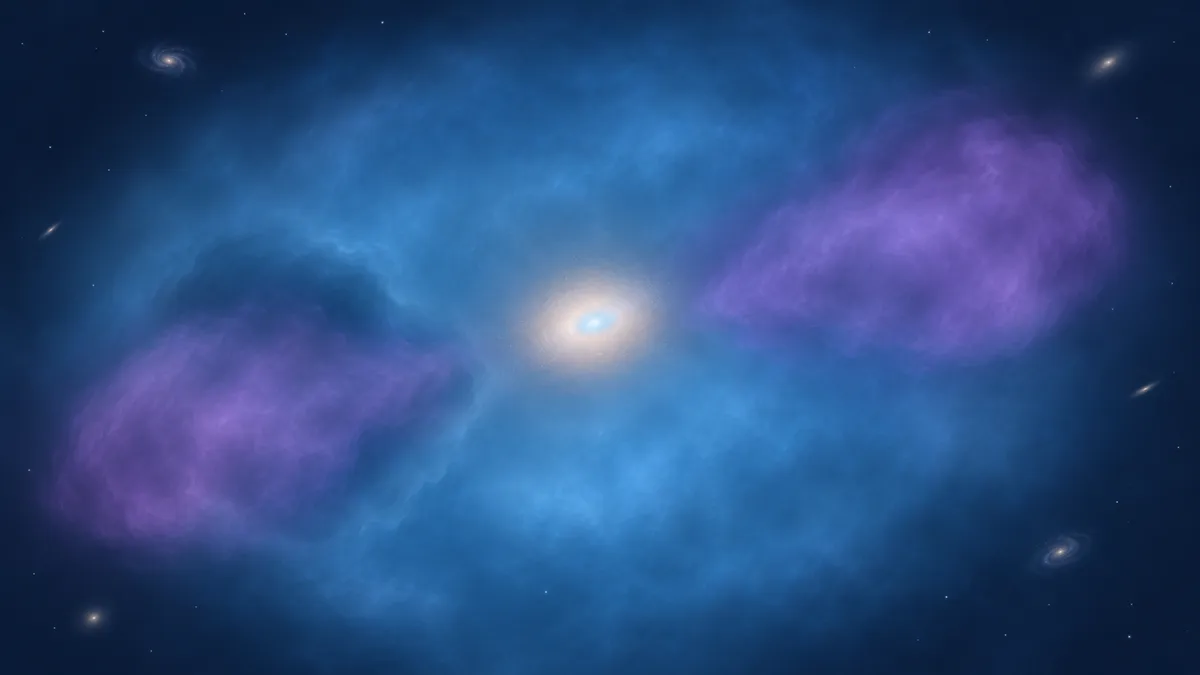
A black hole’s jets can stop long before their effects disappear. In the galaxy group IC 2476, lingering radio lobes sit within a hot atmosphere whose structure may preserve evidence of an earlier outburst. New X-ray analysis suggests that the outburst disrupted a larger cool core, leaving a small central remnant.
Reading the aftermath
Galaxy groups contain hot, diffuse gas that emits X-rays. In some groups, the central gas is denser and cooler than its surroundings, forming a region called a cool core. Jets powered by matter accreting onto a central supermassive black hole can disturb that atmosphere, inflating radio-emitting lobes and displacing gas.
IC 2476 offers a view of what happens after those jets stop. Earlier radio studies found lobes but no obvious jets or bright radio nucleus. Their models placed the shutdown roughly 30–50 million years ago. In a new preprint, Wenhao Liu and colleagues examine whether the surrounding gas still carries the imprint of that activity.
The distinction matters because galaxy groups hold gas less tightly than massive galaxy clusters do. An outburst can therefore have a stronger effect on a group’s atmosphere, but its relatively faint X-ray emission makes that effect harder to measure.
A small core inside a disturbed atmosphere
The researchers analyzed two deep XMM-Newton observations taken in 2020 and 2021, totaling about 180,000 seconds of exposure, alongside an older observation. They removed point sources, modeled instrumental and sky backgrounds, and fitted X-ray spectra in successive regions to estimate gas temperature and chemical abundance. They also reconstructed the gas density and compared the X-ray structure with low-frequency LOFAR radio images.
A cool core survives within roughly 10 kiloparsecs of the central galaxy. Its fitted temperature is about 0.45 keV, unusually low compared with the central coronae discussed in earlier work. Here, keV expresses the thermal energy associated with the gas temperature. The group’s broader atmosphere has a characteristic temperature near 1 keV.
Outside that compact center, the gas has unusually high scaled entropy compared with groups of similar temperature. Astronomers calculate this entropy measure from temperature and electron density; it helps distinguish dense, readily cooling gas from a more diffuse atmosphere. The elevated profile supports substantial past energy input outside the surviving core.
There is also an X-ray brightness deficit about 60–120 kiloparsecs east of the center, overlapping the eastern radio lobe. Such a deficit can indicate a cavity where radio plasma has pushed hot gas aside. However, the researchers find no sharp boundary or bright rim. They suggest an old cavity may now be mixing with its surroundings, rather than identify a cleanly bounded bubble.
Reconstructing the outburst
Assuming a spherical cavity with a radius of about 32 kiloparsecs, the team estimates an energy content of approximately 4.3 × 10^58 ergs. Dividing that energy by an estimated buoyant rise time gives an average cavity power near 6.4 × 10^42 ergs per second.
Those numbers depend on an uncertain cavity geometry and age. A partly dispersed cavity could originally have been larger, while different age estimates produce different powers. The calculation is not a direct measurement of the jets’ original output.
Taken together, the compact core, elevated surrounding entropy and possible cavity favor a picture in which earlier activity disrupted a larger cool core without removing most of the group’s gas. That history is inferred from the present structure, not observed unfolding. A larger cool core might eventually re-form if strong heating does not resume.
An unresolved chemical puzzle
The spectra also yield an exceptionally low iron abundance, generally below about one-fifth of the solar value, even near the center. If real, that could reflect an unusual history of enrichment, metal loss or gas redistribution.
But abundance measurements depend on the emission model. Fitting gas with several temperatures as though it had just one can underestimate iron. Two-temperature fits still favored low values, although uncertainties widened. A broader temperature-distribution model raised some central estimates to roughly 0.2–0.4 times solar. Changes to the sky background affected outer measurements more than central ones. A possible contribution from inverse-Compton X-rays remains untested in detailed modeling.
The very low core temperature is also unexplained: the authors’ simple cooling estimate cannot produce it during the inferred shutdown interval alone. XMM-Newton cannot resolve the innermost gas well enough to distinguish shorter central cooling times from cooling that began before the jets stopped. The preprint therefore supports a post-outburst interpretation while leaving the core’s thermal history and chemical abundance open.
- IC 2476
- galaxy groups
- AGN feedback
- cool cores
- radio lobes
- X-ray astronomy
- iron abundance
Reviewed cross-references
These connections were reviewed by a model, not independently fact-checked by a human. Similarity does not imply agreement; consult the original papers and the evidence below.
Twin radio bubbles offer clues to the mystery of odd radio circles
Supporting evidence: Liu et al. report surviving radio lobes around IC 2476 after its central AGN switched off; Su et al. favor a relic bipolar AGN outburst for the approximately 399 kpc radio shells around LEDA 217397, whose nucleus has only weak radio emission. These findings support the possibility that extended radio structures preserve past jet activity despite weak present nuclear emission. The comparison is provisional: Su et al. require further observations to confirm the shells' origin and allow shock re-energisation; their different environment and radio evidence do not corroborate cool-core destruction in IC 2476. Both sources are preprints.
Model review: · openai-codex/gpt-6.1-sol
Evidence and provenance
Selected excerpts, not complete papers. PDF extraction can omit figures or damage equations, tables and reading order; sources may be preprints.
2611.13506v1 — Original paper
Excerpt reference:
static/papers/2611.13506v1.md:1139-1225
Basis: Paper text
Source SHA-256:be70ad04ae552ae8f97c3fe88d853f48c38fed6caa125ee2503ac0e25ac760992608.22835v2 — Original paper
Excerpt reference:
static/papers/2608.22835v2.md:12-55
Basis: Paper text
Source SHA-256:f3221138c11c93ccea93558312b4bb776c7330280985a4a1d9ca9f520c4761602608.22835v2 — Original paper
Excerpt reference:
static/papers/2608.22835v2.md:861-931
Basis: Paper text
Source SHA-256:f3221138c11c93ccea93558312b4bb776c7330280985a4a1d9ca9f520c476160
Related reading
Automatically matched by shared topic keywords. These links do not imply that the sources agree or establish a consensus.
What stirs a galaxy cluster: black-hole bubbles or a passing neighbor?
Source published
Shared keywords: agn feedback, cool cores
Simulated galaxy clusters match X-ray outskirts—but their cores look too faint
Source published
Shared keywords: agn feedback, x ray astronomy
Reshaping telescope grids could widen the search for gamma-ray bursts
Source published
Shared keywords: x ray astronomy
Separating faint light between galaxies from telescope-scattered glow
Source published
Shared keywords: galaxy groups
Slow-spinning galaxies offer clues to the growth of cosmic giants
Source published
Shared keywords: galaxy groups