TRANSMISSION // 2611.13505v1
A 44-second timing wobble hints at a hidden planet beside TOI-2109 b
Source published
An analysis of 87 transit timings favors an unseen giant planet near the ultra-hot Jupiter TOI-2109 b. The preprint strengthens an earlier companion hypothesis, but its simplified orbital model and modest statistical advantage leave the planet unconfirmed.
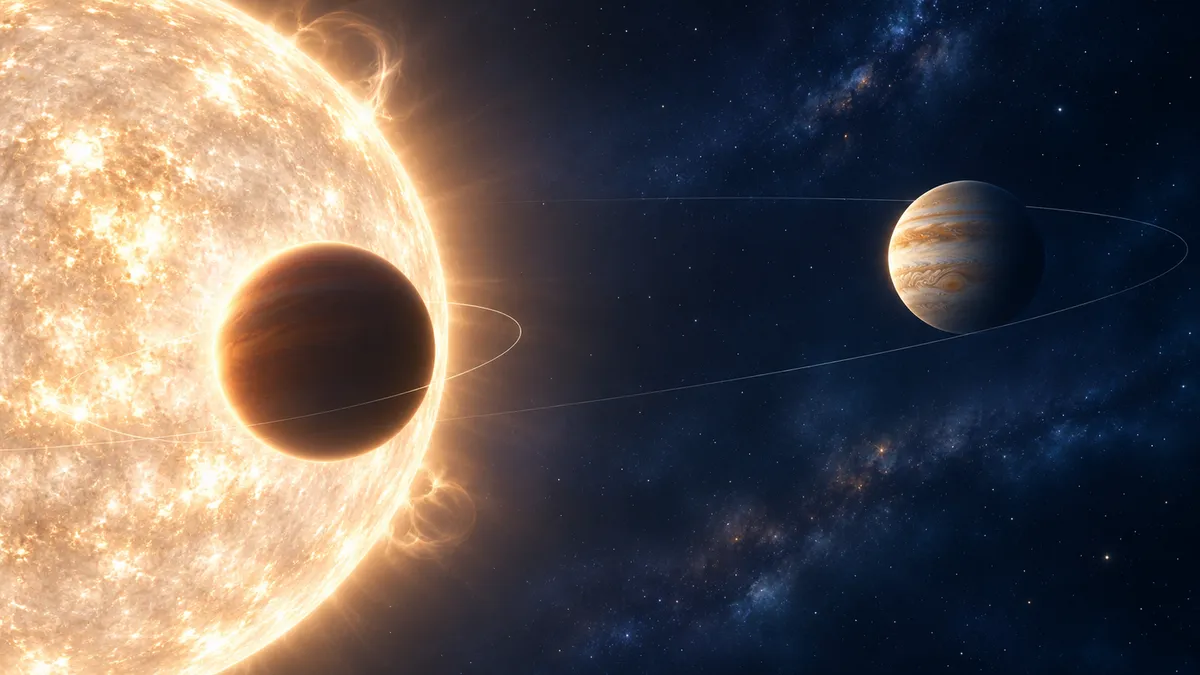
TOI-2109 b circles its star roughly every 16 hours, making its repeated passages across the star a useful astronomical clock. A new preprint finds that this clock appears to run early and late by tens of seconds. The researchers’ preferred explanation is the gravitational pull of another giant planet, one that has not itself been seen crossing the star.
The study, led by Kaviya Parthasarathy, examines whether TOI-2109 b’s changing transit times reveal an unseen neighbor or a different kind of orbital evolution. Its best-fitting companion would have about 70% of Jupiter’s mass and complete an orbit in approximately 1.578 days. That is a candidate inferred from timing measurements, not a confirmed planetary discovery.
Reading the planet’s clock
A transit occurs when a planet passes in front of its star and temporarily dims the starlight. If its orbital period stays constant, those dimmings should follow a predictable schedule. Gravitational interactions with another planet can shift them away from that schedule, producing transit timing variations.
The researchers assembled 87 distinct transit timings using TESS, CHEOPS, Hubble and ground-based observations. The baseline reaches from archival SuperWASP observations in 2006–2011 to new observations made in Thailand in 2025. However, the early SuperWASP measurements enter the analysis as one timing derived from a combined, folded light curve—not as continuous monitoring across those years.
To measure the timings, the team fitted models to the observed brightness dips and corrected for effects such as stellar brightness trends and CHEOPS spacecraft rotation. Measurements covering the same transit with both TESS and CHEOPS were combined, avoiding counting those events twice.
Five explanations compete
The team compared five timing models. The simplest assumes an unchanged orbital period. Another allows the orbit to shrink steadily through tidal interactions with the star. A third considers apsidal precession: a gradual turning of an elliptical orbit that can alter when transits occur.
The remaining models describe a repeating timing oscillation and the gravitational interaction of two planets, respectively. This comparison matters because a departure from a regular transit schedule does not, by itself, identify its cause.
The orbital-decay fit gives a period change of minus 3.96 milliseconds per year, with an uncertainty of 2.05 milliseconds per year. The authors do not regard that as significant evidence for ongoing decay. It therefore does not establish that the planet is currently spiraling inward at a measurable rate.
A sinusoidal fit instead finds a timing amplitude of about 44 seconds. A search for periodic structure gives a false-alarm probability of 2.34% under the search’s noise assumptions. That number is not the probability that the proposed companion is nonexistent; it describes the statistical significance of the periodic timing peak.
A possible nearby giant
Before fitting the companion, the researchers explored which hypothetical systems could avoid chaotic motion in computer simulations. They tested 10,000 combinations of companion mass and orbital period, integrating each system for 500 simulated years. These calculations help screen possible configurations, but do not establish stability over the system’s entire lifetime.
The team then fitted gravitational models around several candidate orbital-period ratios. The best result lay near 7:3: the inner planet would complete roughly seven circuits while the outer planet completed three. Being near that ratio does not alone demonstrate that the planets are locked in a resonance.
The preferred solution gives the companion a mass of 0.70 ± 0.02 Jupiter masses and an orbital period of 1.57813 ± 0.000089 days. Those uncertainties apply within the adopted model, which fixes both orbits as circular and in the same plane. The observations were insufficient to freely determine a more general orbital arrangement.
Evidence, not confirmation
The two-planet model performs best under the Bayesian Information Criterion, which rewards improved agreement with observations while penalizing extra adjustable parameters. Its advantage over the sinusoidal model is 4.95 points. The authors describe this as positive evidence for the companion, rather than decisive confirmation.
Even the preferred fit leaves more scatter than expected from the stated timing uncertainties. Its apparent precision therefore should not obscure the remaining uncertainty about the physical explanation.
The result strengthens an earlier suggestion of a companion on a roughly 1.57-day orbit. Continued transit monitoring can test whether the timing variations keep following the gravitational model’s predictions. For now, TOI-2109 b offers a promising indirect clue to another giant planet—not a settled addition to the planetary census.
- TOI-2109 b
- exoplanets
- transit timing variations
- ultra-hot Jupiter
- non-transiting companion
- orbital resonance
Reviewed cross-references
These connections were reviewed by a model, not independently fact-checked by a human. Similarity does not imply agreement; consult the original papers and the evidence below.
A giant planet’s fading transits point to an unseen companion
Shared method: Parthasarathy et al. and Yee et al. use dynamical modeling of hot-Jupiter transit timing variations to infer nearby planetary perturbers near mean-motion resonances. The TOI-2109 analysis favors a possible companion near 7:3 from an approximately 44-second timing signal; the TOI-2535 analysis also fits transit duration variations and radial velocities, with timing excursions of roughly six hours. These draft analyses concern different systems, not independent confirmation of the TOI-2109 companion; Yee et al. report unresolved architecture and excess timing and radial-velocity scatter.
Model review: · openai-codex/gpt-6.1-sol
Evidence and provenance
Selected excerpts, not complete papers. PDF extraction can omit figures or damage equations, tables and reading order; sources may be preprints.
2611.13505v1 — Original paper
Excerpt reference:
static/papers/2611.13505v1.md:52-116
Basis: Paper text
Source SHA-256:4accc24a1bd765b94135061fee42bdb20cda625efa0a6ddaf4aaf53798f24f162611.13343v1 — Original paper
Excerpt reference:
static/papers/2611.13343v1.md:44-99
Basis: Paper text
Source SHA-256:22b3866e94552cac999659df6c675031d159ca4508aa92848a0de47bcdb988432611.13343v1 — Original paper
Excerpt reference:
static/papers/2611.13343v1.md:1565-1625
Basis: Paper text
Source SHA-256:22b3866e94552cac999659df6c675031d159ca4508aa92848a0de47bcdb98843
Earth 2.0 could reveal shrinking orbits around three distant stars
Shared method: Parthasarathy et al. and Wang et al. combine transit timing across observing facilities and long baselines to constrain secular orbital-period changes in hot Jupiters. Parthasarathy et al. fit observed TOI-2109 timings and find no significant orbital decay, whereas Wang et al. combine archival Kepler and TESS observations with simulated Earth 2.0 data to forecast decay-measurement precision for Kepler hot Jupiters. The forecast depends on assumed mission performance and, for predicted detections, stellar tidal quality factors; it neither confirms nor conflicts with the TOI-2109 result.
Model review: · openai-codex/gpt-6.1-sol
Evidence and provenance
Selected excerpts, not complete papers. PDF extraction can omit figures or damage equations, tables and reading order; sources may be preprints.
2611.13505v1 — Original paper
Excerpt reference:
static/papers/2611.13505v1.md:52-116
Basis: Paper text
Source SHA-256:4accc24a1bd765b94135061fee42bdb20cda625efa0a6ddaf4aaf53798f24f162611.07427v1 — Original paper
Excerpt reference:
static/papers/2611.07427v1.md:16-77
Basis: Paper text
Source SHA-256:f4176f034b17f8a8a73328679fdb4030aabf7bd35a2fb5f307020f050d0b0dc8