TRANSMISSION // 2611.13475v1
Quantum amplitude estimation tests a proton-transport model, but clinical speedup remains out of reach
Source published
A preprint builds a quantum circuit for a simplified model of proton energy loss and uses amplitude estimation to estimate the chance of passing a chosen depth. In simulated tests, its error was lower than classical sampling’s at the same oracle-call budget. But oracle calls are costly in the paper’s clinical-scale resource analysis, and the model leaves out key transport physics. The work is a proof of concept, not a demonstration of faster clinical dose calculation.
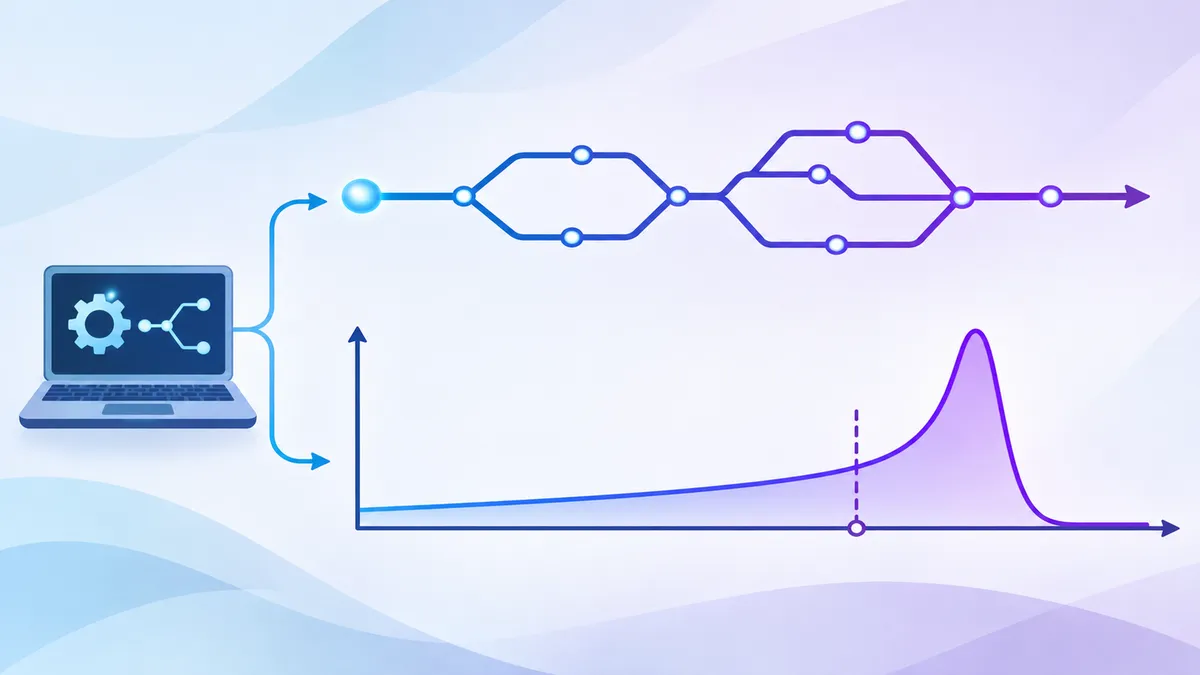
Monte Carlo simulations estimate where proton beams deposit energy, but reducing their statistical uncertainty takes many particle histories. Quantum amplitude estimation can, in ideal conditions, estimate a single probability with fewer oracle calls than ordinary sampling needs for comparable precision. The challenge is to build a reversible circuit for the transport process—and to account for its cost. This preprint examines those questions using a simplified proton model and one range-related statistic.
Proton therapy depends on knowing where a beam deposits energy. Protons tend to release much of their energy near the end of their path, creating a characteristic Bragg peak. Monte Carlo (MC) simulations estimate this depth-dose pattern by following particle histories. Their statistical error typically falls as the inverse square root of the number of histories, so greater precision requires many more samples.
Quantum amplitude estimation (QAE) offers a different ideal scaling for a probability: error can fall roughly in proportion to the inverse number of oracle calls. But this advantage requires a reversible circuit that generates the relevant probability distribution. In this study, that distribution comes from a deliberately simplified transport model; the work does not establish that it accurately represents clinical proton transport. QAE also estimates one number at a time, unlike a full dose map spanning many voxels.
In this arXiv preprint, Kwangzoo Chung constructs a discrete-time quantum walk representing a proton moving through depth while losing energy. At each step, an energy-dependent operation acts like a probabilistic coin: the modeled proton loses one or two units of energy. Registers track its energy and position. A fresh coin qubit at every step preserves the history needed to reverse the circuit, as amplitude estimation requires.
The target is the probability that the modeled proton reaches or passes a chosen depth threshold. The circuit marks states whose position at the end of the walk is at or beyond that threshold. Stopped histories retain their stopping depth; histories still moving reach the walk’s final step. Maximum-likelihood amplitude estimation (MLQAE) uses measurements after different numbers of Grover iterations to estimate the marked probability. The study also compares the model’s depth-deposit profile with classical Monte Carlo using identical transport rules and estimates logical-gate resources for a larger, clinical-scale geometry.
The circuit produces a Bragg-shaped profile. In depth bins carrying appreciable deposit, it agrees with the classical MC reference to within 0.267%. This tests whether the circuit implements the chosen rules, not whether those rules describe a real clinical beam. The walk encodes a classical stochastic process: distinct coin histories remain distinguishable, so the resulting depth probabilities match those of the corresponding classical model.
For the threshold probability, simulated MLQAE error fell approximately as the inverse of the oracle-call budget, while classical sampling error fell approximately as the inverse square root. At the largest tested budget, the classical-to-quantum median-error ratio was 4.8, with a reported interval of 3.8–7.8. This is a comparison at matched oracle-call budgets, not runtime. The estimation used simulated, ideal circuits with finite-shot measurement statistics; no quantum processor was used.
The resource analysis highlights why lower error per call does not mean faster calculation. A full dose map is structurally unfavorable: amplitude estimation would need a separate run for each voxel, whereas one batch of classical histories contributes to many voxels. A scalar statistic passes that output-structure test, but it does not remove the costs of estimating multiple quantities or of running each oracle. For the paper’s clinical-scale geometry, the estimated oracle uses about one million logical gates per call, or more when the cost of synthesizing its arbitrary-angle rotations is included. Under the stated assumptions, the wall-clock crossover occurs only at extremely high precision: around 6 × 10⁻⁸ at an aggressive assumed logical-gate time of 0.1 microseconds. The paper notes that dosimetric applications do not require such precision. The energy-dependent multiplexed coin is the dominant circuit expense.
The model’s limitations matter. It is one-dimensional and uses a simple two-outcome energy-loss rule, rather than a tabulated stopping-power model; it omits multiple Coulomb scattering and nuclear interactions. With losses restricted to one or two units, the peak-to-entrance ratio has a model-specific upper bound below the roughly 3–5 reported for measured curves. In the refinement study, range straggling decreases as energy resolution increases rather than converging to a fixed physical straggling model. The authors describe more realistic physics as a future extension, not a result of this study.
There is also a benchmark caveat: the small one-dimensional model can be propagated exactly by classical methods, so sampling is not the best classical approach for that toy problem. The resource comparison with Monte Carlo is intended to represent a larger three-dimensional task, not the model as built. Its conclusions depend on assumed gate costs and classical throughput, and more realistic physics may add circuit costs. As an arXiv preprint, the work should not be treated as peer-reviewed evidence. It demonstrates amplitude estimation on a physics-generated model and carefully estimates what a possible advantage would require—not a clinical tool or faster proton dose calculation.
- quantum amplitude estimation
- proton therapy
- Monte Carlo
- quantum walks
- Bragg peak
- quantum resource estimates
Reviewed cross-references
These connections were reviewed by a model, not independently fact-checked by a human. Similarity does not imply agreement; consult the original papers and the evidence below.
Could quantum estimation cut the cost of learning to play with hidden information?
Shared method: Both studies apply quantum amplitude estimation to expectations or probabilities generated by classical processes: Chung estimates a proton’s probability of passing a depth threshold using maximum-likelihood amplitude estimation, while Maresch et al. propose estimating counterfactual game values within regret minimization. The estimands and applications differ, and the game-theory work is a theoretical framework rather than an empirical demonstration of end-to-end advantage.
Model review: · openai-codex/gpt-6-luna
Evidence and provenance
Selected excerpts, not complete papers. PDF extraction can omit figures or damage equations, tables and reading order; sources may be preprints.
2611.13475v1 — Original paper
Excerpt reference:
static/papers/2611.13475v1.md:13-53
Basis: Paper text
Source SHA-256:3c1b16cb04f7480d5bb4b44e89dff295a1fc617893fb0a835b49d5ba170a3c942611.14182v1 — Original paper
Excerpt reference:
static/papers/2611.14182v1.md:12-69
Basis: Paper text
Source SHA-256:a15d189ef12319a91bdfa3ffdf418a3d78d913a341351fda246a76d32fd3d5852611.14182v1 — Original paper
Excerpt reference:
static/papers/2611.14182v1.md:128-202
Basis: Paper text
Source SHA-256:a15d189ef12319a91bdfa3ffdf418a3d78d913a341351fda246a76d32fd3d585
Related reading
Automatically matched by shared topic keywords. These links do not imply that the sources agree or establish a consensus.
Could quantum estimation cut the cost of learning to play with hidden information?
Source published
Shared keywords: quantum amplitude estimation
Reading a quantum network depends on how you look
Source published
Shared keywords: quantum walks
Uneven ion spacing changes how a quantum of vibration travels
Source published
Shared keywords: quantum walks