TRANSMISSION // 2611.13465v1
An atom’s returning radiation could reveal a comb of frequencies
Source published
A theoretical preprint predicts that radiation returning to an atom between mirrors produces transient spectral peaks. Their visibility depends on the detector’s memory, while their arrangement reveals information that excitation measurements can miss.
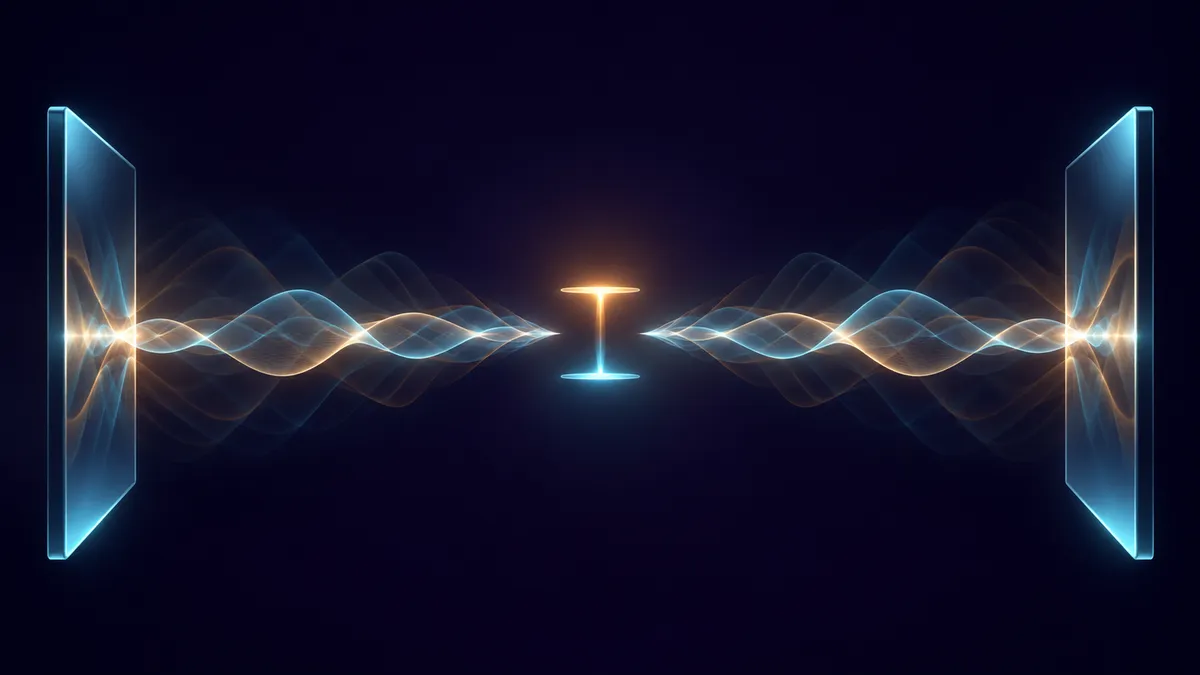
What happens to an atom’s radiation when mirrors send it back? Calculations suggest that repeated emission and reabsorption leave a changing pattern of frequency peaks—and that seeing this pattern requires a detector that remembers earlier emission.
An excited atom can release its energy into radiation. Between mirrors, that radiation can return, partly re-excite the atom and trigger another emission. What would the radiation’s spectrum—the distribution of its signal across frequencies—look like during these successive encounters?
A theoretical arXiv preprint by Diego Aranda-Lozano and colleagues, submitted on November 10, 2026, predicts a transient frequency comb: a sequence of approximately regularly spaced spectral peaks. The study combines analytical calculations with numerical simulations. It does not report an experimental observation of this comb.
Following radiation back to its source
The researchers model an atom with two energy levels inside a one-dimensional cavity. The atom starts excited, and the cavity field starts in its vacuum state. The model allows the excitation to move between the atom and many discrete cavity modes, the standing-wave patterns supported by the mirrors.
Most calculations place the atom halfway between the mirrors. Radiation travelling in opposite directions then returns simultaneously. The relevant delay, called the round-trip time, is the journey from the atom to either mirror and back—not a complete circuit between both mirrors.
The numerical example includes 400 cavity modes. For a centered atom, symmetry prevents coupling to the even-numbered modes. Initially, the atom’s excitation falls much as it would during spontaneous emission without returning radiation. After the first return, its excitation rises again; further returns produce additional revivals.
To explain these dynamics, the authors approximate the coupling as nearly constant across the frequencies most relevant to emission, while accounting for a shift of the atomic transition frequency. This reduces the problem to a delay-differential equation: the atom’s present evolution depends on its state at earlier return times. Its analytical solution, expressed using Laguerre polynomials, closely reproduces the numerical revivals in the regimes examined.
Why separate emissions make spectral teeth
An excitation measurement tells researchers how likely the atom is to occupy its upper energy level. A spectrum can also reveal interference between radiation emitted at different times.
The authors calculate the Eberly–Wódkiewicz physical spectrum, which represents a detector preceded by a frequency-selective filter. Unlike a spectrum that assumes an unchanging source, it incorporates both the observation time and the filter’s finite response.
Successive emission stages contribute amplitudes that can reinforce or cancel one another at different frequencies. Their separation in time sets the characteristic spacing of the resulting spectral teeth. In ordinary frequency units, that spacing is the inverse of the return time; in angular-frequency units, it is 2π divided by that time.
Near the atomic resonance, the peaks are associated with the two effective half-cavities formed when the atom acts as a reflector. They therefore need not coincide with the original cavity modes that couple to the atom. The atom also shifts the peak positions: the half-cavity picture describes the near-resonant structure, rather than an exact, unshifted grid across every frequency.
At longer observation times, a sufficiently narrow filter resolves peaks near the joint atom–cavity system’s dressed-mode frequencies. These are resonances of the interacting system, not of the empty cavity alone. The authors check their analytical frequency predictions against numerical diagonalization.
The detector must retain the earlier emission
The filter’s bandwidth controls whether successive stages can interfere in the recorded spectrum. A broad filter responds quickly but loses the earlier contribution before the next return. A narrow filter retains it longer, making the comb more visible.
The earlier stage’s amplitude is suppressed by a factor involving the exponential of minus bandwidth times return time. This gives the comb visibility its characteristic exponential dependence, alongside factors describing the individual emission stages. Narrowing the filter has a cost: its longer memory blurs the timing of separate revivals.
The spectrum also distinguishes changes in feedback phase—the phase accumulated by returning radiation—that barely affect excitation revivals when the emission stages are well separated. Moving the atom off-center introduces two unequal return times and corresponding spectral spacings. Excitation timing already contains position information; spectroscopy supplies a complementary frequency-resolved signature.
A prediction awaiting a realistic output measurement
The model assumes an ideal lossless cavity, a single initial excitation and approximations that restrict the interaction. The authors discuss superconducting artificial atoms coupled to microwave or surface-acoustic-wave resonators as possible implementations. Slower acoustic propagation makes long delays easier to obtain in compact devices.
A key limitation remains: the calculated spectrum describes the atomic dipole, whereas an experiment would typically measure a field leaving a cavity port. That port introduces losses and its own frequency-dependent response. The paper leaves a detailed comparison of these spectra for future work. Its result is therefore a theoretical account of how delayed feedback could become visible in time-resolved spectroscopy, not a demonstrated device.
- quantum feedback
- cavity quantum electrodynamics
- time-resolved spectroscopy
- frequency comb
- non-Markovian dynamics
- superconducting artificial atoms
Related reading
Automatically matched by shared topic keywords. These links do not imply that the sources agree or establish a consensus.