TRANSMISSION // 2611.13428v1
How many copies does it take to learn a quantum state?
Source published
A theoretical preprint sharpens the measurement costs of learning Gaussian quantum states, showing when joint measurements save copies and how specialised measurements can remove energy dependence.
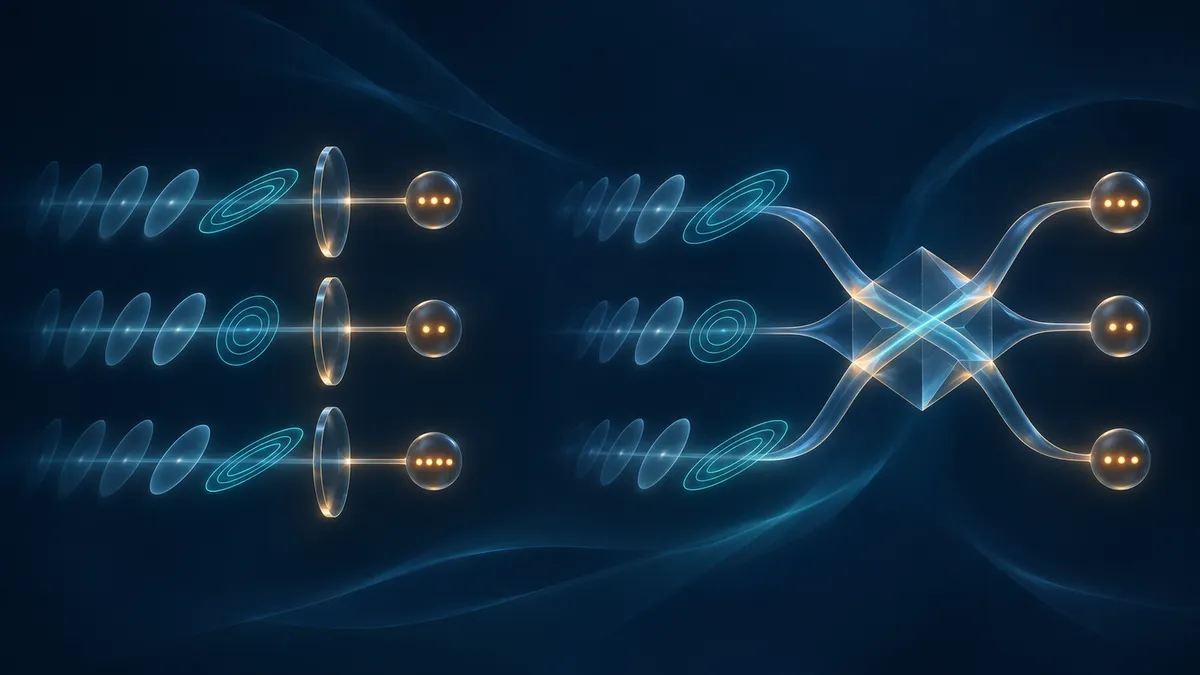
Preparing the same quantum state repeatedly does not guarantee that it is cheap to identify. The measurement strategy matters: inspecting copies separately can require more repetitions than measuring several together.
How many repetitions are needed to reconstruct an unknown quantum state? The answer depends not just on the state, but on what the experimenter can measure together. In a theoretical preprint, Ron Rubin derives new bounds for Gaussian states, a family that includes thermal states of noninteracting particles and coherent and squeezed light.
The work concerns quantum tomography: using measurements on independently prepared copies to estimate their shared state. It presents mathematical protocols and guarantees, not an experimental demonstration of those protocols.
A compact description still has a measurement cost
Gaussian states are specified by their first and second moments: averages, fluctuations and correlations. For light, these describe quantities such as the field’s position-like and momentum-like quadratures. For fermions, they encode correlations between orbitals. A mode is one such quantum degree of freedom.
With m modes, the description contains roughly m² parameters. But counting parameters does not settle the number of copies needed. Quantum observables can be incompatible, preventing one measurement from revealing all their information simultaneously.
The paper measures reconstruction error using trace distance. An error of ε means that the estimated state and the true state differ by at most ε in the probability assigned to any measurement outcome event. Its main guarantees succeed with probability at least two-thirds.
For the unrestricted class of mixed fermionic Gaussian states, Rubin proves that measuring copies separately requires order m³/ε² copies in the worst case. Earlier work supplied a matching lower bound; this preprint supplies an upper bound without an additional logarithmic factor, including states containing pure modes. The matching optimality statement applies in the small-error range ε ≤ 1/3600.
That is a guarantee over a whole class, not a claim that every individual state is equally difficult. Knowing in advance that the entire state is pure allows a better scaling.
Matching measurement noise to the state
The central construction adapts its measurements to the state’s occupation pattern: how likely its normal modes are to contain excitations.
First, measurements learn a useful choice of modes. On fresh copies, the protocol randomly pairs modes, applies two-mode rotations and reads their occupations. For the correlations describing a particle moving between sparsely occupied modes, the measurement noise falls with occupation. That compensates for the increasing accuracy those correlations require near purity.
The proof must make this compensation work across many occupation scales simultaneously. It also treats changes that rotate the mode basis differently from changes in occupation. This avoids relying solely on a covariance-error bound that becomes costly near pure states.
The result establishes an asymptotic limit, not a practical prescription. The paper’s explicit sufficient constant for the general fermionic protocol is extraordinarily large and unoptimised. Rubin notes that existing methods remain more practical for devices with tens of modes.
What joint measurements buy
A second result allows joint measurements on blocks of up to k copies, with only classical information retained between blocks. For fermionic states whose normal-mode occupations stay a fixed distance from purity, the required number scales as max{m³/k, m²}/ε², with constants depending on that distance.
Thus, blocks of about m copies already reach the order previously available with fully collective measurements. The copies themselves are independently prepared; the entanglement resource is in the measurement.
This improvement is not universal. Previously established results for cold, number-conserving classes give only a square-root improvement with block size before saturation. The sharp block-size dependence for unrestricted mixed fermionic states remains open. Learning their covariance matrix accurately is not equivalent to learning the full state accurately near purity.
Light has a different boundary
For bosonic states, the preprint derives bounds that follow a whole profile of occupations rather than assuming one temperature. Under a fixed covariance bound, the protocol selects a cold group from preliminary data, uses photon-number measurements there and heterodyne detection on the remaining modes. It needs neither a supplied cold-mode count nor a spectral gap separating the groups.
Heterodyne detection measures both quadratures while adding vacuum noise. That noise is relatively inexpensive for sufficiently occupied modes, but costly near vacuum. Matching lower bounds establish optimal rates on specified occupation-interval classes, not for every exactly known spectrum.
Finally, specialised non-Gaussian measurements remove energy dependence from copy counts in several settings. These include centred one-mode mixed states and centred multimode pure states using separate copies. General multimode mixed states are covered using first-round blocks of 4m + 6 copies, followed by separate measurements.
Energy-independent does not mean resource-free: gate precision, ancillary energy and detector range are not counted. Efficient finite-resource implementations of the proposed non-Gaussian measurements remain unresolved.
- quantum tomography
- Gaussian states
- fermions
- bosons
- entangled measurements
- sample complexity
- squeezed light
Related reading
Automatically matched by shared topic keywords. These links do not imply that the sources agree or establish a consensus.
A common benchmark for simulating quantum computers made of light
Source published
Shared keywords: squeezed light
Quantum reconstruction theorem recovers local information from relations alone
Source published
Shared keywords: quantum tomography
Why a gentler temperature gradient may not improve a quantum-light cavity
Source published
Shared keywords: squeezed light
How photon-pair graphs make NOON states
Source published
Shared keywords: gaussian states
Quantum-state reconstruction can need far fewer copies—if the measurements are right
Source published
Shared keywords: sample complexity