TRANSMISSION // 2611.13391v1
The Crab pulsar may be less steady than astronomers thought
Source published
An arXiv preprint reports irregular changes in the Crab pulsar’s X-ray and gamma-ray brightness. The analysis challenges an assumption of steady emission, but its proposed connection to the star’s interior remains speculative.
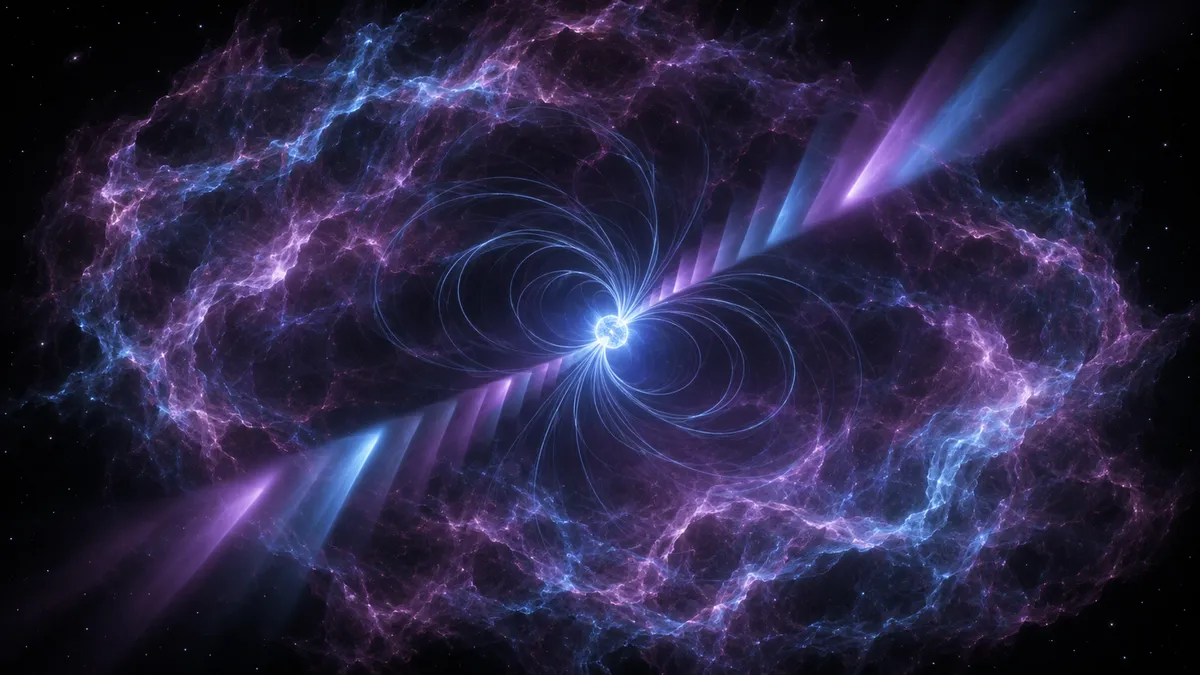
A pulsar can keep a dependable rhythm without shining at a perfectly dependable brightness. That is the distinction behind a new analysis of the Crab pulsar: its high-energy pulses appear to change in strength over time, even after researchers account for a gradual long-term decline.
The Crab contains two sources that must be distinguished: the pulsar, a rotating neutron star, and the surrounding nebula. Astronomers already know that the nebula can flare. Koothodil Abhijith Augustine and Hsiang-Kuang Chang now report evidence that the pulsar’s own pulsed emission also fluctuates. Their arXiv preprint questions the usual assumption that this emission stays steady over periods much longer than an individual rotation, apart from changes associated with aging.
The researchers examined roughly 17 years of observations from NASA’s Fermi Large Area Telescope and 13 years from NuSTAR. Fermi supplied gamma-ray measurements between 0.1 and 100 gigaelectronvolts; NuSTAR covered X-rays between 3 and 79 kiloelectronvolts. These are different energy ranges, allowing the team to ask whether variability appears in both.
Separating the pulsar from its surroundings was central to the analysis. Using radio timing records from Jodrell Bank Observatory, the authors assigned each detected photon a position within the star’s rotation. They compared intervals containing the pulses with an interval in which pulsed emission is negligible. That quieter interval provided an estimate of the nebula and other background emission, which could then be accounted for when measuring the pulsar.
For Fermi, the team analyzed 202 monthly intervals. NuSTAR’s observations were shorter and unevenly spaced, so the authors combined successive exposures into 43 measurement groups, each containing at least 5,000 seconds of exposure. They fitted models describing how the detected radiation was distributed across photon energies, including estimates of instrumental and background-related uncertainties.
The reported gamma-ray energy flux—the energy reaching a given area each second—showed monthly excursions ranging from a few percent to about 20% around its mean. A straight-line decline over time did not adequately describe the measurements. NuSTAR’s X-ray brightness also departed strongly from a simple linear trend.
The early NuSTAR observations mattered, but did not account for the entire brightness result. When the authors removed measurements taken before 2014, substantial X-ray flux variability remained. However, the corresponding test of changes in the X-ray photon index no longer showed significant departures from a linear trend. The evidence for brightness fluctuations is therefore more robust to this particular exclusion than the evidence for irregular X-ray spectral changes.
The authors also found a tendency for brighter measurements to have a harder spectrum: relatively more of the radiation appeared at higher photon energies. They measured this through the photon index, a fitted quantity describing spectral shape, with a smaller index indicating harder emission. The rank correlations were −0.35 for gamma rays and −0.63 for X-rays. This relationship is a potentially useful constraint on explanations, rather than an identification of the cause.
Several limitations qualify the interpretation. Comparing NuSTAR measurements with the corresponding Fermi month revealed no clear brightness correlation between the two bands. But a short X-ray exposure and a month-long gamma-ray average sample different time windows. Their mismatch does not establish precisely how quickly the source changes; the authors say daily Fermi measurements are insufficiently precise.
Checks comparing the fitted pulsar and nebular gamma-ray fluxes found mostly weak relationships. These support the authors’ argument against a simple contamination explanation, but do not prove perfect separation. One nebular component had a weak positive correlation with a reported p-value of 0.00657, despite being described in the paper as not significant. Weak correlation and lack of statistical significance are not interchangeable.
What might drive the changes? The authors discuss altered particle production and acceleration, changing emission efficiency, and possible magnetic rearrangements linked to superconducting and superfluid material inside the star. None is demonstrated. Their comparison with the pulsar’s rotational slowdown exposes a difficulty: changes large enough to explain the radiation could require closely coordinated changes in magnetic properties and the star’s resistance to changes in rotation.
The preprint’s main contribution is thus an observational claim, not a solved mechanism. More quantitative modeling and further monitoring are needed to explain the reported fluctuations and determine whether other pulsars behave similarly.
- Crab pulsar
- neutron stars
- Fermi LAT
- NuSTAR
- gamma rays
- X-rays
- pulsar variability
Reviewed cross-references
These connections were reviewed by a model, not independently fact-checked by a human. Similarity does not imply agreement; consult the original papers and the evidence below.
A nova’s fading visible light could guide the search for gamma rays
Shared method: The Crab study and Henry et al.'s nova study both use binned maximum-likelihood Fermi-LAT analysis with catalog sources and Galactic and isotropic diffuse backgrounds to isolate target emission. The Crab study fixes nebular and background parameters using off-pulse fits; the nova study checks whether coincident catalog sources represent the eruption and should be removed from the background model. This is a shared source-separation method, not independent support for Crab variability; the selected preprint excerpts concern different source populations, energy ranges and observing intervals.
Model review: · openai-codex/gpt-6.1-sol
Evidence and provenance
Selected excerpts, not complete papers. PDF extraction can omit figures or damage equations, tables and reading order; sources may be preprints.
2611.13391v1 — Original paper
Excerpt reference:
static/papers/2611.13391v1.md:625-681
Basis: Paper text
Source SHA-256:d3c029fa994671dbe8c597b755581ff6f9e25309d966c35ffaee7540d4ac6c932608.10388v2 — Original paper
Excerpt reference:
static/papers/2608.10388v2.md:141-186
Basis: Paper text
Source SHA-256:467360d9c058c234ea19995de93dea415f0881c9cf9d000851865dd847a557ce
Related reading
Automatically matched by shared topic keywords. These links do not imply that the sources agree or establish a consensus.
A nova’s fading visible light could guide the search for gamma rays
Source published
Shared keywords: fermi lat, gamma rays
Fermi’s unidentified gamma-ray sources yield no convincing dark matter signal
Source published
Shared keywords: fermi lat, gamma rays
What millimeter waves reveal about gamma-ray blazars
Source published
Shared keywords: fermi lat, gamma rays
Jupiter’s atmosphere offers an indirect way to study faint cosmic gamma rays
Source published
Shared keywords: gamma rays
Gamma rays reveal differences in how galaxies retain cosmic rays
Source published
Shared keywords: fermi lat