TRANSMISSION // 2611.13384v1
When “Hyperbolic” AI Geometry Behaves Almost Euclidean
Source published
Hyperbolic geometry is designed to represent hierarchies efficiently. But tests of four hyperbolic vision-language models suggest that, in their current implementations, a key geometric operation changes little—and removing it barely changes benchmark scores. Euclidean models trained with the same hierarchy objectives performed similarly. The results question how much these models use hyperbolic geometry, not whether that geometry could be useful in better-designed systems.
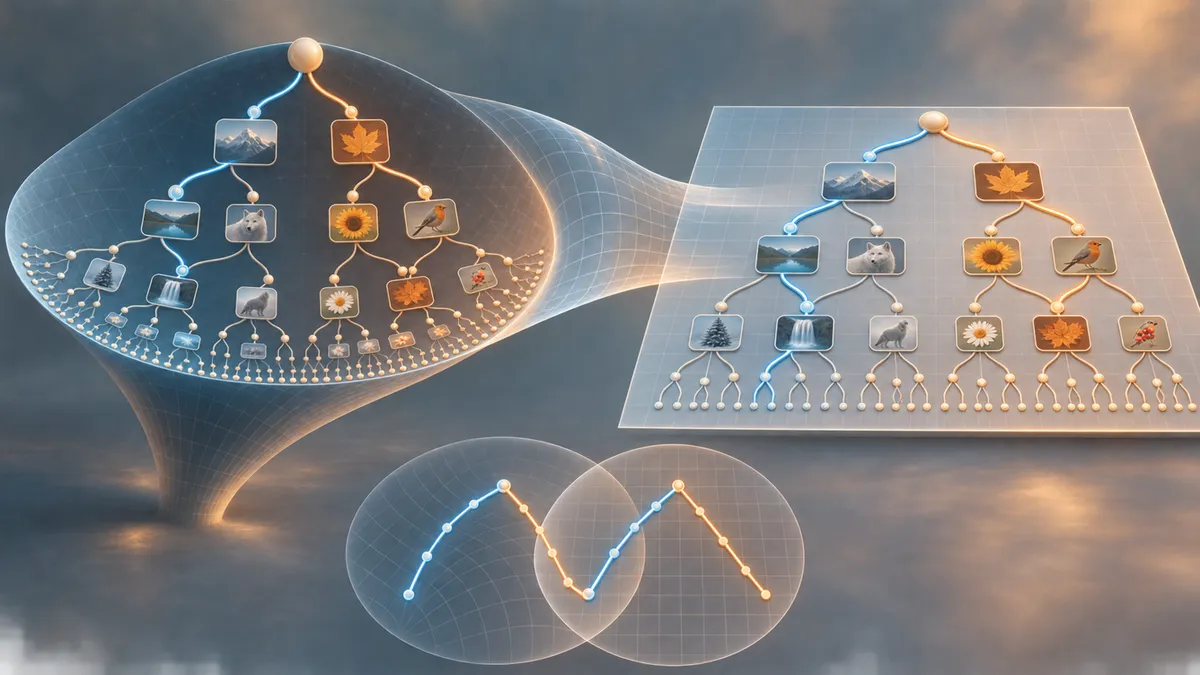
A model that learns that “animal” is broader than “dog” is learning a hierarchy. Hyperbolic geometry is often proposed as a natural way to represent such branching relationships. But does it actually shape the behavior of today’s hyperbolic vision-language models, or do they work much like Euclidean models?
Vision-language models learn to connect images with words, enabling tasks such as recognizing an image from a text description. Some newer models use hyperbolic geometry, a mathematical space whose capacity expands rapidly with distance from its center. That property can make it a good fit for hierarchies: a broad category such as “animal” can sit near the center, while narrower categories such as “dog” and “corgi” occupy more specific positions farther out.
The geometry sounds promising. Yet a model can be built using hyperbolic mathematics without making much practical use of it. Freek Byrman and colleagues ask a direct question: how much does hyperbolic geometry actually affect the behavior of current hyperbolic vision-language models?
Looking at the geometric doorway
The researchers focus on the exponential map, the step that takes a model’s ordinary, Euclidean output and places it on a hyperbolic surface. In the four model families they examine—MERU, HyCoCLIP, ARGENT and PHyCLIP—this is the point at which curvature enters an otherwise Euclidean network.
They assess how that mapping affects basic geometric relationships, including distances and angles between representations. They also run a practical check: take a trained model and remove the map at inference, when it is being used to make predictions. If the map matters substantially, benchmark performance should change.
The authors then make a second comparison. They train Euclidean versions of the models from scratch, keeping the hierarchy-related training objectives and other parts of the setup as similar as possible. The training uses the CC3M image-caption dataset, and evaluation includes zero-shot classification, image-text retrieval and hierarchical classification.
A near-identity map—and similar scores
Across the four model families, the exponential map is generally well approximated by doing nothing: measured pairwise distances and angles change little. There is a qualification for one geometric quantity, the half-aperture, in a narrow region of the box-image embeddings. The authors explain this deviation as a small difference in where the Euclidean and hyperbolic versions leave a mathematical clamp, not as a broad change in geometry.
Removing the map from trained models at inference leaves classification and retrieval scores effectively unchanged in the reported tests. The differences are small and vary in direction, rather than consistently favoring either version.
The from-scratch comparison points the same way. After the early part of training, the Euclidean controls’ training statistics become very similar to those of their hyperbolic counterparts. The final models achieve similar evaluation scores and reproduce similar patterns in how far their representations sit from the origin. That radial organization is notable because radius is intended to encode generality in these models.
The result is not that Euclidean models win. The authors stress that the scores are clustered close together. Rather, under these training conditions, the hyperbolic models appear to spend most of training in a regime where their behavior resembles the Euclidean alternative.
What the evidence does—and doesn’t—show
The study offers two complementary tests: removing the map from an already-trained model, and training a Euclidean counterpart from scratch. The first tests whether the map is needed at readout; the second asks whether the hyperbolic setup leads to meaningfully different learning dynamics or outcomes. Their agreement strengthens the case that the tested models make limited use of the distinctive geometry.
But the conclusion has boundaries. The authors train on CC3M, use two vision-transformer sizes, and report one training run per configuration. They also test particular model designs, objectives and benchmarks—not every hyperbolic learning system or every possible task. A finding that these implementations behave nearly Euclidean does not prove that hyperbolic geometry is inherently unnecessary. The authors argue that different optimization could allow it to deliver more of its theoretical promise.
The paper text identifies the work with Proceedings of Machine Learning Research and a 2026 venue, while the supplied source is an arXiv version. As with any research report, readers should check the version and publication record when assessing its status. The authors also note related concurrent work reaching a similar broad conclusion through different experiments; that is supporting context, not independent proof that every hyperbolic model has the same limitation.
For now, the paper’s practical message is a useful caution: a model’s mathematical label does not guarantee that the corresponding geometry is doing important work. The authors provide diagnostic tools and code for examining that question, and their results invite researchers to test whether new training approaches can make hyperbolic structure matter more.
- vision-language models
- hyperbolic geometry
- machine learning
- representation learning
- AI research
Related reading
Automatically matched by shared topic keywords. These links do not imply that the sources agree or establish a consensus.
VoluCompose compresses medical scans for AI while preserving benchmark performance
Source published
Shared keywords: hyperbolic geometry, vision language models
One Energy Lens for Many Kinds of Machine Learning
Source published
Shared keywords: machine learning, representation learning
VenusGenome learns from the company microbial genes keep
Source published
Shared keywords: representation learning
EEG Models May Separate People Better Than the Tasks They Perform
Source published
Shared keywords: representation learning
FlowAlign uses learned paths to align different kinds of data
Source published
Shared keywords: representation learning