TRANSMISSION // 2611.13364v1
A carbon glow offers clues to the gas around a star-shredding black hole
Source published
Astronomers report an optical carbon feature not previously identified in a tidal disruption event. Its proposed explanation points to dense gas illuminated by extreme-ultraviolet radiation, but detailed modeling is still needed.
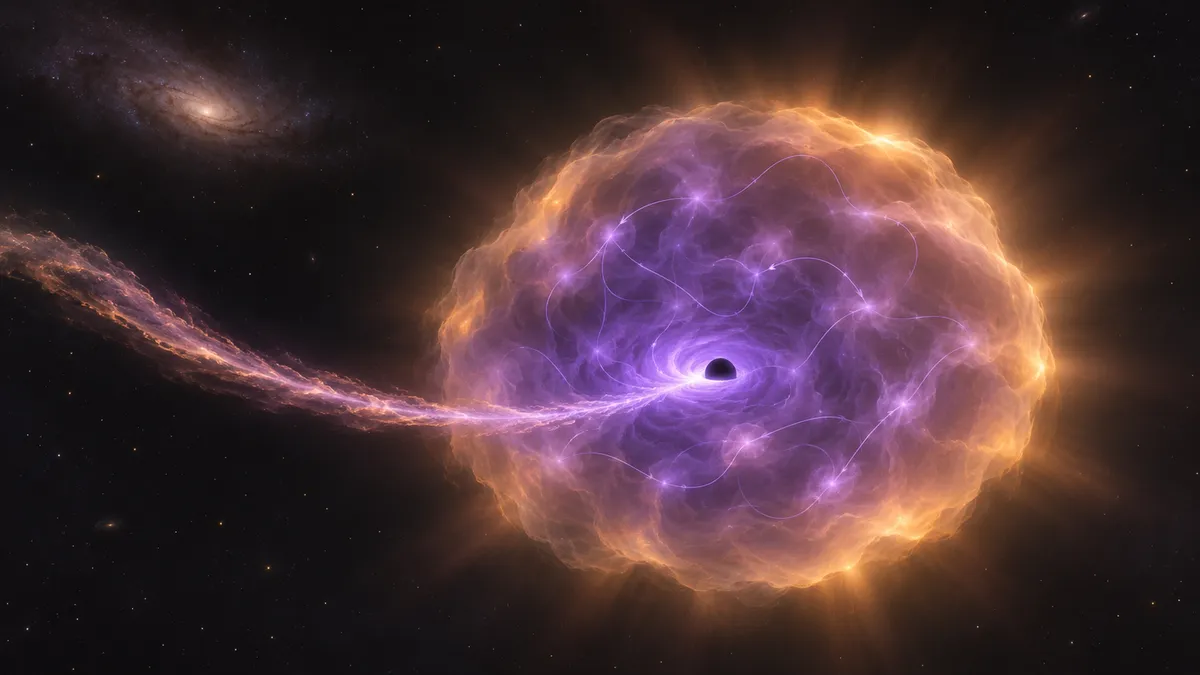
When a black hole tears apart a star, the resulting light must pass through the surrounding debris before reaching us. An unusual carbon signature in TDE 2025abcr could help reveal how that debris absorbs and redistributes the flare’s energy.
A faint feature in the spectrum of a shredded star may offer a new way to investigate the gas surrounding a feeding black hole. In an arXiv preprint, Jingbo Sun and colleagues report what they describe as the first identification of the optical C IV doublet at wavelengths of 5801 and 5812 angstroms in a tidal disruption event. Their interpretation favors a compact, dense envelope illuminated by energetic radiation, rather than an unusually carbon-rich disrupted star.
The event, TDE 2025abcr, lies about 9.3 kiloparsecs in projected distance from its host galaxy’s center. That separation matters observationally: relatively little background starlight contaminates the flare, making its emission features easier to examine. The distance is a separation on the sky, not a measurement of its full three-dimensional position.
Identifying the carbon signature
A tidal disruption event occurs when a star passes close enough to a massive black hole for tidal forces to tear it apart. Returning stellar debris can power a luminous flare. Its spectrum contains information about the material producing and processing that radiation.
The researchers obtained six epochs of spectroscopy with the Very Large Telescope and an additional spectrum with the Nordic Optical Telescope. They also analyzed previously published spectra and assembled optical and ultraviolet brightness measurements from several observatories.
Their central finding is an emission feature near 5805 angstroms, consistent with the blended pair of transitions from triply ionized carbon, denoted C IV. The two carbon lines are not presented as separately resolved peaks. Instead, the blended feature has a peak distinct from neighboring helium emission at 5876 angstroms.
Alternative identifications would require substantial wavelength shifts. Calling it helium would require a blueshift of roughly 3,600 kilometers per second; identifying it as a nitrogen line would require a redshift of about 2,600 kilometers per second. Other measured lines do not show comparable offsets. Together, the wavelength agreement and the separate helium peak favor carbon.
To track the emission, the team subtracted a modeled local continuum and fitted overlapping line profiles simultaneously. The carbon feature and other prominent lines generally weakened and narrowed as the flare faded. Helium and nitrogen line widths fell from around 4,000–5,000 kilometers per second near maximum brightness to about 2,000 kilometers per second in the final spectrum.
How trapped radiation could produce visible light
Identifying an element does not immediately explain why it shines. One possibility is recombination: ions capture electrons, which then cascade through atomic energy levels and emit photons. But the authors argue that explaining the observed carbon-to-helium line ratio through recombination alone would require substantial carbon enrichment. They consider the corresponding carbon-rich stellar progenitors unlikely in this event’s quiescent, early-type host galaxy.
Their preferred explanation combines continuum fluorescence with photon trapping, a mechanism studied in the winds of nitrogen-sequence Wolf–Rayet stars.
First, energetic photons produce triply ionized carbon. Extreme-ultraviolet photons near 312 angstroms then excite those ions. The ions usually release that energy through the same ultraviolet transition. If the gas is sufficiently opaque at that wavelength, however, the emitted photons are repeatedly absorbed and re-emitted rather than escaping directly.
Those repeated interactions provide more opportunities for an alternative atomic transition that produces the visible carbon doublet. In this picture, the optical feature records the conversion of extreme-ultraviolet radiation into longer-wavelength light. Its strength need not simply indicate an abundance of carbon.
The proposed mechanism requires strong extreme-ultraviolet illumination and high opacity in the relevant carbon transition. That opacity is distinct from electron scattering, which can broaden emission lines. The authors interpret the relatively narrow broad lines as evidence for only modest electron-scattering opacity above the line-forming region.
A physical clue, not a completed model
Other observations support the compact-envelope interpretation. Blackbody fits give an emitting radius of roughly 100 trillion centimeters, while nitrogen and oxygen fluorescence features independently indicate extreme-ultraviolet illumination. High-cadence monitoring found no significant hour-scale optical variability, but that nondetection does not independently determine the black hole’s mass.
The researchers also explored gas density and illumination using the CLOUDY photoionization code. These calculations qualitatively favor dense gas exposed to strong extreme-ultraviolet radiation. They do not measure the event’s envelope structure: the prescribed, static gas layer does not self-consistently reproduce an optically thick, moving outflow and its repeated scattering and radiation reprocessing.
The continuum interpretation also remains imperfect, with red optical bands exceeding predictions from a simple single-temperature model. The preprint’s proposed excitation mechanism therefore needs more complete radiative-transfer calculations and contemporaneous ultraviolet spectra. A larger sample could establish whether optical carbon emission consistently accompanies compact photospheres—or whether this event represents only one route to producing the feature.
- tidal disruption events
- TDE 2025abcr
- black holes
- carbon emission
- spectroscopy
- continuum fluorescence
- photon trapping
Related reading
Automatically matched by shared topic keywords. These links do not imply that the sources agree or establish a consensus.
Gas disks could steer stars into growing black holes
Source published
Shared keywords: tidal disruption events
Ansky’s galaxy shows signs of black-hole activity before its 2019 brightening
Source published
Shared keywords: tidal disruption events
What dead stars reveal about matter, gravity and the early Universe
Source published
Shared keywords: black holes
Magnetic disturbances could reshape polarized light around black holes
Source published
Shared keywords: black holes
Neutron star binaries may get their chance after a cluster’s black holes leave
Source published
Shared keywords: black holes