TRANSMISSION // 2611.13350v1
Do gamma-ray bursts have two kinds of X-ray encore?
Source published
An analysis of 97 X-ray flares finds an early, narrow majority and a later, broader minority. The preprint favors prolonged activity near the burst’s central engine, but does not establish what powers either group.
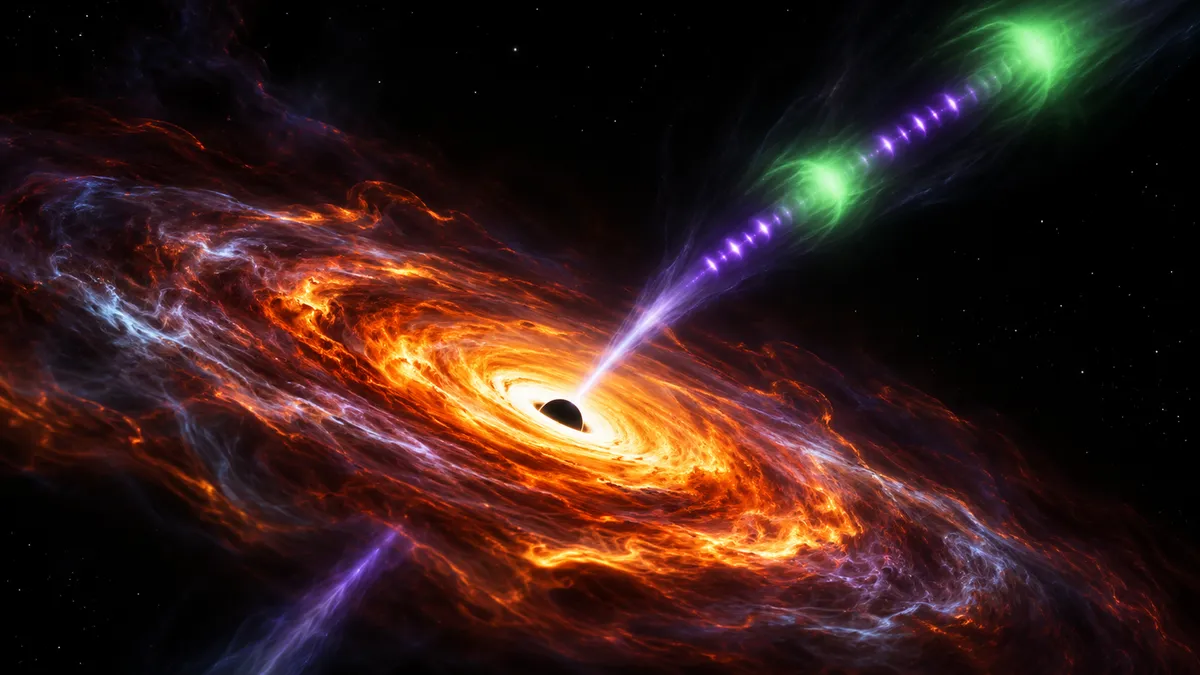
After a gamma-ray burst’s initial flash, its X-ray afterglow can brighten again in sudden flares. Are these outbursts echoes of an explosion interacting with its surroundings, or signs that its central engine is still working? A new analysis suggests that the flares themselves may fall into two distinct timing regimes—offering a sharper question for models to answer.
Sorting the encores
In a preprint posted to arXiv on November 9, 2026, H. Dereli-Bégué and A. Pe’er investigate whether X-ray flares form one continuously changing population or separate statistical groups. The manuscript is listed as submitted to The Astrophysical Journal; its conclusions should be read as preprint findings rather than settled results.
The researchers revisit measurements from their earlier studies of Swift gamma-ray bursts. Their starting sample contained 100 bursts with known redshifts. Eleven were excluded because extremely broad fitted flares prevented an unambiguous separation of flare and afterglow emission. Of the remaining 89 bursts, 61 contained flares: 25 had one and 36 had two, providing 97 flares altogether.
Those measurements came from fitting the flares and underlying afterglow simultaneously. The flare model describes an asymmetric pulse, allowing its peak time, width, rise, decay and energy to be estimated.
For the new classification, the authors corrected times for cosmological time dilation, expressing them in the bursts’ rest frames. They then applied a Gaussian mixture model to the logarithms of peak time and width. This statistical method describes the distribution as overlapping components rather than imposing a single early-versus-late cutoff. Model-selection criteria favored adopting two components.
Early and narrow, late and wide
The larger group contains 78 flares, about 80% of the sample. Its characteristic peak time is roughly 100 seconds after the burst. The smaller group contains 19 flares, with characteristic peaks around 3,100 seconds—about 52 minutes.
Their durations differ relative to those peak times, too. The characteristic width-to-peak-time ratio is about 0.76 for early–narrow flares and 2.04 for late–wide flares. These are overlapping distributions, not rigid rules that every flare obeys.
The split is not simply a distinction between first and second outbursts. Among single or first flares, 55 belong to the early–narrow group and six to the late–wide group. Second flares are more likely to be late and wide, but most—23 of 36—still belong to the early–narrow group.
Within the early–narrow group, later flares tend to be wider, with an approximately proportional relationship between width and peak time. The late–wide group shows a less certain relationship: its correlation narrowly misses the authors’ statistical-significance threshold. That is not proof that no relationship exists, especially with only 19 events.
Longer does not necessarily mean more energetic
Despite their different durations, the groups do not show a statistically significant difference in their isotropic-equivalent energy distributions. Neither group shows a significant correlation between flare width and energy.
Average luminosity tells a different story. Defined here as flare energy divided by width, it declines significantly with peak time among early–narrow flares. The late–wide group’s luminosity trend is poorly constrained and not statistically significant. Crucially, this average luminosity is not the instantaneous peak luminosity or the jet’s power, so comparisons with accretion-model predictions remain indirect.
The intervals between flare peaks also differ. Among usable two-flare bursts, the characteristic interval is about 76 seconds when the second flare is early–narrow, versus approximately 2,950 seconds when it is late–wide. Two cases with reversed fitted peak ordering were excluded. These waiting times are not independent evidence of the split: they partly depend on the peak times already used to classify the flares.
A central engine still at work?
The authors favor prolonged, accretion-powered central-engine activity: material continues feeding the newly formed compact object, producing intermittent emission. The two groups might represent different stages of that process rather than different physical mechanisms. Connections to material falling back from different stellar layers are illustrative and explicitly speculative.
External-shock explanations are not eliminated. Many flares satisfy timing and brightness constraints that permit variability from the outflow’s interaction with its surroundings. The authors’ preference for an internal origin rests on the broader combination of temporal properties and earlier findings that flare properties depend little on whether the afterglow has an X-ray plateau.
The remaining uncertainties matter. Broad-flare measurements depend on separating flares from afterglow emission, the latest group is small, and observational selection could influence the apparent differences. Statistical clusters alone do not identify their physical cause. Independent samples will be needed to establish whether these two timing regimes are a recurring feature of gamma-ray bursts.
- gamma-ray bursts
- X-ray flares
- Swift
- astrophysics
- accretion
- central engines
- preprint
Related reading
Automatically matched by shared topic keywords. These links do not imply that the sources agree or establish a consensus.
Could a magnetar power GRB 241030A’s early X-rays?
Source published
Shared keywords: gamma ray bursts
Fading X-rays connect merger-driven gamma-ray bursts to their opening flash
Source published
Shared keywords: gamma ray bursts
Early X-rays may help reveal what powers gamma-ray bursts
Source published
Shared keywords: gamma ray bursts
Reshaping telescope grids could widen the search for gamma-ray bursts
Source published
Shared keywords: gamma ray bursts
A narrow black-hole jet could explain a seven-hour gamma-ray burst
Source published
Shared keywords: gamma ray bursts