TRANSMISSION // 2611.13343v1
A giant planet’s fading transits point to an unseen companion
Source published
Seven years of TESS observations show TOI-2535 b’s transits shrinking and then disappearing. An arXiv preprint attributes the change to gravitational interactions with a nearby planet, whose orbit and mass remain uncertain.
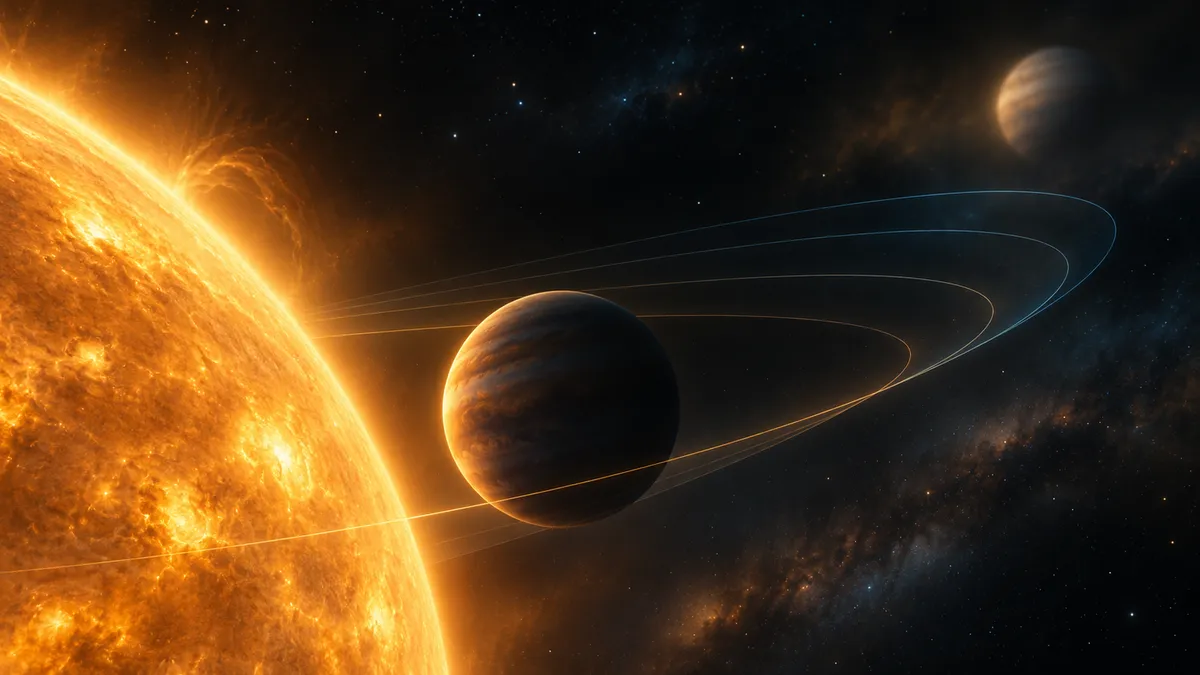
TOI-2535 b has not vanished. Instead, its orbit appears to have shifted out of the alignment that once carried it across its star’s face as seen from Earth. Astronomers report watching those crossings become shorter and shallower before disappearing from the latest TESS observations—a change that points to an unseen planetary neighbor.
In a November 9, 2026 arXiv preprint, Samuel W. Yee and colleagues report what they identify as the first confirmed planet orbiting a single star whose transits have been directly observed to disappear. The distinction matters: changing transit visibility is already known for planets orbiting two stars, where the geometry is more complicated.
TOI-2535 b is a hot Jupiter, a giant planet on a close-in orbit. It circles an old K-dwarf star somewhat smaller and less massive than the Sun roughly every 8.236 days. Its disappearance concerns the dips in starlight it produces during transits, not the planet’s physical survival.
Watching the crossings shrink
NASA’s Transiting Exoplanet Survey Satellite, TESS, observed the system during five observing intervals between April 2019 and March 2026. Ground-based telescopes supplied additional transit measurements.
The changes were not simply a matter of missed appointments. Individual crossings occurred as much as six hours early or late relative to a regular orbital timetable. Their shapes also evolved, eventually becoming grazing events near the star’s apparent edge.
The researchers fitted each observed crossing to measure its timing and impact parameter—the projected separation between the planet’s center and the star’s center at mid-transit, expressed in stellar radii. Their linear model found this parameter changing by 0.16 ± 0.01 per year. It favors a transit chord that moved from one stellar hemisphere to the other before leaving the apparent disk. The observations cannot distinguish the corresponding mirror-image configurations.
Ground-based imaging and spectroscopy helped establish that the original dips belonged to a real planet orbiting the target star, rather than eclipses involving a neighboring or unresolved stellar system. Measurements of the star’s motion also supported the planetary interpretation, although the system’s complexity prevents a unique mass measurement for TOI-2535 b.
Testing the missing signal
In the final TESS interval, Sector 101, the team found no significant transit signal. Because earlier crossings had large timing shifts, the researchers searched a window extending 12 hours either side of the time predicted by a regular orbital timetable.
They calibrated the search against 20,000 synthetic datasets assembled from blocks of the real observations, preserving short-timescale noise. The strongest candidate signal in the actual search window fell below their detection threshold.
They also inserted artificial transits into the observations to determine what could have been recovered. At an impact parameter of 0.991, the recovery probability was about 50 percent. The non-detection therefore supports the disappearance interpretation without establishing that every possible faint, grazing crossing was absent.
A neighboring planet could turn the orbital plane
The favored explanation is nodal precession: the orientation of the planet’s orbital plane turns under another planet’s gravitational influence. This changes the viewing geometry without removing the planet from its orbit.
To investigate, the team explored approximately 300,000 starting configurations for two interacting planets, comparing simulated transit times, transit shapes and stellar motions with the observations.
The data did not select a unique companion. Longer simulations helped narrow the possibilities: about two-thirds of the 100 best-fitting configurations became unstable within one million simulated years. Among the configurations explored, all those that survived these integrations were in orbital resonances. The authors favor 2:1 or 3:2 arrangements, corresponding approximately to two circuits of the inner planet for one of the outer planet, or three for two.
The modeling generally favors a companion around Saturn’s mass or greater, although viable representative solutions include lower masses. The researchers found no configurations with mutual orbital inclinations below about five degrees that could explain the observed transit-duration changes. These are conclusions from a non-exhaustive model search, not independently established measurements of the companion’s properties.
What remains unresolved
Sparse observations leave several architectures viable, including companions inside or outside TOI-2535 b’s orbit. One particularly good fit predicts transits of the companion that were not observed, allowing that specific solution to be rejected without excluding other solutions near the same resonance.
Even the best-fitting models leave timing residuals of up to ten minutes and substantial unexplained stellar-velocity scatter. The authors discuss unresolved timing signals, underestimated measurement uncertainties and additional planets as possible explanations.
With TOI-2535 b no longer providing detectable crossings, the researchers propose frequent measurements of the star’s motion as the best next step. Those observations could identify the perturbing companion and help clarify how nearby giant planets acquired their tilted orbital arrangement.
- TOI-2535 b
- TESS
- exoplanets
- hot Jupiter
- transit duration variations
- orbital precession
- planetary resonance
Reviewed cross-references
These connections were reviewed by a model, not independently fact-checked by a human. Similarity does not imply agreement; consult the original papers and the evidence below.
A 44-second timing wobble hints at a hidden planet beside TOI-2109 b
Shared method: Yee et al. and Parthasarathy et al. use two-planet N-body modeling of transit-timing variations to constrain nearby giant planetary companions near mean-motion resonances. The TOI-2535 analysis also uses transit-duration variations and radial velocities and explores inclined architectures, whereas the TOI-2109 timing analysis assumes circular, coplanar orbits and favors a still-unconfirmed companion near 7:3 resonance. This is a methodological connection between the supplied draft excerpts, not independent confirmation of either system's inferred companion.
Model review: · openai-codex/gpt-6.1-sol
Evidence and provenance
Selected excerpts, not complete papers. PDF extraction can omit figures or damage equations, tables and reading order; sources may be preprints.
2611.13343v1 — Original paper
Excerpt reference:
static/papers/2611.13343v1.md:44-99
Basis: Paper text
Source SHA-256:22b3866e94552cac999659df6c675031d159ca4508aa92848a0de47bcdb988432611.13343v1 — Original paper
Excerpt reference:
static/papers/2611.13343v1.md:2775-2846
Basis: Paper text
Source SHA-256:22b3866e94552cac999659df6c675031d159ca4508aa92848a0de47bcdb988432611.13505v1 — Original paper
Excerpt reference:
static/papers/2611.13505v1.md:52-116
Basis: Paper text
Source SHA-256:4accc24a1bd765b94135061fee42bdb20cda625efa0a6ddaf4aaf53798f24f162611.13505v1 — Original paper
Excerpt reference:
static/papers/2611.13505v1.md:1517-1627
Basis: Paper text
Source SHA-256:4accc24a1bd765b94135061fee42bdb20cda625efa0a6ddaf4aaf53798f24f16