TRANSMISSION // 2611.13260v1
A longer look at weather on brown dwarfs
Source published
A preprint proposes roughly 1,500 hours of JWST observations to compare brown dwarf weather across rotation rates, temperatures and viewing angles—and track how it changes.
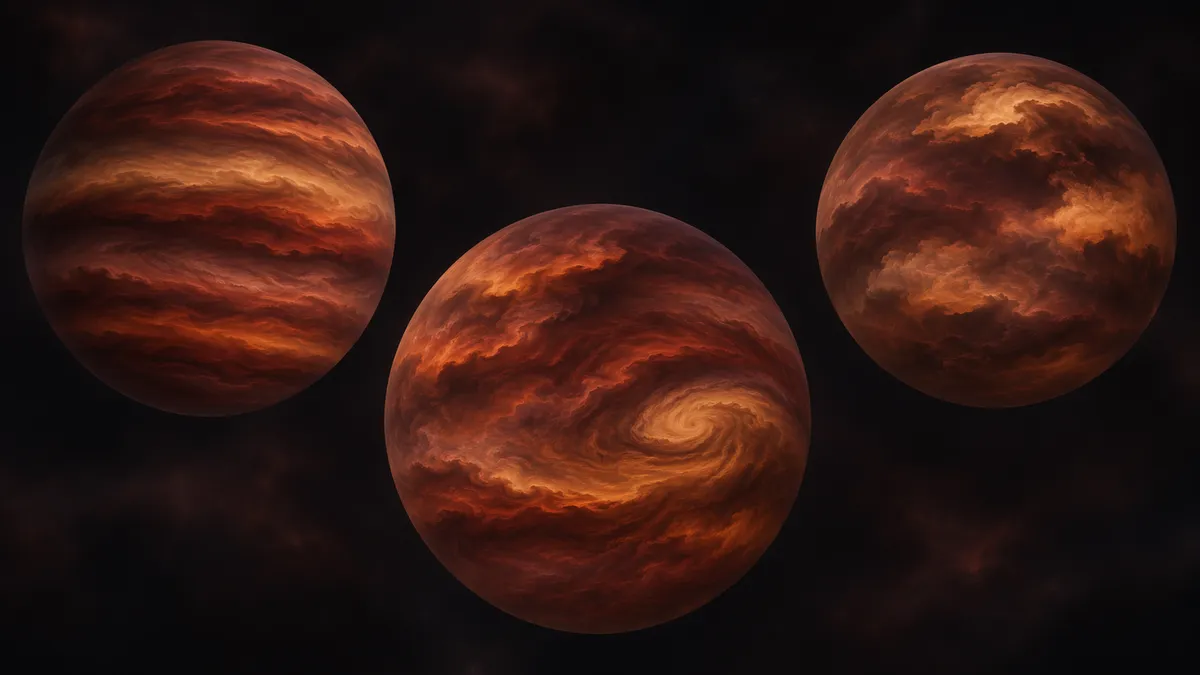
A changing infrared glow can reveal weather on a world too distant to resolve. But does that signal come from clouds, temperature differences, chemistry or the angle of view? A proposed JWST survey would tackle those possibilities together.
What can astronomers learn about weather when they cannot see individual clouds? For brown dwarfs, the answer comes partly from watching infrared light change as the objects rotate. Different wavelengths carry information about different atmospheric pressures, molecules and clouds. Recording those wavelengths repeatedly offers clues to atmospheric structure and evolution.
A November 2026 preprint led by Natalia Oliveros-Gomez, with coauthors including Genaro Suárez, proposes turning that approach into a coordinated James Webb Space Telescope survey. The authors envision roughly 1,500 observing hours spread across multiple observing cycles. This is a proposal, not a report of a completed survey: its central contribution is an observing strategy for answering questions that existing observations leave unresolved.
More than patchy clouds
Uneven cloud cover is one explanation for changing brightness. As an object rotates, regions with different cloud properties move into and out of view. But the research reviewed in the preprint suggests that clouds alone cannot always explain the observed wavelength-dependent changes.
Temperature differences and chemical processes may also contribute. Previous analyses of the brown dwarf SIMP 0136, for example, have identified different variability patterns in spectral regions sensitive to clouds, molecules and atmospheric depth. Analyses that separate a changing spectrum into its main patterns have implicated temperature variations and changes in the clouds’ vertical structure.
These are findings from earlier studies discussed in the proposal, not new measurements made by the proposed survey. They motivate its main question: how can astronomers distinguish several atmospheric processes that may affect the same unresolved signal?
Rotation and perspective complicate the picture
The authors argue that answering that question requires looking beyond a few well-studied objects. Existing JWST programs use different instruments, wavelength ranges and observation lengths, making direct comparisons difficult. Early-L dwarfs and the coldest T/Y dwarfs remain particularly underexplored in time-resolved spectroscopy.
The proposed sample would span the L, T and Y spectral classes, covering warmer, cloud-dominated atmospheres through colder, more giant-planet-like conditions. It would deliberately include fast, intermediate and slow rotators rather than simply maximize the number of targets.
Viewing angle matters too. Studies reviewed in the paper find that objects seen closer to equator-on tend to show larger near-infrared brightness changes, redder colors and stronger silicate absorption than those seen closer to pole-on. However, those trends come from relatively small, heterogeneous samples. Differences in atmospheric properties can be difficult to separate from differences in perspective.
The survey would therefore include a subset with independently constrained orientations. It would not require an inclination measurement for every target. Comparisons could test whether apparent differences reflect genuinely different atmospheric structures or how those structures are presented to the observer.
Watching more than one turn
The core observations would use JWST’s Near-Infrared Spectrograph, NIRSpec, in its PRISM mode to collect spectra repeatedly. Each visit would aim to cover two rotations. That baseline could help distinguish a repeating rotational pattern from features that evolve during the observation, while improving uncertain rotation-period estimates.
Complementary observations with the Mid-Infrared Instrument, MIRI, would examine additional atmospheric signatures. These include silicate absorption around 7–11 micrometers in cloudy L dwarfs. Selected objects near the L/T transition would receive MIRI time series to investigate changes in cloud-sensitive features during rotation.
An important limitation is that NIRSpec and MIRI would observe sequentially, not simultaneously. Their wavelength coverage would be complementary, but a changing atmosphere could complicate comparisons between measurements taken at different times.
Approximately half the sample would be observed at three epochs: initially, several months later, and more than a year after the first visit. Earlier observations reviewed by the authors show why both short and long baselines matter. WISE 1049B has shown changing brightness patterns over seven months, while Ross 458c has shown similar patterns across more than seven years. The mechanisms governing such persistence or change remain uncertain.
A shared benchmark, not a guaranteed explanation
For an illustrative sample of 30 objects with an average nine-hour rotation period, the initial two-rotation NIRSpec observations would require about 540 hours. Revisiting half the sample twice would add another 540 hours. Mid-infrared observations and operational overheads bring the preliminary total to roughly 1,500 hours; the final requirement would depend on target properties and observing feasibility.
The intended legacy is uniformly processed spectra, brightness histories and variability measurements that researchers could compare with three-dimensional atmospheric models. Such a dataset could also inform interpretations of directly imaged giant exoplanets. Its promise is a more consistent test of competing explanations—not an assurance that clouds, chemistry, temperature and viewing geometry will become uniquely separable.
- brown dwarfs
- JWST
- atmospheric variability
- substellar weather
- infrared spectroscopy
- clouds
- rotation
- viewing geometry
Related reading
Automatically matched by shared topic keywords. These links do not imply that the sources agree or establish a consensus.
Webb detects a long-sought rotational signal from a key interstellar ion
Source published
Shared keywords: infrared spectroscopy
Measuring the stars behind JWST’s planet spectra
Source published
Shared keywords: infrared spectroscopy
Webb traces free-floating carbon cages around Tc 1
Source published
Shared keywords: infrared spectroscopy
Teaching AI to account for uncertain molecular physics in brown-dwarf atmospheres
Source published
Shared keywords: brown dwarfs
Webb separates the dust signals around Tc 1’s carbon cages
Source published
Shared keywords: infrared spectroscopy