TRANSMISSION // 2611.13257v1
Modeling Webb’s starlight reveals a planet signal hidden in the glare
Source published
A preprint reports improved sensitivity in existing Webb observations by fitting a flexible physical model of the telescope’s starlight. The method recovers the known planet 51 Eridani b at 4.3 micrometers, but does not yet reach the fundamental noise limit.
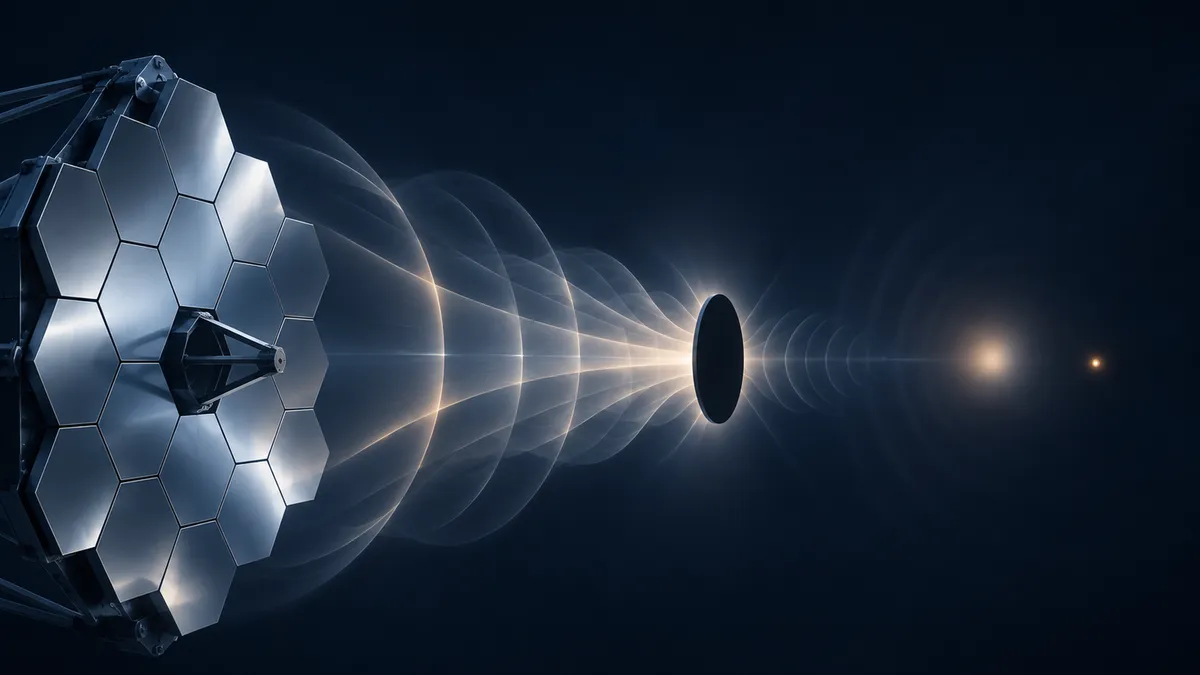
Small changes in a telescope can leave enough residual starlight to conceal a planet. A new method adjusts a physical model to those changes, rather than relying only on reference images that may no longer match.
How do you subtract a star without subtracting its planet? That question sits at the center of direct exoplanet imaging. Even bright young giant planets can be roughly 100,000 times fainter than their stars in near-infrared light. A coronagraph suppresses the star, but processing must remove the glare that remains.
In a preprint posted on November 9, 2026, Rodrigo Ferrer-Chavez and colleagues present Physics-based Learning for Imaging Planets, or FLIP. Reprocessing existing James Webb Space Telescope observations, they report sensitivity improvements reaching a factor of 15 in selected conditions compared with a standard method. They also recover the known giant planet 51 Eridani b at 4.3 micrometers, where the earlier analysis had not detected it. These are preprint findings, not a demonstration of imaging Earth-like planets.
Why reference images fall short
A telescope spreads a star’s light into a pattern called its point-spread function, or PSF. Standard subtraction methods estimate this pattern using reference observations, such as images of another star. The comparison method here, KLIP, builds its estimate from patterns extracted from a reference library.
The difficulty is that the telescope changes. Small pointing errors alter the star’s alignment behind the coronagraph, while thermal changes affect the optical wavefront—the pattern of light passing through the instrument. A reference image can therefore leave residual glare when subtracted from the science observation.
FLIP still uses a reference star, but differently. It first calibrates a physical model against that observation, then adjusts the model to match the science image itself. The aim is to account for changes between observations rather than accept the reference library’s limits.
Fitting the instrument without erasing the planet
The model starts from STPSF, established software for simulating Webb’s optics, and incorporates wavefront measurements. It allows adjustments to stellar brightness and position, optical aberrations before and after the coronagraph’s focal-plane mask, and individual detector-pixel responses.
The researchers implemented the model in PyTorch. Automatic differentiation calculates how changes in the parameters affect the simulated image, making optimization of roughly a million free parameters practical. This is a physical-model fitting procedure, not an image generator inventing a planet’s appearance.
Flexibility brings a risk: the model can mistakenly absorb real planet light into its estimate of the star. FLIP therefore calibrates its full model on a reference observation before adjusting fewer parameters on the science target.
The team also adds simulated planets to the observed images and tracks their recovery during optimization. Fitting stops when their signal-to-noise ratios peak or level off, before continued adjustment removes more of their light. Injection-and-recovery tests also estimate signal losses and calibrate detection sensitivity. These safeguards reduce overfitting; they do not eliminate it.
What the observations showed
The study covers four datasets from three stellar systems: HIP 65426, 51 Eridani in two filters, and TYC 5899. Together they span different stellar types, filters, coronagraph masks and reference-observation strategies.
For HIP 65426 b, FLIP improved the measured signal-to-noise ratio by about 1.6 times. For 51 Eridani b in the F410M filter, the improvement was about 2.1 times. In F430M, near 4.3 micrometers, the planet appeared with a signal-to-noise ratio of 6.3. That ratio is not itself a Gaussian detection significance; the paper separately accounts for small-sample statistics.
The wavelength matters because carbon dioxide absorbs near 4.3 micrometers. However, this study does not deliver a new atmospheric composition measurement. The authors leave calibrated planet-brightness measurements and atmospheric interpretation to future work.
TYC 5899 has no known planetary companion in this analysis. Its planet signals were injected for testing, not newly discovered worlds. Its science observation was taken four months after the reference observations, providing a test of compensation for longer-term instrument drift.
Where the gains stop
The improvements are not uniform across the image. At larger separations in the TYC 5899 dataset, FLIP sometimes loses more planet signal than KLIP and performs worse. Nor does FLIP reach the fundamental noise limit in any dataset tested.
Its fitted parameters are effective descriptions, not yet calibrated measurements of the telescope’s true physical state. Bright neighboring objects can be distorted, detector modeling needs improvement, and ground-based applications face much faster atmospheric changes. The comparison also uses one telescope orientation per dataset for FLIP, versus two combined orientations for KLIP.
The result supports a narrower but useful conclusion: better physical modeling can recover planetary signals hidden by imperfect starlight subtraction in existing Webb data. Whether it can ease the extreme stability requirements of future Earth-imaging observatories remains an open question.
- exoplanets
- James Webb Space Telescope
- coronagraphy
- starlight subtraction
- 51 Eridani b
- automatic differentiation
Related reading
Automatically matched by shared topic keywords. These links do not imply that the sources agree or establish a consensus.
Webb finds no confirmed planets around Altair—but leaves room for hidden worlds
Source published
Shared keywords: james webb space telescope
A proposed Webb survey would map dust, ice and shadows in planet-forming disks
Source published
Shared keywords: james webb space telescope
VENUS maps 60 galaxy clusters that magnify the distant universe
Source published
Shared keywords: james webb space telescope
Early Galaxies Narrow a Search for Neutrino Interactions
Source published
Shared keywords: james webb space telescope
Webb separates the dust signals around Tc 1’s carbon cages
Source published
Shared keywords: james webb space telescope