TRANSMISSION // 2611.13225v1
Slow-spinning galaxies offer clues to the growth of cosmic giants
Source published
A study of 218 galaxies identifies 17 slow rotators whose masses, sizes and stellar histories fit a possible route to today’s largest slow-rotating galaxies: growth through gas-poor mergers. Selection biases and uncertain timing prevent a definitive evolutionary reconstruction.
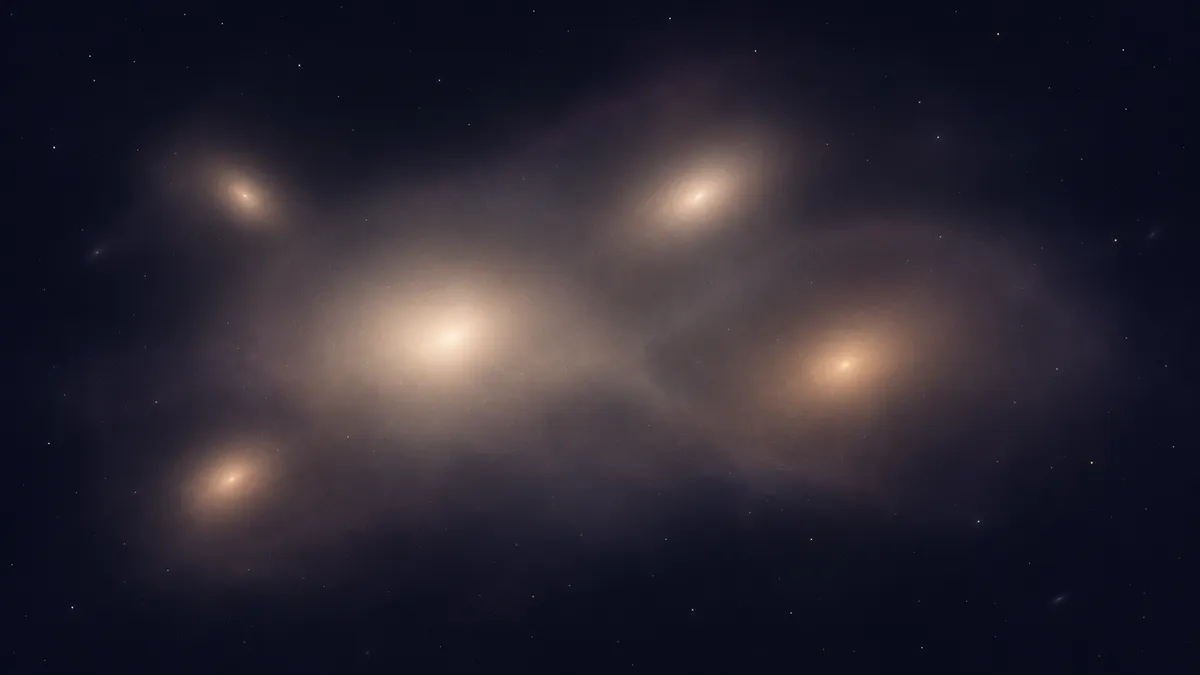
How do galaxies become enormous without making many new stars? Observations of stellar motion suggest that some slow-rotating galaxies were already in place billions of years ago—and could have grown further by absorbing other galaxies.
A galaxy can contain rapidly moving stars yet show little overall rotation. Instead of following predominantly ordered paths around a shared axis, its stars can occupy a mixture of orbits. Understanding how these “slow rotators” form matters because they include some of the most massive galaxies in the nearby Universe.
In a study available on arXiv, C. Muñoz López and colleagues examine 218 galaxies and identify 17 slow rotators. Their properties support a possible connection to today’s largest slow-rotating galaxies, with subsequent growth through mergers involving little gas. The evidence establishes compatibility with that history, not a direct record of the mergers.
The source is an arXiv preprint version; its manuscript also records acceptance by Astronomy & Astrophysics on 4 November 2026.
Measuring motion across a galaxy
The team used observations from MUSE, a spectrograph on the Very Large Telescope. Unlike a single spectrum combining an entire galaxy’s light, these observations provide spectra across its image. Shifts and broadening in stellar absorption features reveal both average motion toward or away from us and the spread of stellar velocities.
The sample spans approximately redshift 0.1 to 1, covering more than six billion years of cosmic history. Redshift measures how much cosmic expansion has stretched light; higher values here mean observing galaxies at earlier times. The galaxies range from roughly 100 million to one trillion solar masses in stars and include both star-forming and largely inactive systems. The work adds spin measurements for 113 galaxies in the group-targeting MAGIC survey to measurements from earlier studies.
The researchers combined their velocity maps into a quantity called λR, a light-weighted proxy for stellar angular momentum. Higher values indicate stronger ordered rotation relative to the spread of velocities. Classification also accounts for apparent flattening: a low projected rotation signal alone does not establish that a galaxy is intrinsically a slow rotator.
Atmospheric blurring can weaken the measured rotation pattern. The team corrected for this where possible, but nine galaxies retained uncorrected measurements treated as lower limits.
A population already present
Slow rotators account for about 8% of the complete sample. The authors identify one at redshift 0.943, which they describe as the highest-redshift formally classified slow rotator then known. That is a statement about available observations, not the epoch when such galaxies first formed.
Comparisons restricted to galaxies with at least ten billion solar masses in stars give slow-rotator fractions of roughly 12% nearby, 10% around redshift 0.3 and 16% above redshift 0.6. The authors find no significant evidence for evolution in those fractions. But these are differently selected samples, not an unbiased census followed through time.
Environment is particularly important. Fourteen of the 17 slow rotators inhabit rich groups with more than ten members. At redshifts above 0.6, the observations suggest that low rotation is associated with dense environments. However, MAGIC deliberately targeted galaxy groups, and stellar mass also varies with environment. The results do not isolate a causal effect of crowding.
Old stars do not date the loss of spin
By fitting mixtures of stellar populations to the spectra, the researchers reconstructed star-formation histories. Most slow rotators appear to have formed their stars in one or two main episodes. Across the sample, more episodes tentatively accompany higher spin, but the scatter is large.
Those histories cannot establish when ordered rotation was lost. Most slow rotators are currently quenched, meaning they form few new stars, but the detailed discussion identifies three with ongoing star formation. Slow rotation and quenching are therefore not interchangeable states.
The source also gives inconsistent summaries of when star-forming mass assembly ended. Its abstract places completion around redshift 1, whereas the detailed results say only about half had finished by then and place completion for the population around redshift 0.3, with exceptions. A single firm cutoff is not justified.
Growing without a new stellar generation
The proposed evolutionary link comes from comparing stellar mass and size with nearby galaxies. The intermediate-redshift slow rotators are generally smaller and less massive than the most massive local examples. Gas-poor, or “dry,” mergers could add existing stars and enlarge them without substantial new star formation. Their positions in the mass–size diagram are consistent with that route.
Important limits remain. Brightness and spatial-resolution requirements favor bright, massive, sufficiently extended galaxies at greater distances. Missing populations complicate comparisons of spin distributions and averages. This account uses the supplied PDF text extraction, which omits figure images and may damage equations, tables and layout; it does not independently inspect the underlying observations. The defensible conclusion is a plausible growth pathway, not proof that these particular galaxies became today’s giants.
- galaxy evolution
- slow rotators
- stellar kinematics
- MUSE
- dry mergers
- galaxy groups
Related reading
Automatically matched by shared topic keywords. These links do not imply that the sources agree or establish a consensus.
How Earth's sky can distort a galaxy's stellar history
Source published
Shared keywords: galaxy evolution
Gas stripping leaves galaxy discs’ stellar spin largely intact
Source published
Shared keywords: galaxy evolution
Separating faint light between galaxies from telescope-scattered glow
Source published
Shared keywords: galaxy groups
A proposed deep Webb survey would examine the stars behind distant galaxies’ light
Source published
Shared keywords: galaxy evolution
A radio burst’s crowded path reveals the challenge of tracing cosmic gas
Source published
Shared keywords: galaxy groups