TRANSMISSION // 2611.13195v1
Which galaxies hosted 8,378 nearby stellar explosions?
Source published
The TITAN team identifies host galaxies for 93.8% of its nearby Type Ia supernova sample and tests which observations reliably reveal their stellar mass, star formation and dust.
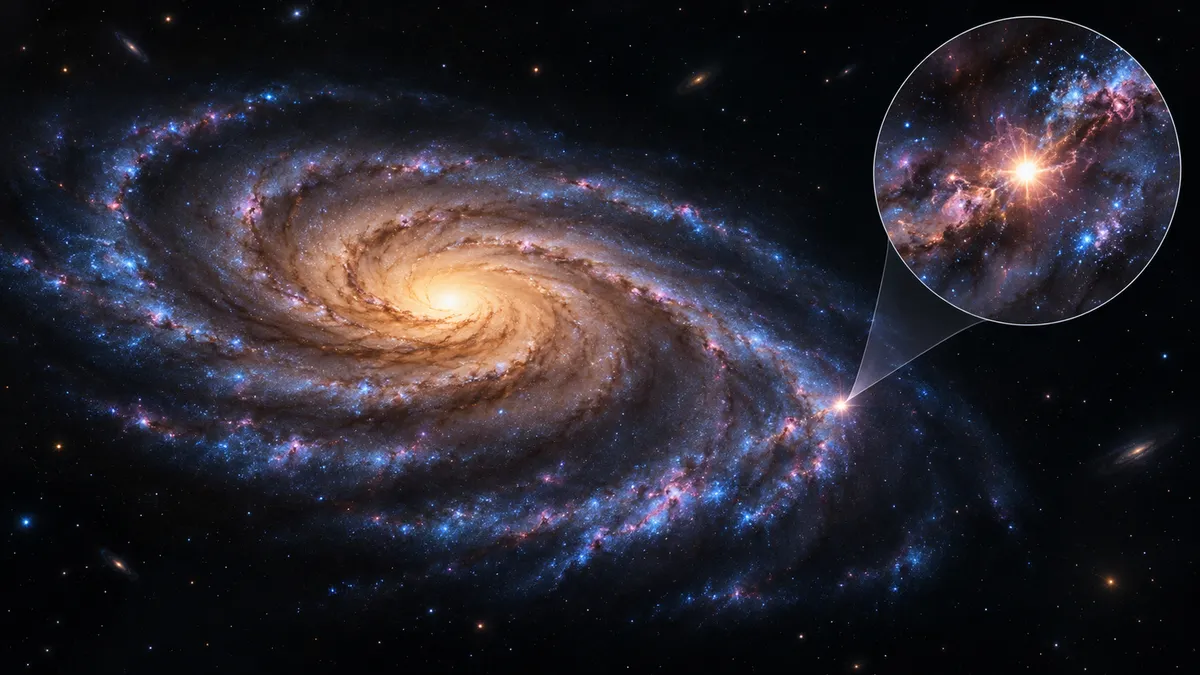
Type Ia supernovae help astronomers measure cosmic distances, but their brightness still depends partly on their surroundings. A new host-galaxy catalogue lays the groundwork for investigating why.
How much does a stellar explosion’s galactic neighbourhood matter when astronomers use it to measure the Universe? The TITAN collaboration has assembled a catalogue designed to make that question easier to test, connecting thousands of nearby Type Ia supernovae with measurements of their host galaxies.
The arXiv preprint, led by Jack W. Tweddle, describes the host-galaxy component of TITAN’s first data release. Its parent sample contains 8,378 spectroscopically confirmed Type Ia supernovae observed by the Asteroid Terrestrial-impact Last Alert System, or ATLAS, mostly at redshifts below about 0.15. Redshift measures the stretching of light and, for these galaxies, reflects both cosmic expansion and local motion.
Why the surroundings matter
Type Ia supernovae are not identical lamps. Astronomers adjust their inferred brightness using the shapes and colours of their light curves—their changing brightness over time. Even after those adjustments, supernovae in more massive galaxies tend to be brighter than those in less massive galaxies. This residual difference is called the host-mass step.
Mass may be a proxy rather than the underlying cause. Stellar ages, star formation and dust are interconnected, and each could carry information relevant to the explosions. This paper builds the environmental dataset; it does not establish which property causes the brightness difference or deliver a new measurement of cosmic expansion.
Nor are all 8,378 events equally suitable for cosmology. Requiring well-sampled light curves reduces the sample to roughly 4,500; additionally requiring a spectroscopic host-galaxy redshift leaves about 3,000.
Finding the right galaxy
A nearby galaxy on the sky is not necessarily a supernova’s host. The researchers combined four association methods with visual inspection, considering galaxy positions, shapes, brightness and available redshifts. They manually reassigned 250 hosts.
Their final catalogue securely associates 7,856 supernovae, or 93.8%, with hosts. The remainder includes 259 events without a detected plausible host, 75 ambiguous cases and 188 whose candidate galaxies lie beyond the adopted separation threshold. An undetected host does not establish that an explosion occurred outside any galaxy.
The team compiled host-galaxy spectroscopic redshifts for 5,522 events. These are generally more precise than redshifts inferred from the broad spectral features of expanding supernova debris. The catalogue also supplies corrections for the Solar System’s motion and estimates of galaxies’ local motions, which can otherwise complicate nearby distance measurements.
What different colours of light reveal
The researchers obtained usable whole-galaxy brightness measurements for 7,568 host entries, drawing on surveys from the ultraviolet to the mid-infrared. They used the Bagpipes modelling software to infer galaxy properties by comparing these measurements with predicted light from stars, gas and dust.
A central test was to repeat the fits after removing particular wavelength bands. Optical light alone generally preserved stellar-mass estimates and rest-frame colour—the colour a galaxy would have without redshift shifting its spectrum. But it was much less reliable for star-formation rates, dust attenuation and average stellar ages.
The problem is ambiguity: an old stellar population and a younger population obscured by dust can both look red. Ultraviolet light helps constrain young stars, while infrared emission helps constrain the energy absorbed and re-emitted by dust. Without mid-infrared information, some weakly star-forming galaxies received inferred star-formation rates up to 100–1,000 times higher than in the full-data fits.
The authors therefore report star formation, dust attenuation and mass-weighted age only for 5,827 hosts with the required ultraviolet and mid-infrared coverage and no luminous active galactic nucleus identified by their selection. Even non-detections help: a faint infrared measurement can rule out models predicting substantial hidden emission.
Adding far-infrared observations to a 92-galaxy comparison subset changed most inferred properties little. That supports using ultraviolet-to-mid-infrared coverage for this nearby sample, but the subset slightly favours massive, star-forming galaxies; it is not a universal demonstration that far-infrared data are unnecessary.
A catalogue, not a final explanation
The measured hosts span diverse environments. About 60% lie above ten billion solar masses in stars. Among hosts with reliable star-formation estimates, 71% are classified as star-forming. Optical measurements within a radius of 1.5 kiloparsecs around each explosion also reveal that local environments can differ from whole-galaxy averages.
Important uncertainties remain. The inferred properties depend on modelling assumptions, especially stellar ages. Galaxy-averaged dust attenuation is not the extinction along an individual supernova’s line of sight. Independent modelling pipelines also produce systematic mass offsets large enough to move some galaxies across the conventional mass-step boundary.
TITAN provides a substantial basis for testing those environmental effects—not yet their resolution. The manuscript states that the catalogue and photometry will be made publicly available upon publication.
- Type Ia supernovae
- TITAN
- ATLAS
- host galaxies
- cosmic distances
- stellar populations
- dust attenuation
- spectral energy distribution
Related reading
Automatically matched by shared topic keywords. These links do not imply that the sources agree or establish a consensus.
Galaxy Images Offer Clues to Billions of Years of Star Formation
Source published
Shared keywords: spectral energy distribution
Nearby galaxies offer clues to the Milky Way’s unusual brightness plateau
Source published
Shared keywords: dust attenuation, stellar populations
Cosmic rulers constrain low-density shells, but do not reveal a unique one
Source published
Shared keywords: type ia supernovae
A Calibration Gap Challenges a Supernova-Based Hubble Constant Claim
Source published
Shared keywords: type ia supernovae
How Red Giant Measurements Shift the Inferred Expansion Rate
Source published
Shared keywords: type ia supernovae