TRANSMISSION // 2611.13185v1
What lets a radio galaxy grow to giant size?
Source published
A preprint reports 2,333 newly identified giant radio galaxies. Their sizes, inferred pressures and cluster environments suggest that radio brightness and cluster mass alone cannot explain their enormous reach.
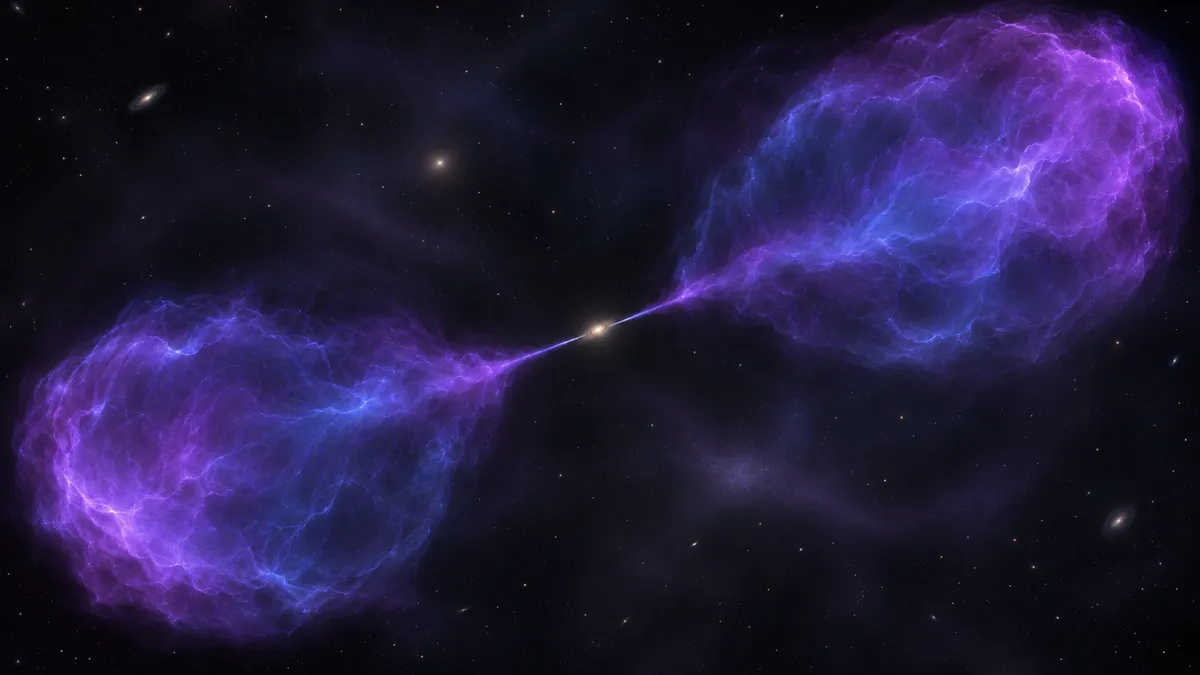
Some galaxies launch jets that build radio-emitting structures stretching across megaparsecs. A new LOFAR study examines thousands of these giants—and shows why their size cannot be read directly from their brightness or surroundings.
What allows a galaxy’s radio jets to reach extraordinary distances? A new study by Souvik Manik and colleagues reports 2,333 newly identified giant radio galaxies, using the third release of the LOFAR Two-metre Sky Survey. Presented as an arXiv preprint, the work examines their energy content, central black holes and environments without identifying a single explanation for their growth.
The word giant describes the radio structure, not the galaxy’s visible stars. An active galactic nucleus launches opposing, fast-moving, magnetised jets that feed extended radio-emitting lobes. Sources qualify as giants when their projected end-to-end extent exceeds 0.7 megaparsecs. These are sizes measured across the sky, not reconstructed three-dimensional lengths.
Finding the giants
The researchers visually searched LOFAR maps for extended structures, then combined radio and optical images to identify plausible host galaxies and reject unrelated components. They used spectroscopic redshifts, measured from spectra, and photometric redshifts, estimated from imaging colours, to convert angular extents into physical sizes. Previously catalogued giants were excluded.
The reported sample spans approximately 0.7–2.9 megaparsecs, with a median of 0.86 megaparsecs. Its redshifts range from 0.126 to 3.517; 726 sources, about 31%, lie at redshift one or above, allowing the study to examine giant structures at earlier cosmic epochs.
Those numbers are not an unbiased census. Finding a source depends on its detectable radio emission and apparent extent, while identifying its host and estimating its redshift introduce uncertainties. Photometric redshift uncertainties can be substantial, affecting derived sizes and luminosities.
Pressure falls as structures grow
The giants cover a broad range of radio luminosities. They are not simply the brightest radio galaxies enlarged: their present radio output and accumulated physical extent describe different aspects of their history.
To investigate the lobes, the team estimated their volumes and applied an equipartition model, which relates energy in magnetic fields to energy in radiating particles. The calculation assumes simplified lobe shapes and particle populations, including a negligible contribution from relativistic protons. Its pressures, magnetic fields and energies are therefore model-dependent estimates, not direct measurements of surrounding gas.
Larger sources generally have lower inferred internal pressures. This is consistent with expanding lobes spreading their energy through a growing volume while also losing energy through radiation. It does not establish a unique age or evolutionary history for each object.
More distant sources tend to have higher inferred pressures. Among 2,273 objects with complete measurements, a positive relationship remains after statistically accounting for radio luminosity and projected size. But that is not proof that lobe pressure intrinsically changes across cosmic time. Faint, diffuse lobes become harder to detect at higher redshift, and electrons lose more energy through interactions with the cosmic microwave background. The distant sample may preferentially retain more detectable systems.
Diverse central engines and hosts
Black-hole mass estimates were available for 631 sources, using stellar motions or quasar emission-line measurements. Their median was roughly 980 million solar masses. Comparing these masses with estimated jet powers showed changing proportions of galaxies and quasars across an empirical radio-morphology transition, but considerable overlap remained. Neither black-hole mass nor estimated jet power uniquely determines the radio structure’s shape.
Infrared measurements also revealed diversity. About 75% of the 862 sources with usable WISE photometry occupied a colour region associated with active nuclei and high-excitation radio galaxies. That percentage applies only to the measured subset. Infrared colours mix contributions from stars, dust and nuclear activity; they do not establish a definitive spectroscopic classification.
A cluster-size trap
The environmental analysis identified 382 giants hosted by brightest cluster galaxies, or BCGs. Their projected physical sizes showed no statistically significant dependence on cluster mass after accounting for redshift.
A different comparison initially looks more striking: dividing half the radio extent by a characteristic cluster radius produces a ratio that decreases strongly with cluster mass. However, more massive clusters have larger characteristic radii. Dividing broadly similar radio sizes by an increasing radius naturally produces a declining ratio. The observed trend is consistent with that scaling, rather than independently demonstrating that massive clusters suppress growth.
The BCG-hosted giants also had sizes statistically comparable to non-BCG giants after redshift matching, but lower radio powers. The primary redshift-adjusted regression estimated about 24% lower conditional geometric-mean radio power. This is an association, not evidence that BCG status causes dimmer emission: host properties, accretion states and detailed gas environments were not fully controlled.
The preprint expands the observed population while leaving the central mechanism open. Resolving it requires better modelling of survey selection alongside measurements of surrounding gas and the radio-emitting particles’ histories—not radio brightness or cluster mass alone.
- giant radio galaxies
- LOFAR
- LoTSS-DR3
- active galactic nuclei
- radio jets
- galaxy clusters
- equipartition pressure
Related reading
Automatically matched by shared topic keywords. These links do not imply that the sources agree or establish a consensus.
Webb maps gas and stars moving differently around faint active black holes
Source published
Shared keywords: radio jets
Faint radio signals probe two growing galaxy clusters
Source published
Shared keywords: active galactic nuclei
Simulated galaxy clusters match X-ray outskirts—but their cores look too faint
Source published
Shared keywords: galaxy clusters
Hyperion’s Densest Regions Show More X-ray-Active Black Holes
Source published
Shared keywords: active galactic nuclei
A faint feature near 3C 84 brightens and fades without clear outward motion
Source published
Shared keywords: radio jets