TRANSMISSION // 2611.13175v1
A small memory makes quantum measurement records predictable
Source published
A preprint derives exact predictions for measurement sequences near the fastest-moving boundary of a quantum circuit. Hardware demonstrations detect the predicted history dependence, although quantitative agreement depends on how noise is modelled.
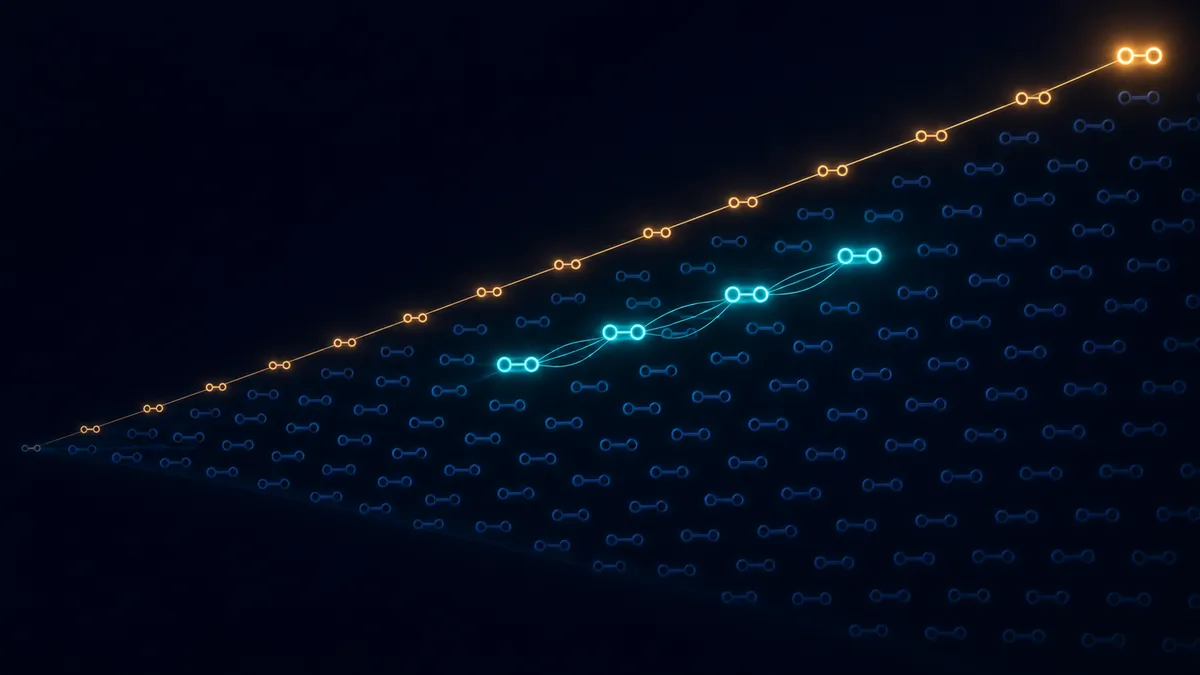
How can researchers check a quantum processor’s output when simulating the whole machine becomes impractical? A new preprint identifies measurement paths whose statistics depend on only a few moving qubits, rather than the entire processor.
Quantum processors increasingly measure qubits while a computation is still running. Those measurements produce sequences of classical outcomes, but they also disturb the quantum state. Predicting an entire sequence therefore requires accounting for how earlier measurements affect later ones—not just calculating each measurement separately.
In a preprint by Jamal Slim, a particular circuit geometry makes that task exactly manageable near the boundary of spreading information. The result supplies a restricted reference for checking dynamic quantum circuits, not a method for efficiently simulating every output of a quantum computer.
Following the fastest information
The model consists of a line of qubits with two-qubit gates arranged in alternating layers, like staggered brickwork. One qubit starts polarized, while the others are maximally mixed: their individual states have no preferred direction, and the initial background has no correlations.
Each layer can move information at most one site. This creates a circuit “light cone,” the region that an initial disturbance can influence. It is a causal boundary within the circuit, not a claim that signals travel at the physical speed of light.
Slim follows measurements moving along one edge at that maximum speed. With the starting qubit correctly aligned to the first gate layer, each incoming background qubit reaches the edge maximally mixed and uncorrelated with the qubit carrying the evolving state. Other routes cannot catch up.
After the first ideal projective measurement, the most recent outcome contains everything needed to predict the next one. The sequence is a two-state Markov chain: earlier outcomes add no predictive information once the latest is known. Its transition probabilities may vary between steps. Calculating a sequence’s probability requires work proportional to its length, independent of the chain’s total size.
Moving inward adds memory
Measurements taken a fixed number of sites inside the boundary remain exactly describable, but their histories become richer.
The paper changes perspective to follow qubits moving with the boundary. At displacement d, only floor(d/2) + 1 such qubits are needed. The rest of the chain supplies fresh inputs and receives outputs that cannot return to influence later measurements. In this description, it acts as a memoryless environment.
The measurement sequence can nevertheless remember. One site inside the edge, measurements probe outgoing partner qubits rather than directly resetting the persistent moving qubit. That unmeasured qubit retains information from earlier interactions.
The paper defines memory through a matrix of joint probabilities, with possible past sequences labelling rows and future sequences labelling columns. Memory is the base-two logarithm of this matrix’s largest rank across time cuts. This is a measure of predictive structure, not an ordinary count of stored outcome bits.
The derived bound is d + 1 bits: at most one on the edge, two one site inside, and three two sites inside. Generic gates attain the bound for displacements through six sites, according to the paper’s argument and numerical constructions. Saturation at every larger displacement remains unestablished. A small persistent state also does not mean that remembering a fixed number of recent outcomes suffices.
Testing the prediction on hardware
The demonstrations used IBM superconducting processors with 156 qubits, including twenty-qubit chains for the main inward-displaced measurements. The memory records contained four successive outcomes.
To detect history dependence, Slim compared the probability of the next outcome for sequences sharing the same latest outcome but differing in the preceding one. Runs with opposite initial polarizations helped distinguish the response to the initial qubit from background effects.
A second demonstration used an analysis specified before its data existed. Two scrambling gates showed the predicted memory signals one and two sites inside the boundary; control configurations showed no detectable polarization-dependent memory where none was predicted. All five acceptance criteria were met on ibm fez.
Repetitions on ibm marrakesh and ibm kingston reproduced the presence and absence of those signals. They did not reproduce every quantitative agreement: the fitted noise model failed some acceptance criteria. The advance protocol was documented in the author’s records, not publicly deposited before execution.
A reference with boundaries
Causality also identifies noise the edge record cannot detect. Operations behind the moving measurement path cannot catch it. Ahead of it, relaxation can spoil the required mixed inputs. Averaging random Pauli operations immediately before each incoming site joins the edge restores those inputs under the stated assumptions. This needs no additional two-qubit gates, but can require single-qubit operations.
The exact results depend on those input conditions; they do not automatically describe arbitrary pure-state preparations. Hardware records were too short to directly measure the full rank-based memory ladder. Instead, they tested a particular history-dependent signal.
The preprint’s contribution is therefore an exact, geometry-dependent reference with supporting hardware evidence—not quantum computational advantage or complete processor certification. Increasing the inward displacement still increases calculation cost, and predicting signal sizes on real devices remains limited by the noise model.
- quantum circuits
- mid-circuit measurements
- light cone
- Markov chains
- quantum memory
- quantum benchmarking
Related reading
Automatically matched by shared topic keywords. These links do not imply that the sources agree or establish a consensus.
Why finite quantum circuits cannot reproduce the quantum switch
Source published
Shared keywords: quantum circuits
For silicon quantum memory, the route can matter as much as the circuit
Source published
Shared keywords: quantum memory
A driven superconducting circuit could correct its own quantum errors
Source published
Shared keywords: quantum memory
Selecting training examples for quantum machine learning
Source published
Shared keywords: quantum circuits
Rotating local axes trims the memory cost of quantum simulations
Source published
Shared keywords: quantum circuits