TRANSMISSION // 2611.13174v1
How the shape of a quantum-code region determines what it reveals
Source published
A preprint connects an observer’s ability to infer an encoded logical bit with optimal error correction using only the observed region. Calculations and small superconducting-processor experiments suggest that geometry can prevent leakage, while uniform-noise models can underestimate what an observer learns on uneven hardware.
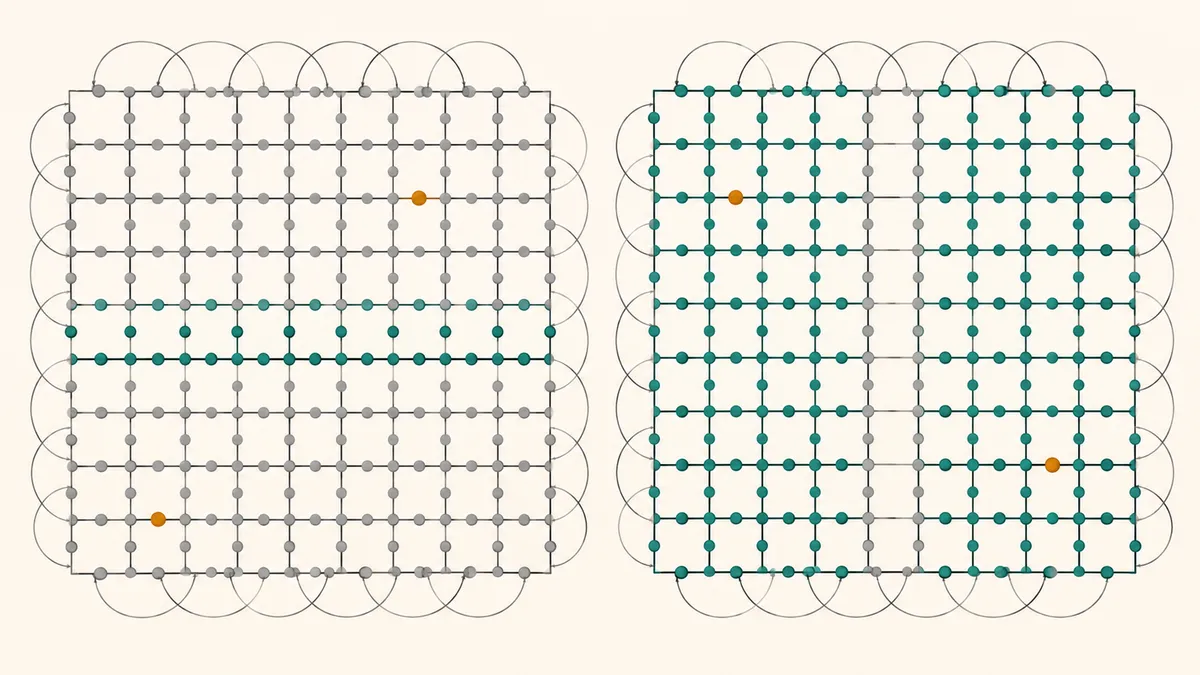
Quantum error correction distributes logical information across many physical qubits. But a party receiving only some final measurement results may still infer an encoded bit. A new theoretical and experimental study examines which regions reveal information, how noise changes that access, and why adding a second row can matter on real devices even when an idealized model says it should not.
Turning leakage into a decoding problem
In a preprint, Konstantinos Karagiannis studies information leakage from the toric code, a quantum error-correcting code defined on a lattice with periodic boundaries. Its logical qubits are encoded collectively rather than stored in individual physical qubits.
The question concerns one logical bit: can an observer distinguish two encoded states using only a chosen region? This is narrower than reconstructing an arbitrary quantum state.
The paper measures leakage with a quantity called trace distance, written as epsilon. Zero means the region cannot distinguish the two logical values; one means perfect distinguishability. For equally likely values, the best guessing probability is (1 + epsilon)/2. Thus epsilon of 0.5 means 75% success, not 50%.
The central theorem states that epsilon equals 1 − 2P_fail, where P_fail is the failure probability of the best decoder confined to that region. Maximum-likelihood decoding means selecting the logical value most probable given the available measurements and noise model.
The proof uses stabilizers: commuting combinations of qubit operations that define the encoded states and provide error information. Under Pauli noise—random combinations of bit flips, phase flips and their combination—the two regional states share a measurement basis. Distinguishing them therefore reduces to a classical inference problem. The theorem allows correlated Pauli errors, not just independent ones.
Geometry determines whether access is possible
A region reveals nothing if it contains no complete representative of the relevant logical operator, the collective operation whose value carries the bit. In the geometry studied, excluding every horizontal edge in one column is sufficient to guarantee zero leakage under the assumed noise model.
This is a condition on which qubits are accessible, not simply their number. A region can contain almost the entire lattice yet lack the necessary logical operator. Conversely, a single row wrapping around the lattice can contain one.
For independent, identically distributed flips with probability p, a single spanning row has epsilon = (1 − 2p)^d, where d is the code distance and lattice circumference. At p = 0.001, its advantage remains about 0.5 at d = 346. Noise alone therefore provides limited protection for such a region at smaller distances.
A striking exact result is that a two-row strip has the same leakage as one row under uniform independent Pauli noise. The additional measurements do not resolve the relevant ambiguity. Three rows can improve logical inference substantially.
Width, length and the noise threshold
The author calculated leakage using transfer matrices, which combine contributions column by column instead of enumerating every full error pattern. A fast Walsh–Hadamard transform enabled related decay-rate calculations for widths up to 16.
At fixed width and noise strength, leakage decreases exponentially with strip length. Below the decoding threshold, however, increasing width suppresses decoding failures sufficiently that the width needed for high leakage grows only logarithmically with d.
The paper connects the operational threshold to the known Nishimori point, approximately a 10.94% independent bit-flip rate. This is a transition in a disordered Ising model, a statistical model of interacting binary spins used to describe decoding.
The numerical evidence is less precise than that identification. Fits across different choices gave crossings between 10.5% and 10.8%. The author attributes the discrepancy to finite-width and boundary effects, while acknowledging that the calculations do not show a consistent approach to the known threshold. Above threshold, large fixed-aspect-ratio regions lose access to the bit, but the code also ceases to provide reliable memory.
What the hardware experiment tested
The study prepared two logical values of rotated surface codes at distances three and five on two IBM Heron processors. Five runs used 20,000 measurements per logical value and distance. Software then restricted an emulated observer to selected rows of the recorded readout.
Three rows outperformed one in every run–distance combination. At distance five, a learned decoder also benefited from a second row, unlike the uniform-noise prediction. A model fitted with separate error rates for individual qubits reproduced roughly 90–99% of that gain. Unequal qubit reliability therefore explained most of the improvement.
This was not a physical side-channel attack: the observer received selected bits offline. Nor did the experiment establish the optimal leakage for arbitrary hardware noise. It measured what particular classical attacks achieved.
Limits and design implications
The theory principally treats one exposure after Pauli noise, with perfect subsequent measurement, rather than a full sequence of noisy error-correction rounds. Correlated repeated exposures remain unquantified, and the hardware tests reached only distance five.
The proposed design rule is to keep untrusted readout regions from supporting a logical operator. It must apply to the union of regions whose observers could pool data. Ordinary error-check outcomes alone do not reveal the logical value in this setting; the concern is access to measurements carrying that value. These conclusions remain findings of a preprint, not established deployment guarantees.
- quantum error correction
- toric code
- surface code
- logical information leakage
- maximum-likelihood decoding
- Nishimori point
- quantum readout
Related reading
Automatically matched by shared topic keywords. These links do not imply that the sources agree or establish a consensus.
Why finite surface codes can obscure coherent-error recovery limits
Source published
Shared keywords: maximum likelihood decoding, quantum error correction
GARI++ splits quantum error correction into a fast first pass and a smaller cleanup
Source published
Shared keywords: quantum error correction
Moving atoms could make globally controlled quantum computers programmable
Source published
Shared keywords: quantum error correction
FusionQ starts quantum error decoding before measurements finish
Source published
Shared keywords: quantum error correction
Tracing photon noise from atomic scattering to quantum algorithms
Source published
Shared keywords: quantum error correction