TRANSMISSION // 2611.13156v1
Shared conductors could produce long-range, direction-dependent qubit noise
Source published
A theoretical preprint derives how charge fluctuations in a disordered conductor can correlate the loss of quantum phase across nearby qubits. In a two-dimensional conductor, the predicted correlations weaken with the square of separation and change sign with orientation. A worst-case noise bound grows logarithmically with array size, limiting the applicability of certain fault-tolerance guarantees without proving that error correction fails.
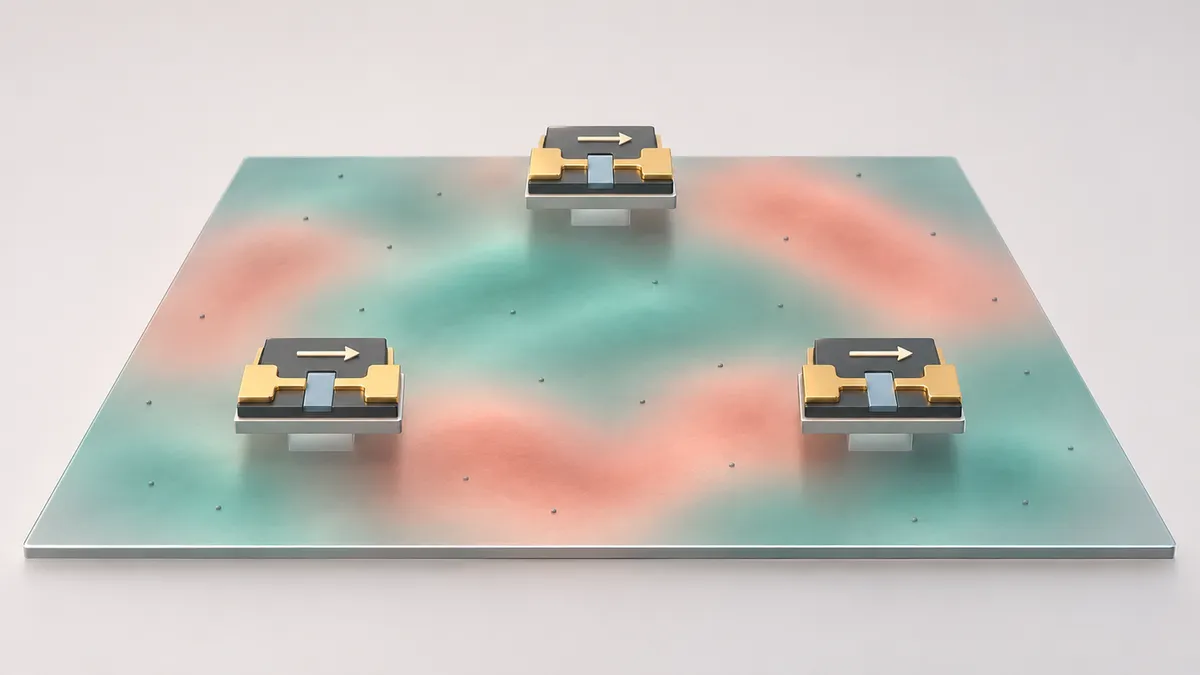
Conducting layers used to control solid-state qubits may also connect their noise. N. R. S. van Venrooij and M. E. Flatté calculate a mechanism in which slowly spreading charge fluctuations disturb multiple qubits sharing a disordered conductor. Their preprint predicts a distinctive directional pattern that could be tested in small devices, while identifying important qualifications for its implications at larger scales.
How a conductor connects qubit fluctuations
Quantum information depends on the relative phase between a qubit’s two logical states. Fluctuations that change their energy difference can randomize that phase, a process called dephasing. When multiple qubits respond to the same environment, their phase disturbances need not be independent.
The preprint examines qubits coupled electrically to a shared disordered conductor: a material in which electrons repeatedly scatter, making charge spread diffusively. Relevant structures include metallic screening planes, ground planes and conducting semiconductor layers.
Charge conservation is central to the calculation. A local excess of charge cannot simply disappear; it must spread. Fluctuations extending over larger distances therefore relax more slowly. The theory describes this slow collective motion through a mode called a diffuson. Several qubits can respond to the same extended fluctuation, producing what the authors call diffuson-correlated dephasing.
This is correlated environmental noise, not, in the static limit considered, a coherent interaction that directly couples two qubits.
Deriving the noise from a microscopic model
The authors start with a two-level charge qubit coupled capacitively to the electron density of a disordered conductor. They assume short-range, statistically specified disorder and an effectively short-range screened interaction between qubit and conductor.
They use a Keldysh nonlinear sigma model, a field-theory framework that describes the conductor’s slow collective dynamics after averaging over disorder. Integrating out those fluctuations gives a noise kernel: a function specifying how strongly disturbances at different qubits are correlated across frequency and distance.
The calculation also covers spin qubits when their logical spin states have different charge distributions. The paper demonstrates this for a confined electron in a magnetic-field gradient. Its applicability to other spin-qubit designs depends on how those designs acquire electrical sensitivity.
At low frequencies and finite temperature, the derived noise becomes approximately frequency-independent, corresponding to temporally white noise within that regime. Its spatial correlations nevertheless remain long-ranged.
Distance matters—and so does direction
For a shared two-dimensional conductor, the long-distance correlation falls as the inverse square of qubit separation. This expression applies when the separation exceeds the size of the qubits’ effective charge dipoles but remains below the frequency-dependent diffusion length.
A dipole here describes the difference in charge distribution between a qubit’s logical states. The correlation depends on both dipoles’ orientations relative to the line joining the qubits. Consequently, equally separated pairs can experience positively correlated fluctuations, which vary together, or anticorrelated fluctuations, which vary oppositely.
For aligned, equal dipoles, the angular factor is minus the cosine of twice the angle between the dipoles and the pair’s separation direction. Turning that direction by 90 degrees reverses the predicted sign.
The authors propose an illustrative test using three equally spaced qubits arranged as an equilateral triangle. With equal dipole magnitudes and a common orientation and sign, the three pair correlations sum to zero in the low-frequency limit. Equal-distance correlations from a nonzero, distance-only noise contribution would not show that cancellation.
This is a proposed signature, not a reported measurement or a complete experimental protocol. Other shared noise sources could obscure the pattern and would need to be separated.
What the scaling result does—and does not—show
Although individual correlations weaken with distance, the number of distant qubits increases in a two-dimensional array. Summing the absolute magnitudes of the correlations therefore gives logarithmic growth with array size, rather than convergence.
Taking absolute values deliberately removes cancellations between positive and negative correlations. It represents a pessimistic bound used in sufficient conditions for fault tolerance: conditions under which error correction is guaranteed to remain effective.
The authors conclude that the derived finite-temperature channel does not meet the relevant convergence condition in the large-array, long-duration limit. That removes a guarantee; it does not establish that quantum error correction necessarily fails. The actual consequences depend on qubit dynamics and the encoded observables, which the paper does not calculate in detail. The authors also leave a detailed matching of normalization and operator-ordering conventions to earlier threshold results outside their scope.
Finite reach and remaining uncertainty
At nonzero frequency, correlations are cut off beyond a diffusion length set by the conductor’s diffusion constant and the fluctuation frequency. Over a finite computation, correlations between distant qubits require time to develop. The zero-temperature scaling also differs: the convergence criterion examined in the paper is satisfied there.
The results are analytical predictions from a preprint, not experimental confirmation. The calculation retains Gaussian charge-density fluctuations and averages over disorder, so it does not resolve sample-to-sample variations. Additional effects may matter near localization or outside the assumed diffusive regime.
The practical message is conditional but specific: shared conducting layers can introduce a spatially structured dephasing channel whose strength, range and directional dependence should be assessed rather than assumed negligible.
- quantum computing
- correlated dephasing
- solid-state qubits
- diffusons
- disordered conductors
- quantum error correction
Related reading
Automatically matched by shared topic keywords. These links do not imply that the sources agree or establish a consensus.
FusionQ starts quantum error decoding before measurements finish
Source published
Shared keywords: quantum error correction
Moving atoms could make globally controlled quantum computers programmable
Source published
Shared keywords: quantum computing, quantum error correction
A cryptography shortcut helps classify quantum gates
Source published
Shared keywords: quantum computing, quantum error correction
GARI++ splits quantum error correction into a fast first pass and a smaller cleanup
Source published
Shared keywords: quantum error correction
Tracing photon noise from atomic scattering to quantum algorithms
Source published
Shared keywords: quantum error correction