TRANSMISSION // 2611.13143v1
AI agents search for faster atom-simulation algorithms
Source published
A study tests whether AI coding agents can speed up software used in atomistic simulations and reduce the number of force calculations needed by some optimizers. In a framework with benchmarks and checks outside the agents’ control, six software kernels ran substantially faster, and some optimizers used fewer force evaluations on selected unseen tests. Results varied by task and run; a separate test also found poorer performance on drug-like molecules started far from their minima.
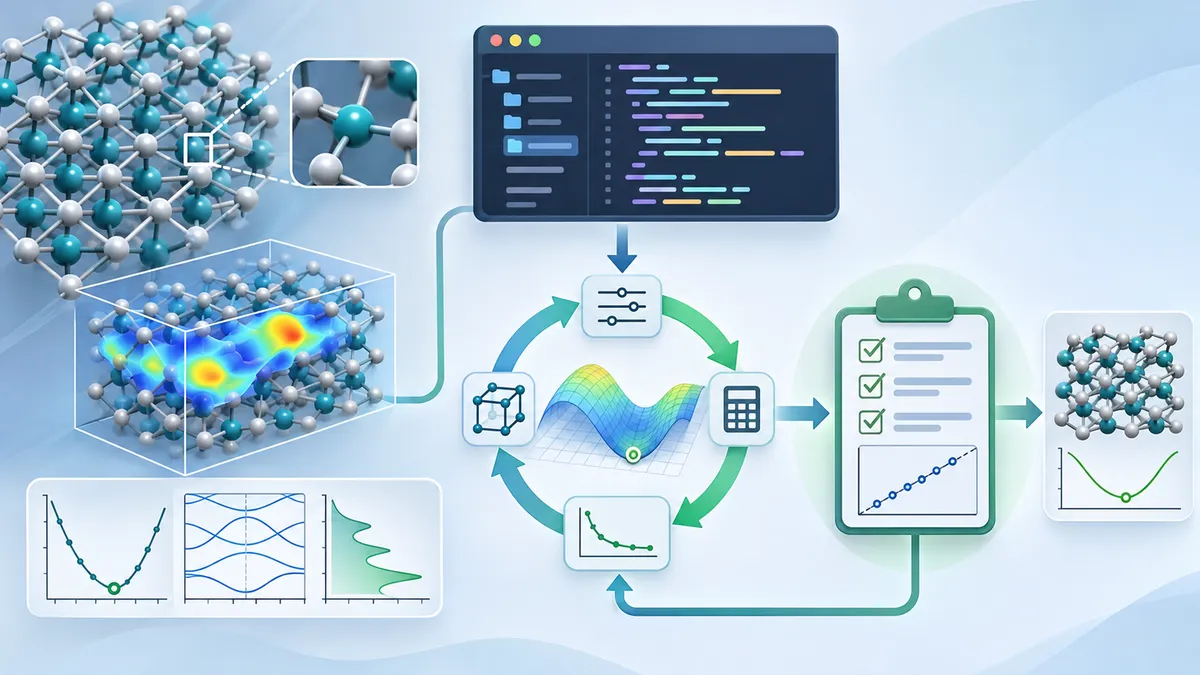
Can an AI coding agent improve the software and methods used to simulate atoms—and how can researchers check its work when it is rewarded for a benchmark score? A study introduces a framework for testing algorithm changes against fixed measures and checks, then evaluates it on the Atomic Simulation Environment, a widely used simulation library.
A scientific program must produce reliable results as well as run efficiently. A new study applies AI coding agents to atomistic simulation: computer models that calculate properties of atoms and molecules. It introduces AIOA, a framework in which agents propose changes, measure them and keep only those that improve a predefined metric while passing checks they cannot edit.
The study focuses on two kinds of improvement. The first is implementation: make existing calculations run faster without changing their results. The second is algorithmic: change how an optimizer works so it reaches an acceptable structure or reaction path using fewer force evaluations. A force evaluation calculates the forces on atoms in a specified configuration; optimizers use these calculated forces to decide what to evaluate next.
Separating speed from correctness
For implementation, agents worked on six computational kernels, including energy and force calculations, neighbor lists, distances, structural analyses and the image-dependent pair potential, which builds initial bands for reaction-path calculations. Changes had to match ASE’s original outputs within tight numerical tolerances and pass selected software tests. A separate reviewer agent also tried to find inputs where a proposed change failed.
For the algorithm tests, agents optimized methods for structure relaxation and reaction-path calculations. They measured progress on an optimization set, while a different set of systems and reactions was kept outside their repositories and used to evaluate each final optimizer after its run. Independent checks assessed convergence and additional conditions for structures or paths. For paths, those checks did not assess saddle position, barrier height or path geometry. The study reports repeated runs, not just the best result.
Faster kernels, fewer force evaluations
Across three runs, the six kernels ran about 22–24 times faster on average in Python with NumPy and SciPy than ASE’s original implementations. Agents often replaced Python loops with array operations. Individual speedups ranged from about 12-fold for one distance calculation to as much as 99-fold for the image-dependent pair potential. Some agents also wrote compiled C code, but the reported average excludes those compiled kernels to make the Python comparison more consistent.
For optimizers, the headline depends on which runs are included. Across the main Opus 5 runs, final methods used, on average, about 1.8 times fewer force evaluations than the corresponding ASE reference methods on held-out problems. The strongest reported configuration used agents that could consult records of earlier runs. Its optimizers needed about 3.1–3.4 times fewer force evaluations for structure relaxation than L-BFGS, and about 4.6–17 times fewer for reaction paths than the chosen standard climbing-image nudged elastic band reference. These comparisons apply to the study’s tasks, test sets and scoring rules; they do not establish equivalent reductions in total runtime for other simulation workflows.
The agents combined and adapted familiar ideas, including models that approximate how molecular structure responds to changes. The authors also identify two components they did not find in the literature. That describes the authors’ search; it does not prove no one has ever used them. Nor does the study show that AI independently invented every ingredient: the best-informed runs could reuse code and records from earlier runs.
What the checks did—and did not—establish
Verification mattered in practice. The paper reports at least 53 kernel candidates and 42 optimizer candidates rejected after checks exposed problems. Blind evaluation also caught five optimizer finals that had passed the in-loop gates but whose reaction paths failed held-out checks. This is evidence that some in-loop checks missed problems in these experiments, not an estimate of how often benchmarks generally fail.
Results varied. With only three runs per configuration, the authors describe comparisons as descriptive and say differences below roughly 10–15% may be difficult to detect. The informed runs’ advantage cannot be cleanly separated from access to earlier work and the compute used to create that archive. Moreover, on a separate benchmark of drug-like molecules started far from their minima, the study’s informed relaxers needed more force evaluations than Sella and failed to converge more often. The authors caution that results on structures started near equilibrium do not establish performance for molecules far from their minima.
This is an arXiv preprint, not evidence of peer review. The paper says its code and generated data will be made publicly available upon publication; the supplied source does not establish whether that has happened. The work demonstrates algorithm search under specified checks, not that an agent can replace scientific judgment. Its results also show why held-out evaluation and independent verification matter: in this study, some candidates passed the checks used during optimization but did not pass later evaluation.
- AI coding agents
- atomistic simulation
- numerical algorithms
- scientific software
- ASE
- optimization
Reviewed cross-references
These connections were reviewed by a model, not independently fact-checked by a human. Similarity does not imply agreement; consult the original papers and the evidence below.
AI-guided simulations trace how a plasma pinch releases energy
Shared method: Both frameworks use iterative agent-driven computational work with checks outside the agent’s control: AIOA keeps changes only when metrics and gates pass, while Simjecture separates numerical-instrument qualification from scientific-claim review. The shared design is guarded iteration, not an identical evaluation protocol; AIOA optimizes ASE kernels and optimizers, whereas Simjecture investigates physical hypotheses through simulations.
Model review: · openai-codex/gpt-6-luna
Evidence and provenance
Selected excerpts, not complete papers. PDF extraction can omit figures or damage equations, tables and reading order; sources may be preprints.
2611.13143v1 — Original paper
Excerpt reference:
static/papers/2611.13143v1.md:68-105
Basis: Paper text
Source SHA-256:1d1a36353a699f0cefcdd4106495ac4511140a4aea81ad95764115bdcde9392b2611.13143v1 — Original paper
Excerpt reference:
static/papers/2611.13143v1.md:106-224
Basis: Paper text
Source SHA-256:1d1a36353a699f0cefcdd4106495ac4511140a4aea81ad95764115bdcde9392b2611.03721v1 — Original paper
Excerpt reference:
static/papers/2611.03721v1.md:133-178
Basis: Paper text
Source SHA-256:29d6dff7282222de59dd24bb3c98456be5c3b2b80208f1049bcd8f2a2ebe2e1b2611.03721v1 — Original paper
Excerpt reference:
static/papers/2611.03721v1.md:1583-1671
Basis: Paper text
Source SHA-256:29d6dff7282222de59dd24bb3c98456be5c3b2b80208f1049bcd8f2a2ebe2e1b
Related reading
Automatically matched by shared topic keywords. These links do not imply that the sources agree or establish a consensus.
Phentax adapts black hole waveform calculations for LISA’s crowded signals
Source published
Shared keywords: scientific software
Fulqrum speeds up the classical step in quantum-assisted energy calculations
Source published
Shared keywords: scientific software
AI coding agents build a robotics simulation benchmark
Source published
Shared keywords: ai coding agents
Robot-coding agents need better failure diagnosis, not just more feedback
Source published
Shared keywords: ai coding agents
When a Bug Report Screenshot Is Too Blurry, the Codebase May Help
Source published
Shared keywords: ai coding agents