TRANSMISSION // 2611.13136v1
Debris around a white dwarf changes its dominant rhythm
Source published
Observations of ZTF J0328−1219 show two recurring transit patterns trading prominence within weeks. Collisions could explain the changing dust clouds, but the cause remains unconfirmed.
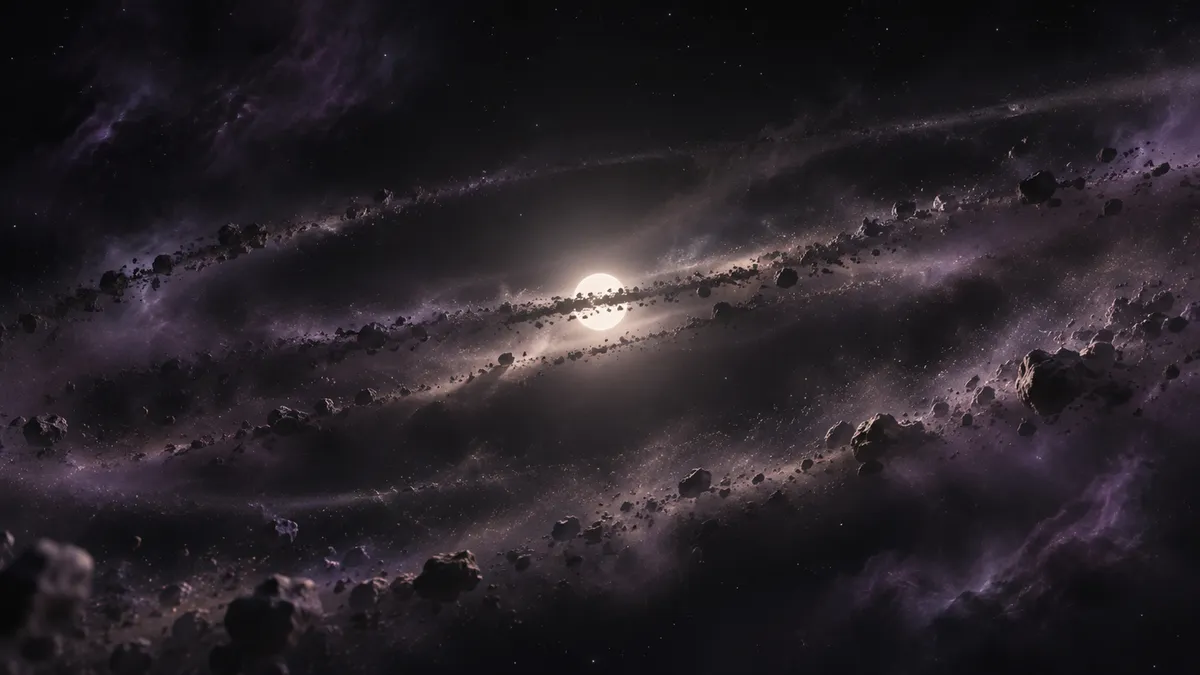
How do you follow planetary wreckage when its shadows keep changing? Around one white dwarf, astronomers watched a familiar dimming pattern give way to another—and then return.
The white dwarf ZTF J0328−1219 never offered astronomers a clearly unobstructed view during these observations. Planetary debris continually crossed the star, producing overlapping, changing dips in brightness. Yet within that disorder, recurring patterns emerged.
In a preprint, Joseph A. Guidry and colleagues report that the strongest repetition switched between two previously known periods during an autumn 2025 observing campaign. The result does not show one object suddenly changing its orbital period. Instead, debris associated with different recurring patterns took turns dominating the starlight blocked along our line of sight.
Following the changing shadows
A white dwarf is a stellar remnant whose atmosphere can reveal material accreted from surviving planetary debris. For systems viewed at a suitable angle, that debris also passes in front of the star. These crossings, called transits, let researchers investigate how the surrounding material changes.
Earlier observations of ZTF J0328−1219 had established a persistent transit period of 9.937 hours, labelled A, and a transient second period near 11.2 hours, labelled B. The team wanted to track the repeating shadows while comparing their behavior at optical and near-ultraviolet wavelengths.
Their observations combined ground-based brightness measurements spanning roughly two weeks in autumn 2025 with five consecutive Hubble Space Telescope orbits of near-ultraviolet spectroscopy. They also analyzed simultaneous observations through three optical filters, obtained with ULTRACAM in November 2024, and a new optical spectrum from SOAR.
To find repetitions in the irregular dips, the researchers used two period-search methods. One, conditional entropy, looks for trial periods that organize the measurements into a more repeatable pattern without requiring a simple sinusoidal signal. They also divided the 2025 observations into shorter windows to see whether the patterns remained consistent.
The 2024 observations were dominated by the familiar A period. In early autumn 2025 measurements, however, B became stronger, with a measured period of 11.17 hours. The shapes of the dips then grew more complicated and less repeatable. By the final observing window, A had regained prominence.
A possible third pattern, repeating every 7.64 hours, appeared in dips recorded from October 29 through November 1. Its statistical significance and persistence remain uncertain. Other apparent periods were likely aliases: misleading repetitions created by the sampling and underlying signals rather than independent debris orbits.
What the colors can—and cannot—reveal
Comparing dimming at different wavelengths can help constrain the obscuring material. Small dust grains can block different colors with different efficiencies. But similar transit depths across wavelengths do not uniquely determine grain size: sufficiently opaque debris can also produce nearly color-independent dips.
The November 2024 optical measurements did not establish a convincing transit-dependent color change. Near-simultaneous ultraviolet and optical measurements during Hubble orbits two through four likewise showed no significant change in color with transit depth. There was a constant relative ultraviolet offset, which is distinct from the dips becoming progressively redder as they deepen.
Including the fifth Hubble orbit produced a statistically significant reddening trend in the fitted relationship. That result carries an important qualification: those transits were the shallowest and especially sensitive to noise and the choice of brightness baseline. Because the star was never clearly unobscured, its true unblocked brightness was unknown. The authors therefore treat changing dust properties as plausible, not established.
Chemical clues and an unconfirmed cause
The combined ultraviolet and optical spectra also revealed atmospheric elements, including carbon, consistent with accretion of material resembling chondritic meteorites. This is a compositional interpretation, not identification of a particular parent asteroid. Silicon was an exception to the close chondritic agreement, and unresolved absorption by surrounding gas could bias the inferred abundances.
Collisions offer one explanation for the changing transit patterns. A cascade of impacts could temporarily increase the amount or vertical extent of debris associated with B, allowing its shadows to overwhelm A. The return of A could then reflect that disturbance subsiding.
But the observations do not directly demonstrate such a cascade. Changing viewing geometry or gravitational interactions could also contribute. Longer monitoring could test whether B returns cyclically or sporadically; infrared brightening around the episode would provide supporting evidence for collision-produced dust.
The clearest finding is the changing visibility of recurring debris patterns. Explaining why they trade prominence requires more than measuring their periods.
- white dwarfs
- planetary debris
- transits
- circumstellar dust
- ultraviolet spectroscopy
- ZTF J0328−1219
Related reading
Automatically matched by shared topic keywords. These links do not imply that the sources agree or establish a consensus.
Planetary debris leaves hydrogen behind in white dwarf atmospheres
Source published
Shared keywords: planetary debris, white dwarfs
Dust around a yellow hypergiant could make it look brighter than it is
Source published
Shared keywords: circumstellar dust
Webb separates the dust signals around Tc 1’s carbon cages
Source published
Shared keywords: circumstellar dust
Did two stars become one? Clues from the heaviest white dwarfs
Source published
Shared keywords: white dwarfs
Small white dwarf explosions could resemble the faintest Type Iax supernovae
Source published
Shared keywords: white dwarfs