TRANSMISSION // 2611.13128v1
Planetary debris leaves hydrogen behind in white dwarf atmospheres
Source published
A preprint estimates that at least 22 ± 2 per cent of hydrogen-bearing, helium-atmosphere white dwarfs in its main sample acquired some hydrogen from planetary material. The result concerns the fraction of stars, not the fraction of their hydrogen supplied by planets.
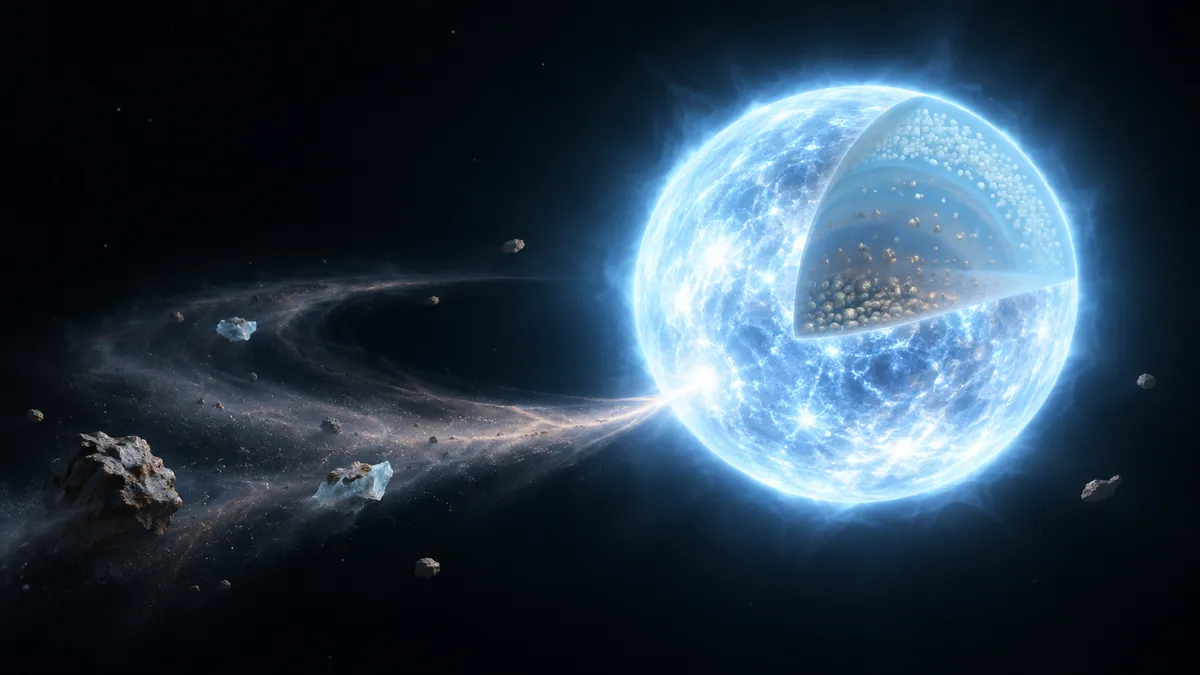
Why do some helium-atmosphere white dwarfs contain hydrogen? A population study suggests that hydrogen inherited from stellar evolution cannot explain the observations alone: material from surviving planetary systems must also contribute.
A white dwarf can retain evidence of planetary material long after some of its chemical traces have disappeared. Heavy elements sink out of its visible atmosphere, while hydrogen can accumulate in its outer layers. That difference offers a way to investigate where the hydrogen in these stellar remnants came from.
In a preprint by Paula Izquierdo, Andrew Swan and colleagues, a simple population model indicates that at least 22 ± 2 per cent of helium-atmosphere white dwarfs with detectable hydrogen in the main sample must have received some hydrogen from planetary material. The estimate does not mean that planets supplied 22 per cent of the hydrogen, or that the result applies to every kind of white dwarf.
Two possible origins
White dwarfs are dense stellar remnants that have stopped sustaining nuclear fusion and gradually cool. Their strong gravity separates elements, while convection—the movement of material through their outer layers—can mix them together.
Some white dwarfs have atmospheres dominated by helium but also show hydrogen absorption lines: characteristic signatures in their spectra. One possible source is hydrogen inherited from earlier stellar evolution. A hidden reservoir deeper inside the star may gradually diffuse upwards and become mixed into the observable layers as the star cools.
Another source is accretion: the capture of material from a remnant planetary system. Ices, minerals containing bound water, or planetary atmospheres can deliver hydrogen alongside heavier elements. Astronomers call these heavier elements “metals,” including elements such as oxygen and calcium.
The key clue is that hydrogen is detected more frequently in helium-atmosphere white dwarfs that also show metals. Internal redistribution of inherited hydrogen alone does not explain that association within the authors’ model.
Counting chemical combinations
The researchers divided stars into four observable categories: helium only, helium with hydrogen, helium with metals, and helium with both hydrogen and metals. They then modelled how inherited hydrogen and planetary accretion could populate those categories.
Their main sample contained 2,407 white dwarfs from the Dark Energy Spectroscopic Instrument survey, or DESI. A comparison sample contained 1,065 from the Sloan Digital Sky Survey, or SDSS. The samples overlap, so the team analysed them separately rather than treating every entry as a distinct star.
The selection focused on stars classified through helium absorption lines, with colours corresponding roughly to temperatures between 10,000 and 19,000 kelvin. Additional cuts removed spectra below chosen signal-to-noise thresholds, where weak hydrogen or metal features would be difficult to recognise. DESI was the primary sample because its selection was less biased than SDSS’s.
The model describes a population snapshot, not the detailed history of each star. Its parameters represent how often inherited hydrogen is detectable, how many stars have accreted planetary material, whether their metals remain visible, and whether accretion has supplied detectable hydrogen.
Why the estimate is a minimum
Different combinations of those parameters can reproduce the observed counts. To obtain the smallest planetary contribution, the researchers assumed that every star that had ever detectably accreted planetary material still showed metals.
That deliberately conservative assumption leaves no population whose metals have already sunk away while its accreted hydrogen remains. Allowing such stars increases the inferred contribution of planetary hydrogen.
Under that limiting assumption, DESI yielded a minimum fraction of 22 ± 2 per cent among stars with detectable hydrogen. SDSS yielded 18 ± 3 per cent. The team estimated these statistical uncertainties by repeatedly resampling the observations, a method called bootstrapping.
What remains uncertain
Those uncertainty ranges do not capture every possible systematic effect. Using another team’s classifications of DESI spectra produced a lower limit of 16 ± 2 per cent. Differences in classification and in how exposures were combined could help explain the shift. Small changes to the selection cuts generally preserved the main result, but larger changes also altered the kinds of stars included.
The model assumes that planetary delivery does not depend on atmospheric composition, that spectral classifications reliably reflect composition, and that stars follow its prescribed evolutionary pathways. Its lower bound is conditional on that framework.
Nor does the analysis identify the hydrogen-bearing objects or their delivery times. Rare, volatile-rich events and repeated accretion of rocks containing small amounts of hydrogen remain possible explanations. Hydrogen abundances, metal abundances and cooling ages could help distinguish them.
The preprint’s central finding is therefore about a population: inherited hydrogen and planetary hydrogen are complementary explanations, and the observed chemical combinations require a planetary contribution within this model.
- white dwarfs
- helium atmospheres
- hydrogen
- planetary debris
- accretion
- stellar evolution
- DESI
- SDSS
Related reading
Automatically matched by shared topic keywords. These links do not imply that the sources agree or establish a consensus.
Debris around a white dwarf changes its dominant rhythm
Source published
Shared keywords: planetary debris, white dwarfs
Did two stars become one? Clues from the heaviest white dwarfs
Source published
Shared keywords: white dwarfs
What dead stars reveal about matter, gravity and the early Universe
Source published
Shared keywords: stellar evolution, white dwarfs
Merging stars could give newborn black holes a faster spin
Source published
Shared keywords: stellar evolution
Weighing a magnetic white dwarf through hot gas and a companion’s motion
Source published
Shared keywords: white dwarfs