TRANSMISSION // 2611.13123v1
Borrowed stellar material leaves clues in Collinder 261’s blue stragglers
Source published
Rotation, close companions and unusual surface chemistry support mass transfer as a major origin of Collinder 261’s blue stragglers. But tides complicate their rotational clocks, and some chemical signatures remain unexplained.
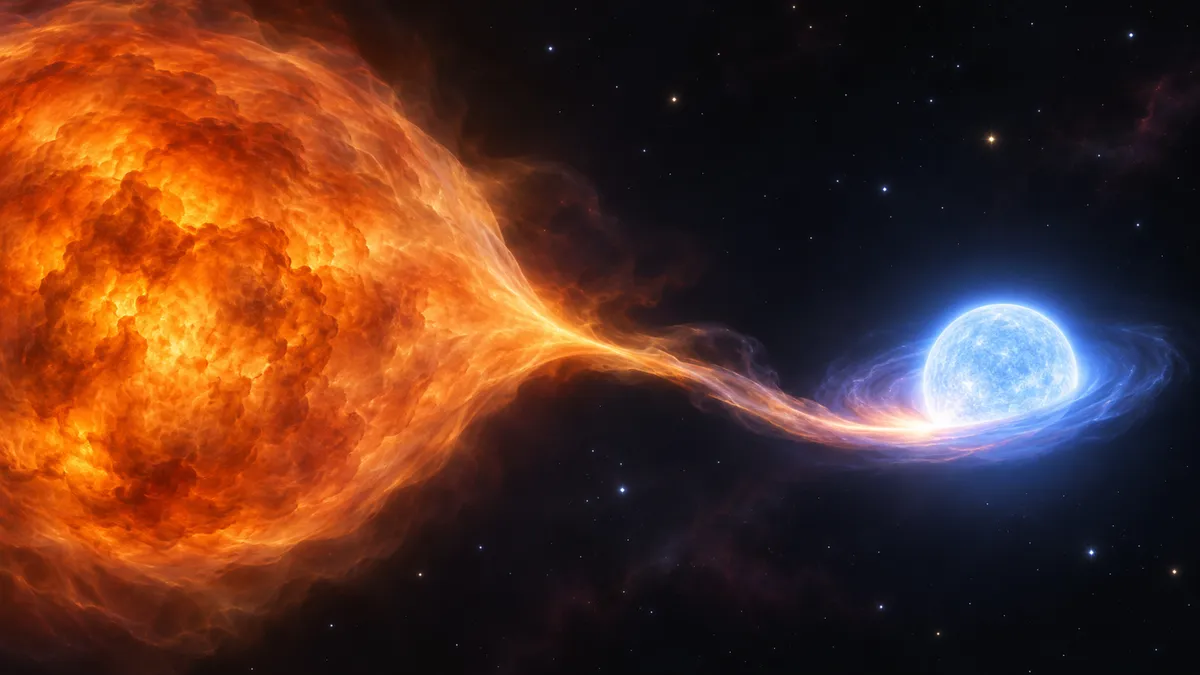
Some stars in an old cluster look unexpectedly young. A new preprint combines their spins, companions and surface elements to investigate how exchanging material between stars could explain the mismatch.
In an old star cluster, the hottest, brightest stars originally born there should already have evolved away from the main sequence, the long-lived stage of hydrogen burning in stellar cores. Yet blue stragglers sit beyond the expected boundary, looking younger than their neighbours. Did they gain material from companions, merge with other stars, or form through direct collisions?
A preprint by M. J. Rain and colleagues, posted on arXiv on November 9, investigates these possibilities in Collinder 261. The researchers adopt an age of 6.7 billion years for this open cluster, although published age estimates vary. Their evidence supports mass transfer as a major formation route, while showing why neither rapid rotation nor unusual chemistry tells the whole story alone.
Three clues to a shared history
The team observed 40 of the cluster’s 53 catalogued blue-straggler candidates with the FLAMES–GIRAFFE spectrograph on the Very Large Telescope. They also observed 42 ordinary stars near the point where stars begin leaving the main sequence, providing a comparison for rotation and composition.
Spectra supplied three complementary clues. Broadening of absorption lines measured projected surface rotation: the apparent speed depends on the angle of the star’s spin axis. Shifts in those lines revealed motion towards or away from Earth, which can flag an orbiting companion. Line strengths supplied estimates of surface carbon, oxygen, barium and iron.
Observations in 2022 and 2025 provided a baseline of about 2.8 years, with repeated measurements during a 63-day interval in 2022. The researchers also used TESS brightness measurements to identify short-period binaries.
Of the 39 blue stragglers that could enter the rotation statistics, 17—44%, with an uncertainty of eight percentage points—were classified as fast rotators, above a projected speed of 40 kilometres per second. None of the comparison stars was securely identified as a fast rotator. The fastest blue stragglers had lines so broadened that precise speeds could not be established.
Fast rotation was strongly associated with spectroscopic binary candidates: 13 of 14 candidates in the rotation sample were fast, compared with four of 25 stars not flagged that way. Some velocities are unreliable because very broad lines can mislead the measurement, but the association persisted when the authors removed four uncertain binary flags.
A fast spin is not necessarily a young clock
Accreting material can spin a star up. Subsequent slowing might therefore offer a rough indication of time since the interaction. Close companions complicate that interpretation: tides can maintain rotation in step with orbital motion.
Seven eclipsing or tidally distorted systems had orbital periods of roughly half a day to 2.1 days. Their measured rotation was broadly consistent with tidal synchronisation, although several measurements were only limits and follow-up spectroscopy is needed. For these systems, rapid spin cannot reliably date the mass-transfer event.
An eighth apparent short-period binary failed the rotation and velocity checks. A nearby source showed the same brightness period, making contamination the likely explanation.
For the two clearest eclipsing systems, preliminary velocity fits suggested companions of about 0.33 and 0.45 solar masses. Their eclipses indicate companions too extended and luminous to be cool, compact white dwarfs. Ongoing mass transfer cannot be excluded.
Chemistry reveals interactions that velocities miss
Rapid rotation blurred the lines too much for reliable chemical measurements, restricting that analysis to slow rotators. Of 21 stars with usable carbon and oxygen measurements, 13, or 62%, showed enhancements interpreted as transferred material.
Four were strongly enriched in barium. The authors associate this pattern with donors that reached the asymptotic giant branch, a late evolutionary stage when internal material can reach the surface. Such stars can produce heavy elements through slow neutron capture, the s-process.
Three other stars had enhanced carbon and oxygen without strong barium enrichment. Six more shared the carbon–oxygen pattern but lacked barium measurements, making their classification provisional. The authors suggest donors below the mass needed for substantial s-process enrichment. However, they explicitly acknowledge that the large oxygen enhancements are not explained by the available evidence.
Only nine stars had usable barium measurements. Barium also lacked the directly observed comparison-star baseline available for carbon and oxygen. Uneven foreground dust changes inferred temperatures and abundances; the authors find that it could alter some borderline classifications, though not erase the main chemical separation.
Strong evidence, incomplete histories
The velocity cuts miss many wide binaries, so an apparently constant star need not be single. Chemical enrichment helps uncover past interactions in precisely this otherwise hidden population. Conversely, normal chemistry does not uniquely establish a merger origin.
The authors suggest that Collinder 261’s low-density environment lets some binaries remain wide enough for donors to evolve further before transferring material. This could help explain the enrichment, unlike the depletion reported in some globular-cluster blue stragglers. That environmental interpretation remains a hypothesis.
Together, the observations favour binary interaction as a major source of these apparently rejuvenated stars. They do not establish a unique formation history or rate: tidal locking, uncertain slowing times, incomplete orbits and unexplained oxygen enrichment still limit the reconstruction.
- blue stragglers
- Collinder 261
- binary stars
- stellar mass transfer
- stellar rotation
- chemical abundances
- open clusters
Related reading
Automatically matched by shared topic keywords. These links do not imply that the sources agree or establish a consensus.
Close companions are unlikely to explain most slow-spinning stars in open clusters
Source published
Shared keywords: binary stars, open clusters, stellar rotation
Stellar pulses point to two binaries—and spectra confirm the motion
Source published
Shared keywords: binary stars
Cluster galaxies show a subtle nitrogen–oxygen abundance offset
Source published
Shared keywords: chemical abundances
Reading starlight without flattening the star
Source published
Shared keywords: chemical abundances
A white dwarf’s abrupt magnetic switch hints at compact atmospheric regions
Source published
Shared keywords: stellar rotation