TRANSMISSION // 2611.13116v1
Webb reveals gas differences hidden in a galaxy’s optical glow
Source published
JWST observations distinguish the warm molecular gas around NGC 4696’s nucleus from its surrounding filaments, despite similar optical classifications. The results reveal varied excitation conditions without uniquely identifying their energy sources.
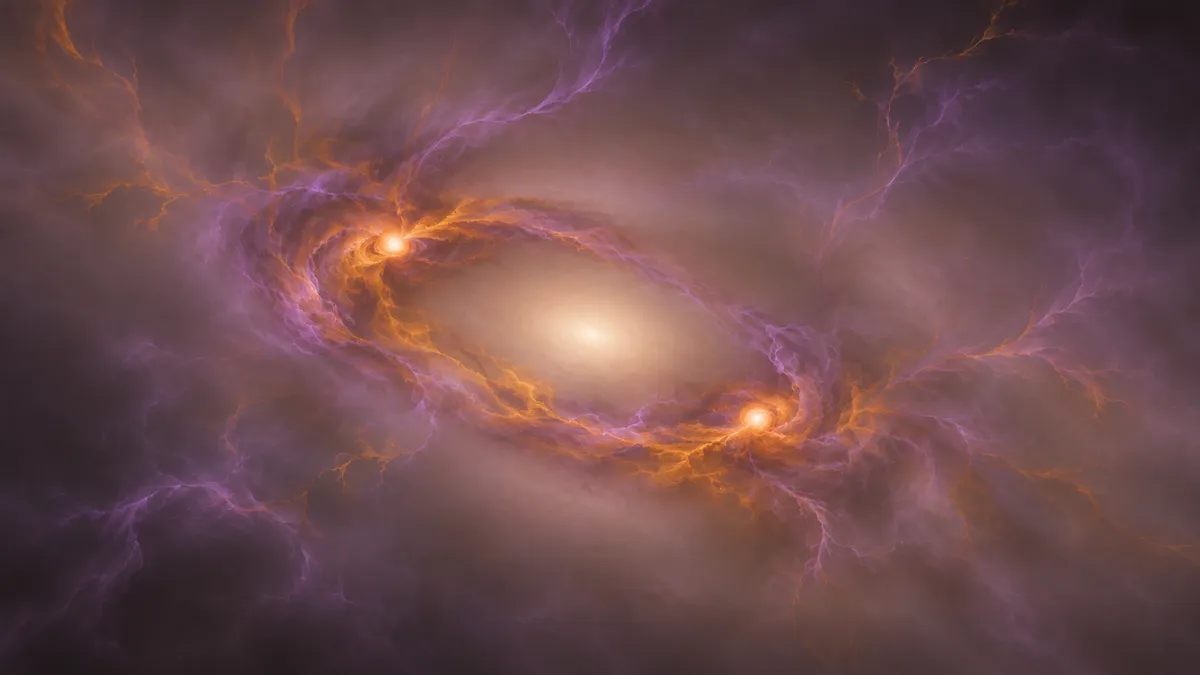
What makes the gas filaments near a galaxy’s central black hole glow? In NGC 4696, Webb’s infrared spectra reveal regional differences that conventional optical classifications largely conceal—but several possible heating mechanisms remain in play.
Gas near the centre of NGC 4696 can look broadly similar in optical diagnostic diagrams while behaving quite differently in the infrared. New James Webb Space Telescope observations separate compact nuclear regions from surrounding gas filaments through the light emitted by hydrogen molecules.
The study, led by Olivia R. Pereira, is an arXiv preprint, submitted to The Astrophysical Journal and revised in response to referee comments. Its central finding is a distinction between local gas conditions, not a definitive identification of what powers them.
Reading the gas in several places
NGC 4696 is the brightest galaxy in the Centaurus cluster. It sits amid hot, X-ray-emitting intracluster gas, while much colder molecular material occupies filamentary structures. Activity associated with its central supermassive black hole supplies energy to this environment. Understanding how that energy reaches different gas components is part of the larger problem of how cluster cores balance heating and cooling.
The researchers used Webb’s NIRSpec instrument for about 7.7 hours on June 5, 2025. Its integral-field mode records spectra across an image, allowing the team to compare locations rather than combine everything into one measurement. The nominal field spans three arcseconds on each side—about 620 parsecs at the adopted distance—and covers infrared wavelengths from 1.7 to 3.1 micrometres.
Using emission maps, Hubble imaging and statistical grouping of similar spectra, the team defined two compact nuclear regions, a surrounding “Swirl”, three filament regions and a faint continuum-reference region. They fitted the underlying stellar light and emission lines, then corrected the line measurements for dust attenuation.
Two kinds of hydrogen emission provide complementary information. Paschen-alpha, abbreviated Paα, is a recombination line tracing ionized gas. Molecular hydrogen, H₂, emits infrared lines as its rotational and vibrational states change. Comparing their strengths reveals differences in molecular emission relative to ionized-gas emission; it does not directly measure the relative masses of those gas components.
A contrast that optical classifications miss
The compact nuclear regions are relatively bright in Paα. The surrounding filaments have much stronger H₂ emission relative to that line. For the H₂ transition called 1–0 S(1), the reported H₂/Paα ratios are approximately 0.2–0.3 in the two cores and 0.9–1.4 in the filaments. Spatial ratio maps also show the nuclear-to-filament contrast, supporting the conclusion that it is not solely a consequence of how the extraction regions were drawn.
Optical spectra from the ground-based MUSE instrument provide a comparison. Those measurements place the regions in broadly similar low-ionization, or LINER-like, territory in conventional diagnostic diagrams. That classification describes emission-line patterns; it does not establish one common heating mechanism. MUSE also has lower spatial resolution, requiring the two Webb nuclear regions to be combined for the optical comparison.
Ratios between H₂ lines alone distinguish the cores from the surrounding structures too. The difference therefore extends beyond the strength of the Paα reference line: the molecular excitation itself varies.
Excitation diagrams examine how molecules populate different energy levels. A single thermal population would follow an approximately straight trend. Instead, higher-energy populations rise above the extrapolation from lower-energy levels. Under the authors’ fitting procedure, the three filament regions require an additional hotter component. Such curvature can reflect a mixture of temperatures or excitation processes that a single temperature cannot describe.
Several energy sources remain possible
The team compared the observations with CLOUDY calculations for clouds illuminated either by an active-galactic-nucleus spectrum or by radiation from cooling intracluster gas. Nuclear measurements approach the former sequence in some diagrams; filament measurements approach portions of the latter. Neither model family reproduces every observed combination, and the sequences overlap.
These are reference calculations, not a complete competition between all plausible mechanisms. They omit explicit shock, turbulent-dissipation and enhanced particle-heating components. Agreement with cooling-gas radiation also does not demonstrate a steady cooling flow inside an individual filament.
The mass estimates require particular caution. These infrared lines sample excited molecules, not the bulk cold reservoir. Extrapolating to a warm-gas mass depends strongly on the assumed temperature distribution; the authors explicitly warn that extreme nuclear estimates may be substantially inflated and are not evidence for enormous gas concentrations.
Future mid-infrared observations of lower-energy H₂ lines could extend the temperature coverage and help discriminate among models. For now, Webb establishes that similar optical classifications conceal different molecular conditions—not that the energy budget has been uniquely solved.
- NGC 4696
- James Webb Space Telescope
- NIRSpec
- molecular hydrogen
- Centaurus cluster
- galaxy filaments
- AGN feedback
Related reading
Automatically matched by shared topic keywords. These links do not imply that the sources agree or establish a consensus.
Webb maps gas and stars moving differently around faint active black holes
Source published
Shared keywords: james webb space telescope
Stellar motions support an excess of small stars in massive galaxy cores
Source published
Shared keywords: james webb space telescope
Webb spots a faint oxygen line in a distant galaxy’s core
Source published
Shared keywords: james webb space telescope
JWST probes the chemistry of tiny early galaxies—and a nitrogen puzzle
Source published
Shared keywords: james webb space telescope
Webb catches a molecular ion shedding the energy of its formation
Source published
Shared keywords: james webb space telescope