TRANSMISSION // 2611.13115v1
A rare Sculptor star points to enrichment by two early stellar explosions
Source published
Francisco Cuadra and colleagues find an unusual chemical pattern in the carbon-rich star DR20080. Their models favor enrichment mainly by a faint Population III supernova, with a smaller contribution from a hypernova, although the progenitor properties remain uncertain.
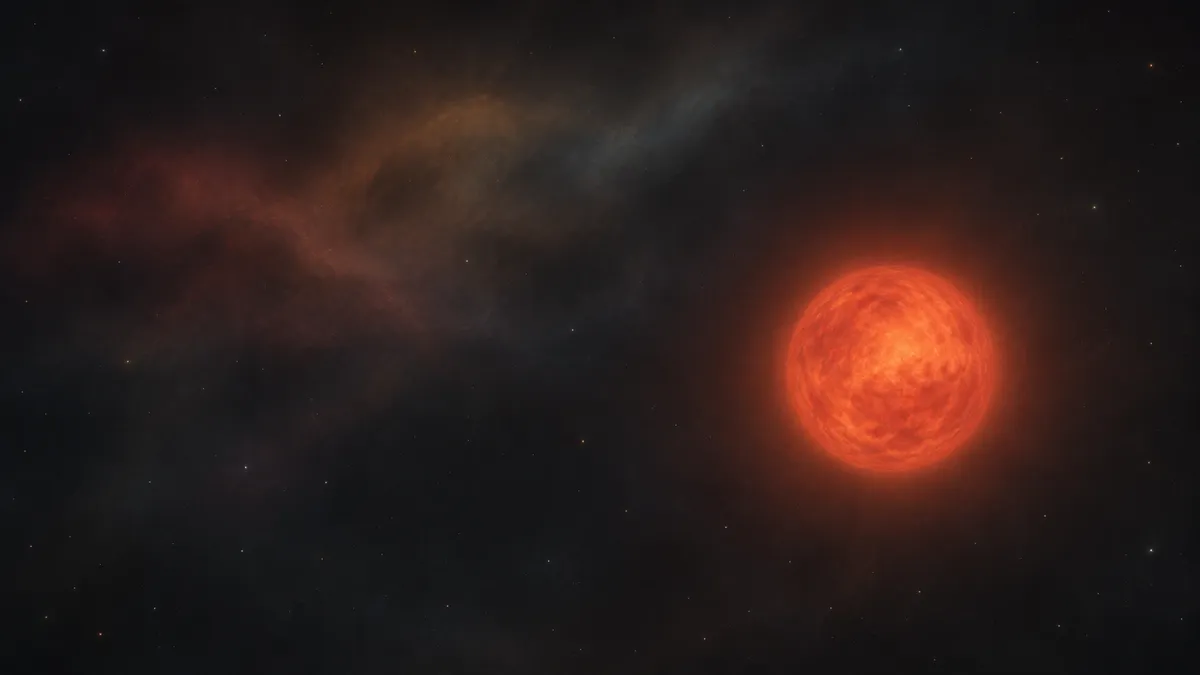
An ancient star in the Sculptor dwarf galaxy may preserve chemical evidence of two explosions from the Universe’s first stellar population. Its unusually high oxygen and low manganese and nickel abundances give astronomers a distinctive—but model-dependent—record to interpret.
A chemical record in Sculptor
The first stars formed from gas composed of hydrogen and helium. Their explosions supplied heavier elements to the surrounding gas, leaving chemical signatures that later stars could inherit. Astronomers study these surviving stars to investigate the earlier generation indirectly.
In a study available as an arXiv preprint, Francisco Cuadra and colleagues examine DR20080, a red giant in the Sculptor dwarf spheroidal galaxy, a satellite of the Milky Way. They report the first detailed high-resolution abundance analysis of a carbon-enhanced, barium-poor star in Sculptor with an iron abundance below [Fe/H] = −3.
Such stars belong to the CEMP-no class: carbon-enhanced metal-poor stars without strong enrichment in neutron-capture elements such as barium. They are commonly interpreted as descendants of the first, metal-free stars, called Population III. Yet they are surprisingly rare in dwarf spheroidal galaxies compared with the Milky Way halo and ultra-faint dwarf galaxies.
Reading the starlight
The team used eight observations taken in October and November 2022 with the UVES spectrograph on the European Southern Observatory’s Very Large Telescope. Each exposure lasted 3,000 seconds. Combining them improved the signal available for identifying absorption features in the star’s light.
The researchers measured individual spectral lines and compared observed features with calculated spectra. Gaia photometry helped establish the star’s atmospheric parameters. Together, these methods yielded abundances for 17 elements and upper limits for four others—limits rather than detections because their spectral features were too weak.
The initial analysis used one-dimensional model atmospheres and a simplifying assumption called local thermodynamic equilibrium, or LTE. The authors then applied corrections for departures from that assumption where suitable calculations were available. They used the corrected abundances for their supernova-model comparisons, but retained LTE values when comparing with literature samples analyzed that way.
High carbon and oxygen, little iron
On the LTE scale, DR20080 has [Fe/H] = −3.26. This logarithmic notation compares the iron-to-hydrogen ratio with the Sun’s: the result corresponds to roughly one eighteen-hundredth of the solar ratio.
Its carbon-to-iron ratio is high, [C/Fe] = +1.60, after correcting for internal mixing during the star’s evolution. Its low barium-to-iron ratio, [Ba/Fe] = −1.28, supports its CEMP-no classification.
The distinctive feature is the combination of abundances. The authors find [O/Fe] = +1.53, above the mean of their Milky Way CEMP-no comparison sample, alongside low manganese and nickel ratios of −1.02 and −0.45 respectively. These numbers are LTE values; the corrected iron abundance, for example, becomes [Fe/H] = −3.08.
The oxygen result deserves particular care. It rests on one weak spectral line, and the researchers adopted a conservative uncertainty. Oxygen is also difficult to measure in such iron-poor stars unless it is strongly enhanced, limiting the comparison sample.
Testing possible predecessors
The team compared the corrected abundance pattern with theoretical predictions for material released by Population III and later-generation supernovae. They tested enrichment by either one or two progenitors. Nitrogen was excluded because internal mixing has altered its surface abundance, making it unreliable for reconstructing the birth gas.
Among the tested models, two Population III explosions provided a better match than one. In the broader fit, the dominant contributor was a faint supernova from a star with 43 times the Sun’s mass and an explosion energy of 0.6 × 10^51 erg. A smaller contribution came from a much more energetic hypernova, modeled with a progenitor mass of 19.4 solar masses and energy of 10^52 erg. Their fitted enrichment contributions were 95% and 5%.
Those are model results, not direct observations of the explosions. Restricting the fit to ten elements considered more reliably predicted retained the same dominant progenitor, but changed the secondary to a 50-solar-mass hypernova and the mixture to 85% and 15%. Several different solutions remain possible, and titanium and cobalt were still poorly reproduced. A contribution from a rapidly rotating early star also cannot be ruled out.
What one star cannot settle
The unusual pattern may help investigate whether early stellar enrichment differed between galactic environments. But DR20080 alone cannot establish that relationship. Earlier research suggests it could belong to a population accreted into Sculptor through a merger with an ultra-faint dwarf galaxy, rather than having formed within Sculptor itself.
The authors therefore call for larger samples and detailed follow-up spectra. DR20080 offers a strong candidate record of Population III enrichment—not a uniquely determined reconstruction of its stellar ancestors.
- DR20080
- Sculptor dwarf galaxy
- Population III
- CEMP-no stars
- stellar abundances
- supernova enrichment
Related reading
Automatically matched by shared topic keywords. These links do not imply that the sources agree or establish a consensus.
Rocky planets may look iron-rich because other ingredients are missing
Source published
Shared keywords: stellar abundances
Low-resolution starlight reveals 133 candidate chemical families in the Milky Way
Source published
Shared keywords: stellar abundances
Could nova explosions explain the chemistry of phosphorus-rich stars?
Source published
Shared keywords: stellar abundances
Measuring the stars behind JWST’s planet spectra
Source published
Shared keywords: stellar abundances
Reading the Ingredients of Planets in M-Dwarf Starlight
Source published
Shared keywords: stellar abundances