TRANSMISSION // 2611.13111v1
FusionQ starts quantum error decoding before measurements finish
Source published
A preprint describes a framework that decodes small, measurement-defined regions while quantum error-check data arrive. Simulations and timing-trace replay suggest substantially shorter waits after acquisition, with an exact optimality guarantee under specified conditions—but no end-to-end hardware demonstration.
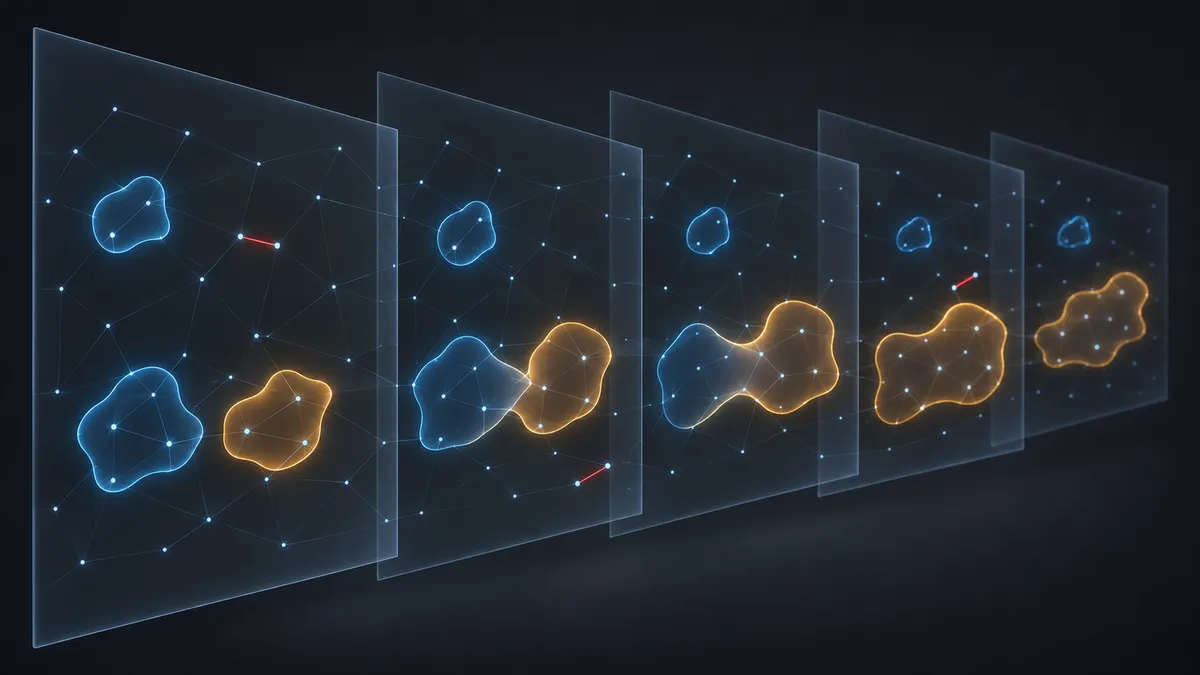
Quantum error correction generates a continuous stream of measurements, and interpreting them can delay a quantum computation. FusionQ aims to shorten that delay by starting with small decoding problems around detected activity, enlarging and merging them only when necessary.
Decoding the measurement stream
Quantum error correction protects encoded, or logical, quantum information using multiple physical qubits. Repeated checks reveal evidence of faults without directly measuring the protected logical state. A classical decoder interprets these measurements and determines a correction or an update to the record of tracked errors.
In their FusionQ preprint, Junyu Zhou and colleagues propose changing how this classical work is organized. Instead of waiting to decode an entire measurement history, or dividing it into predetermined time windows, their framework constructs local problems from the detection events actually observed.
The motivation is sparsity: at sufficiently low physical error rates, only a small fraction of detectors register unexpected outcomes. Processing those local regions during measurement acquisition could leave much less work after the final round arrives.
Small problems that grow when needed
The framework uses a detector error model: a representation connecting possible elementary faults to the detectors they would trigger. A detector tests a relation among measurement outcomes that should be predictable without errors. It “fires” when that relation is violated. One fault can affect several detectors, and multiple faults can cancel each other’s effects at a detector.
FusionQ groups nearby fired detectors according to this model’s connections, then adds their immediate detector neighborhoods. These regions include non-firing detectors, whose outcomes also constrain possible explanations.
Each local problem includes artificial, zero-cost errors at its boundary. These are mathematical devices, not additional physical faults. They let a local solver accommodate effects that might require a larger region to explain. If the selected solution uses an artificial boundary error, FusionQ expands the region and solves again.
Expansion can bring regions into contact. When their overlap includes an interior detector, FusionQ merges them, reconstructs the local problem from the original model, and repeats decoding. Even an answer that uses no artificial boundary errors remains tentative: another region may later expand into it. The framework releases the combined correction only once all active regions satisfy its completion conditions.
What the optimality guarantee means
The authors prove that combining exact local solutions gives a globally minimum-weight error explanation under specific conditions. Every fired detector must lie inside a region, distinct regions may overlap only at their boundaries, and every selected local solution must avoid artificial boundary errors. Real error weights must also be non-negative.
Under the paper’s independent-error model, minimizing weight selects the most probable individual set of elementary faults consistent with the observations. This does not guarantee that the inferred faults are the ones that actually happened, or that every logical error is corrected.
The distinction between framework and solver matters. FusionQ can use exact solvers or faster heuristic methods, but heuristic local answers do not inherit the theorem’s optimality guarantee. The theorem also establishes correctness, not a bound on decoding time.
Shorter waits in the evaluated workloads
The evaluation covers surface, bivariate-bicycle and hypergraph-product codes, using three decoder backends. Comparisons use the same backend for FusionQ and the baseline, helping separate scheduling effects from solver choice.
In the main study, each configuration used 200,000 simulated runs per measurement basis, a physical error parameter of 0.0005, and an assumed five milliseconds between measurement rounds. For the surface-code matching decoder, mean post-acquisition latency fell from approximately 56.7 milliseconds to 0.12 milliseconds. Its 99th-percentile latency—the time within which 99% of runs finished—was 0.54 milliseconds, versus approximately 90.7 milliseconds for whole-history decoding.
Other code–solver combinations showed smaller improvements and heavier tails. All main-study mean latencies remained below five milliseconds, but rare runs could take seconds. Most evaluations also raced FusionQ against a whole-history decoder and used whichever valid answer finished first; that fallback won an average of 2.28% of runs across the ten main configurations.
Correction costs always matched the whole-history baseline for the surface-code matching experiments. Tesseract, a search-based backend, occasionally differed because its search was capped. Thus, the implementation results are more qualified than an unconditional claim of identical exact decoding on every run.
Hardware and noise remain important limits
The reported latency results are not measurements of a complete deployed parallel system. The researchers timed tasks on one CPU core, then replayed their readiness and durations assuming ideal parallel resources. This evaluates the scheduling critical path, but does not establish achievable end-to-end hardware performance with finite resources and communication costs.
The assumed five-millisecond measurement period also provides substantially more overlap time than a microsecond-scale platform. Accelerating the whole acquisition-to-correction path remains future work.
Finally, increasing noise makes local regions grow and merge more often, reducing the advantage. The authors observe code- and solver-dependent crossings in latency-scaling curves, but whether these imply a well-defined large-system threshold remains open. FusionQ’s supported contribution is a conditional optimality theorem and promising scheduling results—not yet a universal real-time decoding solution.
- quantum error correction
- FusionQ
- decoding latency
- detector error model
- streaming decoding
- fault-tolerant quantum computing
Related reading
Automatically matched by shared topic keywords. These links do not imply that the sources agree or establish a consensus.
Moving atoms could make globally controlled quantum computers programmable
Source published
Shared keywords: quantum error correction
GARI++ splits quantum error correction into a fast first pass and a smaller cleanup
Source published
Shared keywords: quantum error correction
A driven superconducting circuit could correct its own quantum errors
Source published
Shared keywords: quantum error correction
Quantum turbo codes reveal a trade-off between decoding rounds and computing cost
Source published
Shared keywords: quantum error correction
Tracing photon noise from atomic scattering to quantum algorithms
Source published
Shared keywords: quantum error correction