TRANSMISSION // 2611.13110v1
How a noisy photon counter can hide infinite microscopic irreversibility
Source published
A theoretical preprint constructs a driven quantum oscillator whose imperfect detection record shows finite time asymmetry even when its fully resolved entropy production is infinite. False detector clicks conceal the absence of reverse energy exchanges at zero bath temperature, without erasing all evidence of time’s direction.
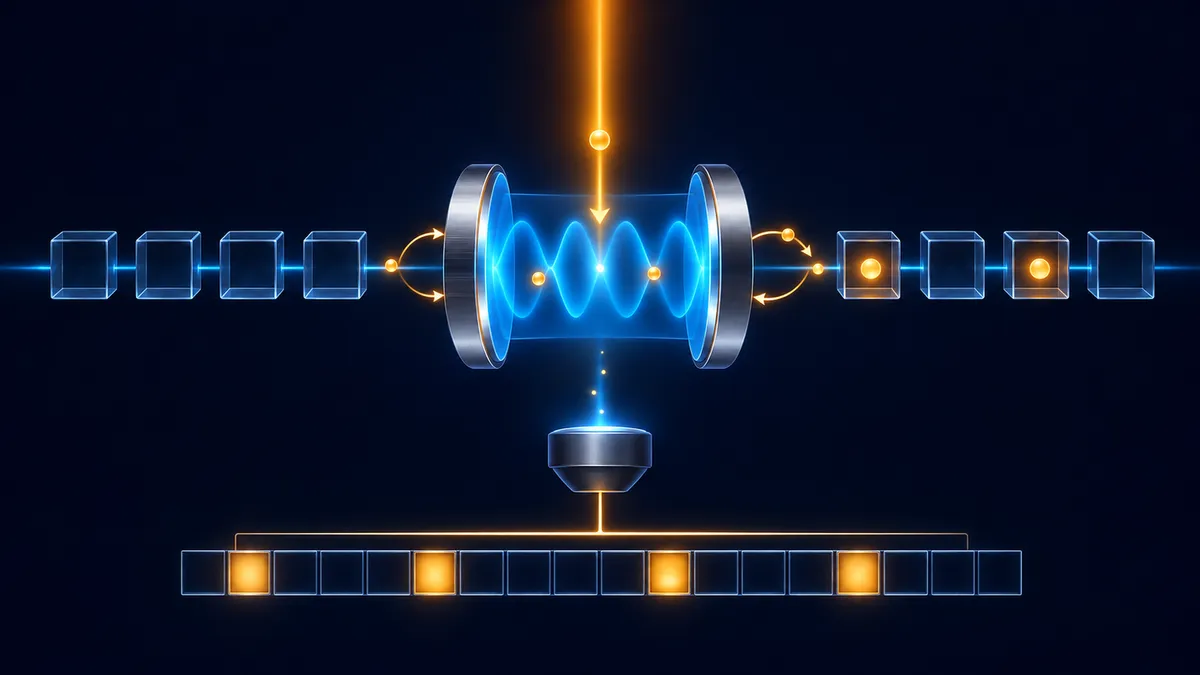
An imperfect detector can reveal that a quantum system behaves differently forward and backward in time while concealing how large that difference really is. In an arXiv preprint, Hieu Nguyen constructs a model in which finite, informative photon-counting records coexist with infinite microscopic irreversibility. The infinity concerns the probabilities of energy-exchange histories—not an infinite heat flow.
Measuring the direction of time
Entropy production can be expressed through a comparison between the probabilities of a system’s forward histories and their properly defined time reverses. The mathematical measure used here is relative entropy: an average log probability ratio that quantifies how distinguishable two distributions are. The paper uses a dimensionless entropy production, equivalent to expressing entropy in units of Boltzmann’s constant.
A detector usually records only part of a microscopic history. Such coarse-graining cannot increase relative entropy, so the measured value provides a lower bound on the fully resolved value. Nguyen’s theoretical preprint asks how much that bound can conceal while still providing evidence of time asymmetry.
The answer, within the constructed model, is an unbounded amount.
A pumped oscillator and a cold reservoir
The system is a single electromagnetic cavity mode driven by a pump that creates and annihilates excitations in pairs. This is a degenerate parametric oscillator. The pump operates below the instability threshold, allowing a stationary state with finite mean photon occupation and finite heat flow.
The reservoir is represented by a succession of independent harmonic quantum systems, called ancillas. Each arrives in a thermal state, interacts briefly with the cavity and then leaves. Comparing its occupation before and after the interaction identifies energy transferred into or out of the reservoir. In the short-interaction limit, this construction yields thermal damping with separate emission and absorption processes.
The author derives the stationary state analytically and calculates the resulting photon currents. Even when the reservoir is in its zero-temperature vacuum state, the pump maintains a positive, finite flow of energy into it.
The reverse experiment is specified physically, rather than obtained simply by playing an ordinary photon-counting record backward. It uses fresh thermal ancillas and a pump phase shifted by half a cycle. Aligned reversed histories exchange the roles of emission and absorption.
Why the microscopic quantity becomes infinite
At positive reservoir temperature, both emission and absorption are possible. Their rate ratio assigns an entropy contribution equal to the energy delivered to the reservoir divided by its temperature, with Boltzmann’s constant included for the dimensionless convention.
At exactly zero temperature, incoming reservoir ancillas contain no excitations. The cavity can still emit, but the reservoir cannot supply the excitation needed for the reversed absorption.
Some histories therefore have positive forward probability and zero aligned reverse probability. This mismatch makes their relative entropy infinite. It does not make the cavity’s energy, photon population or heat current infinite, nor does it mean every individual history reveals time’s direction with certainty.
For a fixed observation duration, the fully resolved entropy production grows inversely with reservoir temperature as the reservoir approaches vacuum. Its leading coefficient is fixed by the finite vacuum heat current. A separate contribution from the specified endpoint measurements remains bounded.
What the imperfect counter retains
The detector reports only whether each time bin contains a click. It can miss photons, be inactive during randomly selected bins and generate independent false clicks, known as dark counts. Its activity status is not recorded.
A crucial detail is that the same mathematical observation rule acts on both aligned microscopic laws. Operationally, the comparison involves emission counts forward and absorption counts in the reverse experiment, with time order aligned. It is not merely a comparison of two ordinary emission records.
At vacuum, the reverse absorption channel has no physical events, but dark counts still produce clicks. Every finite binary record consequently has positive reverse probability, making the observed relative entropy finite. Forward emissions nevertheless raise the click probability above that dark-count baseline, so the observed time asymmetry remains strictly positive.
Missed photons and finite time bins cannot achieve this alone: without false clicks, a detected emission still lacks a possible reverse counterpart. Random gating additionally supplies the paper’s explicit temperature-independent bound when the live-bin probability is below one.
Evidence, scope and interpretation
The work combines analytical proofs with numerical calculations that enumerate all 256 detector records across eight bins. The author reports checks against larger photon-number truncations and an independent Gaussian calculation. These are model calculations, not an experimental demonstration, and the source is a preprint.
For fixed observation duration and detector settings, the hidden entropy production has a leading term equal to duration multiplied by the vacuum heat current, divided by Boltzmann’s constant and reservoir temperature. The remaining correction stays bounded. The fraction visible in the detector record therefore tends to zero as the reservoir cools.
The conclusion concerns inference from partial records, not an impossibility of learning the heat flow. With additional knowledge of temperature, detector response and the dynamical model, an observer could recover the leading thermodynamic contribution. A finite measured time asymmetry alone, however, cannot establish finite microscopic irreversibility or near-reversible operation.
- quantum thermodynamics
- entropy production
- irreversibility
- photon counting
- dark counts
- coarse-graining
- parametric oscillator
Related reading
Automatically matched by shared topic keywords. These links do not imply that the sources agree or establish a consensus.
What a system’s relaxation modes can—and cannot—reveal about equilibrium
Source published
Shared keywords: entropy production
A geometric measure of extractable energy
Source published
Shared keywords: quantum thermodynamics
Engineered reservoirs help a tiny quantum refrigerator stay colder
Source published
Shared keywords: quantum thermodynamics
When a faint cosmic signal might just be a lucky scatter of photons
Source published
Shared keywords: photon counting