TRANSMISSION // 2611.13109v1
What an orbiting hot spot could reveal about a black hole
Source published
Simulations suggest that light-travel delays, motion and gravitational lensing leave distinct patterns in a fluctuating hot spot’s brightness. Comparing different halves of its image could help reveal an orbit’s orientation, but the method remains untested on realistic accretion flows and observations.
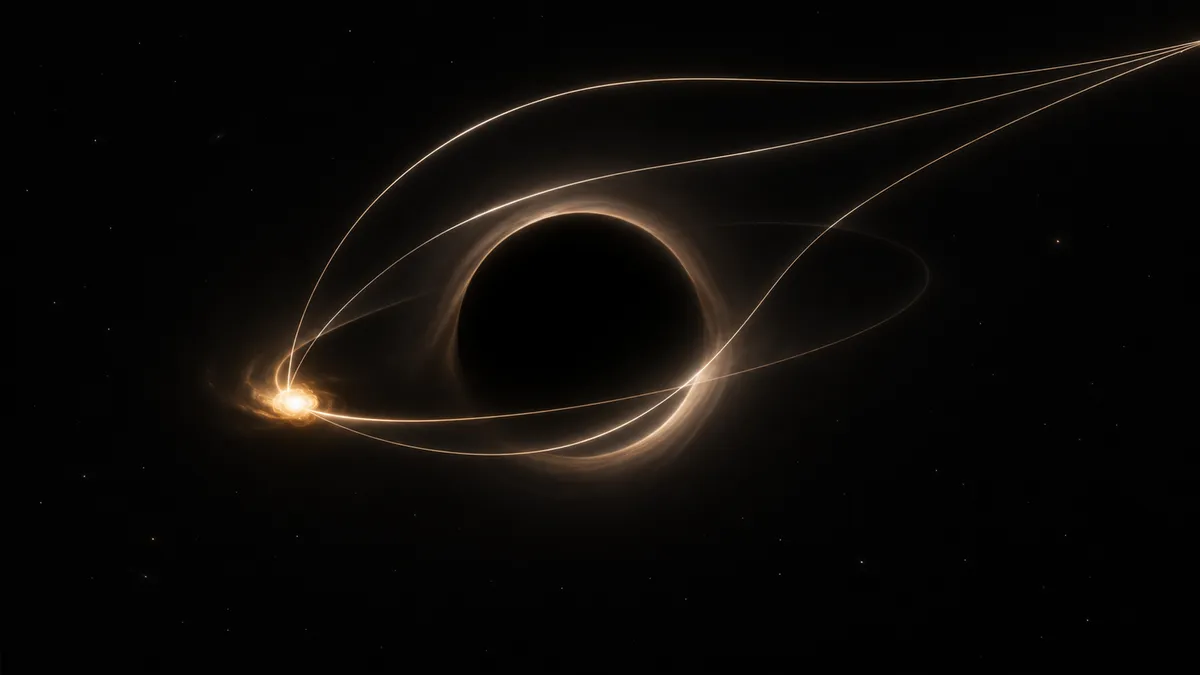
The flickering around Sagittarius A*, the supermassive black hole at the Milky Way’s centre, reflects both changing plasma and the journey its light takes to reach us. A new preprint separates those ingredients using a deliberately simple model: one orbiting patch whose brightness rises and falls regularly.
A controlled experiment in flickering
Sagittarius A* varies in brightness on timescales from minutes to hours. The paper describes how simulations of its surrounding plasma produce compact, magnetised structures often called hot spots. Such structures offer a way to investigate how the environment near a black hole transforms a changing light signal.
In their preprint, I. Urso, C. Deffayet, A. Held and F. H. Vincent ask what an observer would see if a single hot spot followed a circular orbit while its emitted brightness oscillated at one fixed frequency. Their purpose is not to reproduce the full complexity of Sagittarius A*. It is to isolate effects that could otherwise become entangled in a turbulent accretion flow.
Following light to the observer
The authors used the GYOTO ray-tracing code to create simulated image sequences. They compared three settings: flat space-time, the curved space-time around a non-rotating black hole, and that around a rotating black hole.
The flat-space comparison retained prescribed circular motion without introducing space-time curvature. Across the settings, the researchers imposed the same orbital angular-velocity prescription, allowing them to examine propagation differences without also changing the assumed motion according to each geometry.
Each movie covered five orbits, with 200 frames per orbit. Crucially, the calculations included the finite time light takes to travel. Light arriving in one frame could therefore have left different parts of the source at different times. The calculation retained the direct image and excluded delayed secondary images formed by light looping around the black hole.
From these movies, the team extracted light curves—brightness measured over time—and power spectra, which show how strongly different fluctuation frequencies contribute to a signal.
An accordion in the light curve
Even without curved space-time, the observed flickering differs from the imposed oscillation. As the hot spot approaches the observer, successive brightness changes arrive closer together. As it recedes, they arrive farther apart. The authors describe the resulting compression and stretching as accordion-like behaviour.
Motion also changes the apparent brightness through relativistic beaming: the approaching source looks brighter, while the receding source looks fainter. Meanwhile, its apparent area changes because a single image combines light emitted at different stages of the moving patch’s trajectory. That area change affects the total collected flux.
Together, these effects produce two families of spectral peaks. One occurs at the orbital frequency and its multiples. Another surrounds the imposed brightness-oscillation frequency, with neighbouring peaks separated by the orbital frequency. These are patterns in the timing of brightness variations, not a measurement of individual photons’ colours.
The authors developed a semi-analytical model in flat space-time, combining analytical calculations with a numerically determined apparent area. They report that it reproduces the qualitative spectral features found in curved space-time at moderate viewing inclinations. Consequently, many features in these simulated spectra do not uniquely identify strong gravity.
Comparing two halves of an image
The team also divided the simulated image into two halves and compared their power spectra, rotating the dividing line through different orientations.
At relatively face-on viewing angles, the spectra differed most when the division separated the approaching and receding portions of the orbit. In flat space-time, this recovered the projected angular-momentum direction exactly; gravitational lensing introduced a small offset in the black-hole cases.
For more nearly edge-on views, curvature produced stronger distortions. Lensing changed the apparent area and travel times differently on the near and far sides of the orbit. The resulting asymmetry in the sector-comparison pattern increased with inclination and showed relatively little sensitivity to orbital radius or black-hole spin across the configurations examined. The authors propose this as a possible inclination diagnostic within their model.
What remains to be demonstrated
This is a conceptual simulation study, presented as a preprint, not an observational detection or an established measurement technique.
The source contains only one hot spot, one imposed oscillation frequency and no surrounding disc background. Its brightness prescription is not tied to a specific physical emission mechanism. Real accretion flows fluctuate across many frequencies and can contain multiple evolving structures.
The simulated observations are also more extensive and finely sampled than typical hot-spot measurements, which the authors say generally cover at best about one orbit. Shorter records would make individual spectral peaks harder to distinguish.
Finally, extracting separate angular-sector signals from real interferometric data remains to be assessed. The study identifies interpretable propagation signatures in a controlled setting; whether those signatures remain useful in realistic discs and observations is still an open question.
- Sagittarius A*
- black holes
- accretion variability
- hot spots
- light-travel time
- gravitational lensing
- power spectra
Related reading
Automatically matched by shared topic keywords. These links do not imply that the sources agree or establish a consensus.
What dead stars reveal about matter, gravity and the early Universe
Source published
Shared keywords: black holes
JWST finds where a Little Red Dot’s red rise stops
Source published
Shared keywords: gravitational lensing
JWST probes the chemistry of tiny early galaxies—and a nitrogen puzzle
Source published
Shared keywords: gravitational lensing
Can geometry help astronomers find gravitational arcs?
Source published
Shared keywords: gravitational lensing
Can brightness gradients reveal subtle distortions in distant galaxies?
Source published
Shared keywords: gravitational lensing