TRANSMISSION // 2611.13104v1
Four lithium-rich giants stand out in the Small Magellanic Cloud
Source published
Astronomers report four unusually lithium-rich giant stars among 209 studied in the Small Magellanic Cloud. Their measurements suggest that stellar mixing and lithium supplied by nova outbursts both help shape the galaxy’s varied lithium abundances, but the origins of the four outliers remain unresolved.
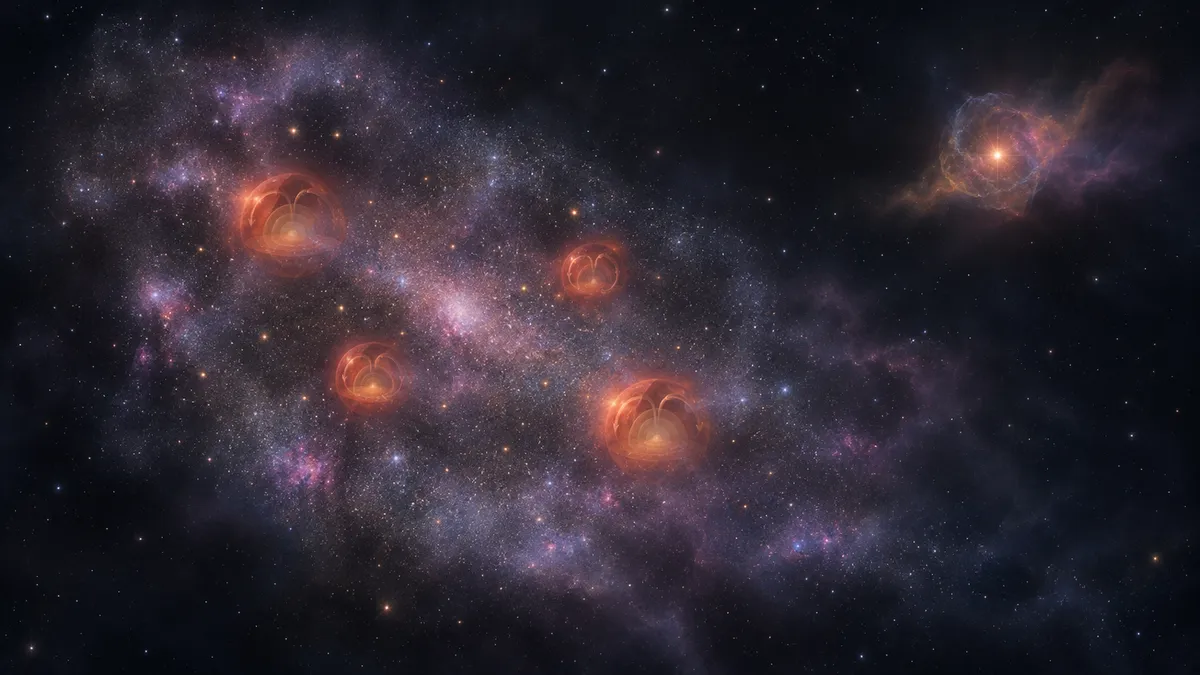
Lithium is easily destroyed inside stars, yet some ageing giants retain surprisingly strong signs of it. A study led by A. Mucciarelli uses stellar spectra and theoretical models to investigate this contrast in the Small Magellanic Cloud, finding four lithium-rich exceptions alongside a much broader spread in lithium content.
Reading a fragile chemical record
Measuring lithium beyond the Milky Way presents a difficult compromise. In older stellar populations, stars near the bright tip of the red giant branch are accessible to spectroscopy. But their surface chemistry has already changed through internal mixing, so their lithium content is not a straightforward record of the material from which they formed.
Lithium can be destroyed at temperatures of roughly 2.5 million kelvin. Mixing that connects a star’s outer layers with hotter regions can therefore reduce its surface abundance. Meanwhile, a galaxy’s gas can gain fresh lithium from sources including nova outbursts, changing the starting abundance of later generations of stars.
In an arXiv preprint, Mucciarelli and colleagues examine how these competing effects appear in the Small Magellanic Cloud. They report substantial differences between stars, along with four unusually lithium-rich giants.
Separating detections from limits
The researchers observed 209 field giants with the FLAMES instrument at the European Southern Observatory’s Very Large Telescope. They searched for a lithium absorption feature at a wavelength of 6707.8 angstroms and compared models with and without that feature.
Their statistical procedure accounted for the fact that the fitted absorption strength could not be negative. This matters when deciding whether a weak feature is distinguishable from noise.
The team classified 67 stars, about 32% of the sample, as secure detections at a significance of at least five sigma. Including weaker candidates brought the total above three sigma to 111 stars, or 53%. For stars below that threshold, the researchers reported upper limits rather than definite abundances.
They derived lithium abundances using synthetic spectra or calculated relationships between line strength and abundance, then applied corrections for three-dimensional and non-equilibrium effects in stellar atmospheres. The resulting spread was larger than the typical abundance uncertainties of 0.1–0.15 dex. A dex is a logarithmic unit: a difference of one dex means a factor of ten in the underlying abundance ratio.
Two processes could explain the spread
The authors identify stellar mixing as one likely contributor. Their Small Magellanic Cloud sample contains stars with different ages, masses and iron abundances, which need not lose lithium at the same rate.
Using the PARSEC stellar evolution code, they calculated models with masses of one and 1.5 times the Sun’s mass at four metallicities. The models included thermohaline mixing, an internal transport process associated with an inversion in the material’s mean molecular weight.
Under the adopted assumptions, higher-metallicity stars depleted more lithium when compared at the same mass and surface gravity. Higher-mass stars showed less depletion. These differences offer a plausible explanation for part of the observed scatter, rather than a unique reconstruction of each star’s history.
The second proposed contribution comes from novae. The authors’ galaxy models predict that nova-driven lithium enrichment begins at a lower iron abundance in the Small Magellanic Cloud than in the Milky Way’s disk. Their explanation is that slower star formation allows delayed lithium sources to contribute before iron enrichment has progressed as far.
The predicted rise begins around an iron abundance roughly one-thirtieth of the Sun’s value in the Small Magellanic Cloud, compared with roughly one-sixth in the Milky Way model. These are model predictions, not direct measurements of lithium production by individual novae in this dataset.
Clusters offer a limited age comparison
The team also analysed 14 giants in three Small Magellanic Cloud clusters. Lithium was securely detected in four stars in NGC 419, a cluster about 1.5 billion years old. Only upper limits were obtained in NGC 339 and NGC 121, approximately six and 10.5 billion years old.
The authors interpret the higher lithium abundance in the younger cluster as supporting enrichment over time. But three clusters provide sparse coverage, and stellar depletion also affects their measurements. Crucially, the galaxy models do not include the surface lithium losses experienced by these evolved stars, so they cannot directly reproduce the measured abundances or recover the stars’ initial lithium content.
Four exceptions, without a settled explanation
The four lithium-rich field giants make up about 2% of the sample. The authors report them as the first low-mass lithium-rich giants identified in the Small Magellanic Cloud.
Their excess lithium could have been produced internally or transferred from a companion. Available velocity and chemical measurements do not establish either explanation. One star has a Gaia astrometric indicator suggesting possible binarity, but no significant velocity change between its two available observing epochs.
The study therefore supplies constraints rather than a complete solution: even chemically altered giants retain useful information about lithium evolution, but disentangling stellar destruction from galactic enrichment requires more detailed models and observations.
- Small Magellanic Cloud
- lithium
- red giant stars
- stellar mixing
- novae
- galactic chemical evolution
Related reading
Automatically matched by shared topic keywords. These links do not imply that the sources agree or establish a consensus.
A Century of Stellar Eruptions, Recounted in the Small Magellanic Cloud
Source published
Shared keywords: small magellanic cloud
Lead-Rich Stars Offer Clues to a Hidden Heavy-Element Factory
Source published
Shared keywords: galactic chemical evolution
A close galactic encounter could bend the Large Magellanic Cloud’s bar
Source published
Shared keywords: small magellanic cloud
Low-resolution starlight reveals 133 candidate chemical families in the Milky Way
Source published
Shared keywords: galactic chemical evolution