TRANSMISSION // 2611.13103v1
Selecting training examples for quantum machine learning
Source published
A preprint adapts an information-based measure to identify which examples a quantum model finds difficult before training. Simulations suggest that selecting those examples can reduce training-data requirements, although scoring has a cost and hardware performance remains untested.
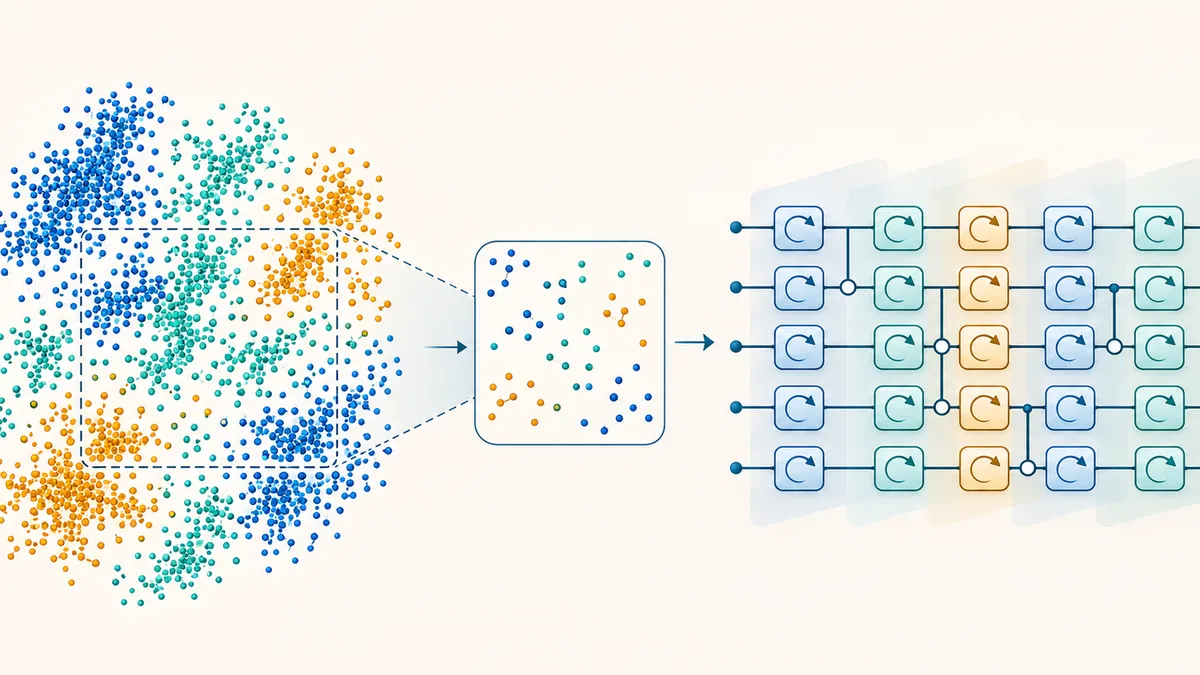
Not every training example is equally useful to a machine-learning model. A new preprint by M. Emre Sahin and colleagues investigates that question for quantum models: can researchers identify useful examples before undertaking expensive training? Their simulations suggest that a model’s initial predictions can help select smaller training sets that preserve much of its predictive performance.
Information a particular model can use
A dataset may contain information about the correct answers without a particular model being able to extract it. The researchers investigate this distinction using V-usable information, a measure defined relative to a chosen family of predictive models. Here, that family consists of quantum circuits with adjustable parameters, whose measurement outcomes determine probabilities for different labels.
The measure compares prediction without informative input against prediction with the data supplied. Both are assessed through logarithmic loss, which penalizes a model when it assigns a low probability to the correct answer. A larger improvement means more label information is accessible to that model family.
This is not a model-independent measure of a dataset’s information content. Changing the circuit architecture or the input representation can change what is accessible. Moreover, finding the mathematically best predictor within a model family is generally impractical. The study therefore estimates usable information with ensembles of model instances rather than calculating it exactly.
A sample-level version, pointwise V-information, or PVI, scores individual examples. Negative PVI means that the input-conditioned prediction assigns the correct label a lower probability than the no-information baseline. This can occur for noisy, atypical or difficult examples; it does not by itself establish that a label is wrong.
Building a quantum baseline
The comparison requires a null input that contains no information about the target label. Choosing one is not straightforward for quantum circuits, because even a fixed input state can interact with the circuit architecture to produce biased predictions.
The authors compare three candidates: a randomly prepared state, the all-zero state, and a state prepared by applying a Hadamard gate to every qubit. Hadamard gates create equal superpositions of the two computational basis states.
In the four-class phase-classification experiment, the random-state and Hadamard preparations produced predictive entropies close to two bits, corresponding to approximately uniform predictions across four labels. The authors use the simpler Hadamard preparation thereafter. Its suitability remains an empirical modelling choice, not a guarantee for every quantum architecture.
What individual examples reveal
The main phase-classification task uses 16-qubit states representing four phases of a quantum system. It contains 240 training examples and 1,000 test examples. The classifier uses ten layers of adjustable rotations and entangling gates, giving 480 trainable parameters.
Tracking PVI during training revealed uneven learning across the phase diagram. Some phases became well represented, while one phase and regions near phase boundaries remained harder. Average usable information increased more steadily than accuracy, which fluctuated later in training.
The authors also compare usable information on training and test data. Their difference follows the corresponding loss gap qualitatively. Because usable information is constructed from logarithmic loss, this relationship should not be interpreted as an independent guarantee of performance on unseen examples.
Selecting examples before training
The practical proposal is to estimate PVI using several random parameter initializations, without first training the model. Examples with lower initial PVI receive higher sampling probabilities. The hypothesis is that these examples supply useful learning signals because the untrained model does not already represent them well.
This differs from removing low-scoring examples after training: the meaning and proposed use of the score depend on when it is measured.
The researchers compare their method with random sampling, uncertainty-based selection, and two approaches intended to cover the dataset’s structure. They retain between 3.3% and 30% of the training data. In the phase task, PVI-guided selection performed best on the presented metrics when retaining at least 10%. Across that task and two additional synthetic quantum classification benchmarks, its integrated accuracy scores matched or exceeded the competing strategies.
A larger simulation—and its limits
A separate 50-qubit experiment uses classical tensor-network simulation, which represents the circuit computation in a structured form. It is not a demonstration on quantum hardware. The model is also shallower than those used in the smaller experiments.
Training on 200 selected examples from a 1,000-example dataset produced mean test accuracy of 71.6%, with a standard deviation of 2.7 percentage points across ten runs. Full-data training reached 74.2%. The 2.6-percentage-point difference was smaller than that reported standard deviation, but this alone does not establish statistical equivalence.
The result demonstrates an 80% reduction in training examples, not a measured 80% reduction in total computing cost: scoring the candidate data also requires model evaluations. The preprint does not establish an advantage over classical machine learning, and robustness to quantum hardware noise remains open. Its contribution is a tested data-selection criterion for the studied simulations, with broader usefulness still to be determined.
- quantum machine learning
- training data selection
- V-usable information
- pointwise V-information
- quantum circuits
- tensor-network simulation
Related reading
Automatically matched by shared topic keywords. These links do not imply that the sources agree or establish a consensus.
Can a Tiny Quantum Gate Help Recognize Signers the Model Has Never Seen?
Source published
Shared keywords: quantum machine learning
Putting sensitivity limits on hybrid quantum–classical AI
Source published
Shared keywords: quantum machine learning
Teaching smaller AI models with corrections they can follow
Source published
Shared keywords: training data selection
Does a quantum layer improve stock rankings—or just sit in the model?
Source published
Shared keywords: quantum machine learning
Why finite quantum circuits cannot reproduce the quantum switch
Source published
Shared keywords: quantum circuits