TRANSMISSION // 2611.13098v1
Why finite surface codes can obscure coherent-error recovery limits
Source published
A theoretical preprint identifies two widely separated size scales that can make surface-code simulations difficult to extrapolate. It also proves that, for the even-distance codes studied, optimal Pauli decoding achieves the best deterministic quantum recovery fidelity under the specified noise and measurement conditions.
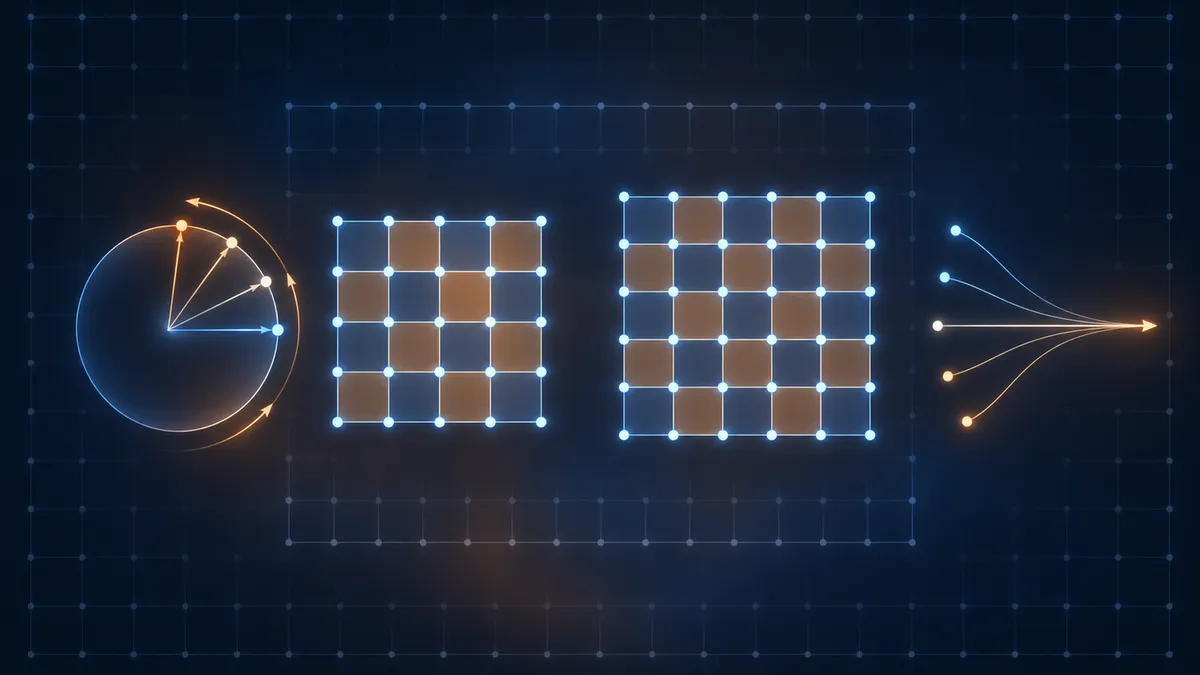
Increasing the size of a quantum error-correcting code should improve protection below its decoding threshold. But systematic, coherent errors can make that improvement difficult to recognize in finite simulations. A new preprint separates exact recovery limits from a proposed explanation of slow size-dependent behavior—and leaves the ultimate threshold unresolved.
A controlled model of systematic errors
Xu-Dong Dai, Zhou-Quan Wan, Xi Dai and Guo-Yi Zhu study square, rotated planar surface codes, which store one logical qubit across a grid of physical qubits. The code distance, denoted d, characterizes the shortest nontrivial logical error; these patches contain d squared physical qubits.
Their noise model is deliberately restricted. Every physical qubit undergoes the same coherent Z rotation, written exp(iθZ), followed by perfect syndrome measurements. A syndrome is the collection of check outcomes used to guide error correction. The study is theoretical and numerical, reported in an arXiv preprint rather than an experimental demonstration.
Unlike random phase flips, coherent rotations generate error contributions with complex amplitudes. Contributions producing the same syndrome can interfere. Their relative phases therefore matter: replacing the rotations with random flips does not preserve the full recovery problem.
The central question concerns information remaining after measurement. The rotation alone is reversible; syndrome measurement can change what recovery remains possible.
An exact distinction between odd and even distances
For each syndrome, the authors express the remaining logical operation as a combination of doing nothing and applying logical Z. Whether d is odd or even fixes the relative phase between those contributions, because the relevant stabilizer checks have even weight.
At odd distance, each conditional logical operation is a reversible rotation. With the syndrome retained and the required rotation known, a recovery can undo it perfectly. This established property does not mean that a decoder restricted to Pauli corrections—here, choosing between identity and logical Z—will succeed perfectly.
At even distance, the conditional operation instead behaves as a weak measurement of logical Z. Syndrome probabilities can reveal something about the encoded state, reducing its entanglement with an untouched reference qubit.
The authors prove that maximum-likelihood Pauli decoding achieves the highest entanglement fidelity among all deterministic, syndrome-conditioned quantum recoveries for these even-distance codes. Entanglement fidelity measures how well recovery preserves an initially maximally entangled logical qubit and reference, corresponding to a maximally mixed logical input. Maximum-likelihood decoding chooses the logical sector with the larger squared amplitude.
They also establish size-independent bounds linking this fidelity to coherent information, an information-theoretic measure evaluated with the syndrome record retained. For even distances, the measures approach perfect recoverability under exactly the same asymptotic conditions. These results establish equality of recovery limits, not the numerical location of the threshold.
Two size scales behind apparent plateaus
To investigate finite-size behavior, the researchers map coherent error amplitudes to a statistical-mechanical model with complex couplings, then to an auxiliary Majorana-fermion network. These fermions are mathematical simulation variables, not additional particles in the quantum device.
At θ = π/4, the auxiliary network propagates through deterministic signed exchanges, called the SWAP point. Departures from that point are measured by βR = −½ ln(tan θ), which tends to zero as θ approaches π/4.
The proposed crossover picture contains two very different characteristic distances. The first grows as 1/βR for odd codes and 1/βR squared for even codes. It organizes the parity-dependent departure from endpoint behavior.
The second, motivated by a long-distance field theory, grows exponentially as exp(C/βR to the fourth power), with a positive matching constant C. Renormalization-group analysis—the study of how an effective description changes with observation scale—therefore predicts extremely slow evolution across sizes.
Between these scales, decoding measures can appear almost constant or drift substantially. Such plateaus need not represent infinite-size performance.
What the simulations support
Using free-fermion simulations, the authors examine distances up to 385, generally sampling 50,000 syndromes per point and 10,000 for the largest two distances. Replotting results against βR to the fourth power multiplied by ln d approximately aligns curves from different sizes.
The alignment supports the proposed scaling picture, but residual size dependence remains. Alternative scaling powers can perform better in selected comparison windows, so the data do not uniquely determine the asymptotic exponent.
Near the SWAP point, odd-distance Pauli fidelities show a bump before falling to one-half. Even-distance curves approach one-half smoothly. At the endpoint, their identical Pauli fidelities conceal opposite information outcomes: odd-distance branches remain reversible, whereas even-distance branches projectively measure logical Z and have zero coherent information.
The threshold remains an open question
The results are consistent with optimal Pauli decoding becoming asymptotically successful for every fixed θ below π/4. They do not prove that scenario. The authors explicitly identify missing connections between the bulk field theory, logical errors and behavior beyond weak coupling.
The conclusions also depend on code geometry, available syndrome information and the noise assumptions. Imperfect measurements, unobserved angle fluctuations or mixed coherent and random errors require renewed analysis. The firm result is the even-distance recovery optimality theorem; the broader threshold picture remains a qualified interpretation of theory and finite simulations.
- quantum error correction
- surface codes
- coherent errors
- maximum-likelihood decoding
- finite-size scaling
- coherent information
Related reading
Automatically matched by shared topic keywords. These links do not imply that the sources agree or establish a consensus.
How the shape of a quantum-code region determines what it reveals
Source published
Shared keywords: maximum likelihood decoding, quantum error correction
GARI++ splits quantum error correction into a fast first pass and a smaller cleanup
Source published
Shared keywords: quantum error correction, surface codes
Tracing photon noise from atomic scattering to quantum algorithms
Source published
Shared keywords: quantum error correction, surface codes
FusionQ starts quantum error decoding before measurements finish
Source published
Shared keywords: quantum error correction
A driven superconducting circuit could correct its own quantum errors
Source published
Shared keywords: quantum error correction