TRANSMISSION // 2611.13095v1
Fermi’s unidentified gamma-ray sources yield no convincing dark matter signal
Source published
A search through 2,428 unidentified Fermi-LAT sources found no convincing evidence for dark matter annihilation. The authors derive model-dependent limits and distinguish them from stronger forecasts that would require ruling out every remaining candidate.
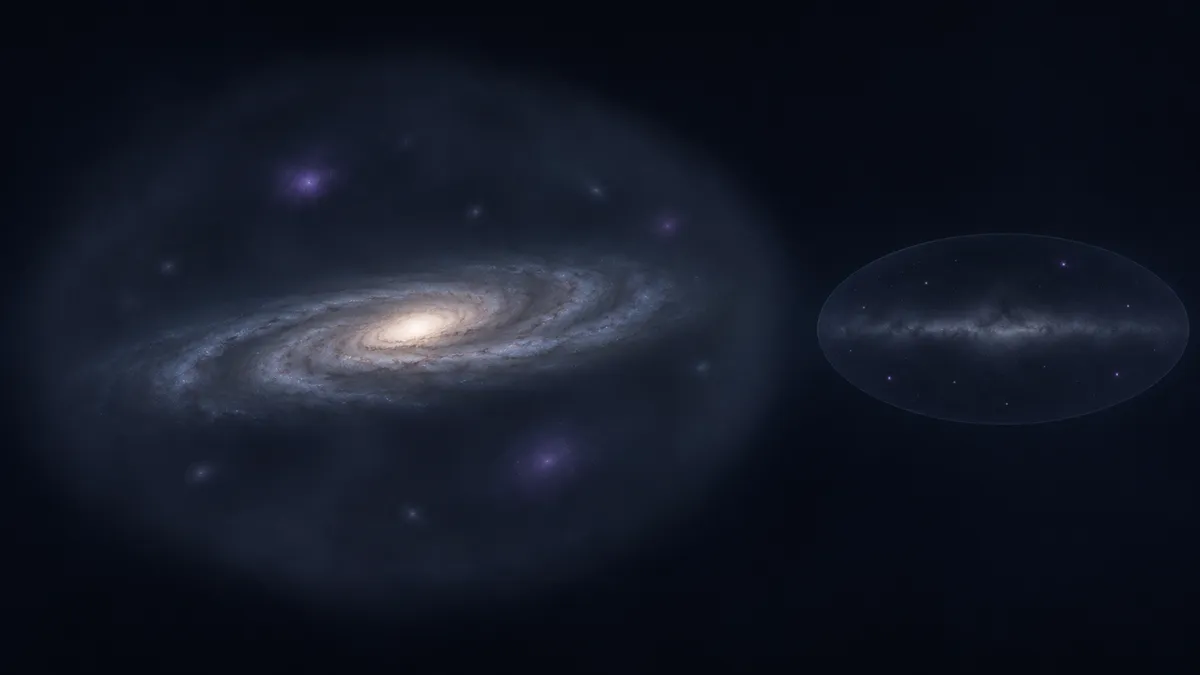
Could a gamma-ray source with no visible counterpart be a clump of dark matter? In a new preprint, Fernando Valenciano, Miguel A. Sánchez-Conde and Jorge Martin Camalich investigate that possibility using Fermi-LAT observations. Their analysis narrows the candidate list substantially, but does not establish a dark matter detection.
Looking for satellites without stars
In the standard cosmological framework, the Milky Way’s dark matter halo should contain many smaller clumps, called subhalos. Some may be too small to retain gas or form stars. These hypothetical objects are known as dark satellites: structures that could exist without the visible contents of a galaxy.
If dark matter consists of weakly interacting massive particles, or WIMPs, particle annihilations inside these clumps could produce gamma rays. A dark satellite might therefore appear in a gamma-ray catalog without a counterpart at other wavelengths. That possibility motivates the authors’ search, but an unidentified source is not itself evidence for dark matter.
The researchers began with the 4FGL-DR4 catalog, which covers 14 years of observations by the Large Area Telescope aboard Fermi. It contains 7,195 sources, including 2,428 without a clear astrophysical association.
From thousands of sources to 77 candidates
The team first selected sources with properties expected for dark satellites. They excluded objects within 20 degrees of the Galactic plane, where ordinary gamma-ray sources and diffuse emission complicate interpretation. They also removed sources flagged as variable, because annihilation emission should be steady, and required a detection significance of at least five sigma.
These cuts left 445 sources. They also deliberately excluded some regions and faint objects where genuine dark satellites could potentially occur.
Next, the authors compared the sources’ spectral shapes—how their gamma-ray emission changes with energy—with simulated annihilation spectra. Using the CosmiXs library, they explored particle masses from 5 GeV to 100 TeV, including mixtures of two annihilation channels. Selecting sources whose spectral peak and curvature fell within the modeled dark matter region left 220 candidates.
A search for possible counterparts at other wavelengths reduced that list to 77. The exclusions included tentative catalog classifications, radio and X-ray counterpart candidates, and nearby emission recorded in SIMBAD. Crucially, these were not all secure identifications: positional coincidence alone does not demonstrate that another object produces the gamma rays. The resulting sample is therefore a selection under the authors’ assumptions, not a definitive inventory of dark satellites.
Spectral resemblance is not a detection
For the 77 remaining candidates, the team analyzed almost 16 years of Fermi-LAT data, extending beyond the catalog’s observation period. They compared seven individual annihilation channels with three standard mathematical descriptions of astrophysical gamma-ray spectra.
Their comparison used the corrected Akaike Information Criterion, which weighs fit quality against the number of adjustable parameters. It measures relative support among the tested models; it does not establish a source’s physical identity.
Most results favored astrophysical descriptions. Two sources reached the authors’ nominal threshold for strong support for a dark matter spectrum before accounting for the multiple channels tested. Neither reached their decisive-evidence threshold. Testing multiple possibilities increases the opportunity for apparently favorable fits by chance, and the reported comparisons did not include that correction.
The authors also found no clustering of the preferred dark matter masses and annihilation rates across the sample. They interpret this as a lack of support for a shared dark matter explanation, rather than proof that every candidate has an ordinary origin.
Limits, forecasts and uncertain populations
Without a convincing detection, the authors compared the surviving candidate counts with predictions from a Milky Way dark matter simulation. They supplemented the simulation with smaller subhalos below its original resolution and estimated Fermi-LAT’s sensitivity for different annihilation spectra and sky positions.
This comparison yields upper limits on the average annihilation cross section multiplied by relative velocity—a quantity describing how readily the particles annihilate. The limits depend on particle mass, annihilation products and the assumed subhalo population. Retaining 77 candidates gives tighter limits than retaining 220, but neither scenario reaches the thermal-relic benchmark over the masses examined. That benchmark describes an annihilation rate associated with producing today’s dark matter abundance through early-universe thermal processes.
The stronger headline result belongs to a separate forecast. If all 77 candidates were robustly ruled out as dark satellites, the method could exclude thermal-relic WIMPs below about 50 GeV for annihilation into bottom quarks, or 30 GeV for tau leptons. The authors explicitly caution that these are projected sensitivities, not established exclusions.
Another major uncertainty is the simulation’s omission of ordinary matter. Stars and gas can affect subhalo survival and distribution, changing the predicted annihilation brightness. Those effects are not explicitly included in the reported limits.
The preprint thus offers no dark matter discovery. Its contribution is a complementary search of potentially starless structures, alongside clearer distinctions between surviving candidates, current limits and what future identifications might allow.
- dark matter
- Fermi-LAT
- gamma rays
- dark satellites
- WIMPs
- unidentified sources
Related reading
Automatically matched by shared topic keywords. These links do not imply that the sources agree or establish a consensus.
A nova’s fading visible light could guide the search for gamma rays
Source published
Shared keywords: fermi lat, gamma rays
Jupiter’s atmosphere offers an indirect way to study faint cosmic gamma rays
Source published
Shared keywords: gamma rays
What millimeter waves reveal about gamma-ray blazars
Source published
Shared keywords: fermi lat, gamma rays
Gamma rays reveal differences in how galaxies retain cosmic rays
Source published
Shared keywords: fermi lat
Galactic Center Gamma Rays Stay Extreme, but IceCube Finds No Neutrino Counterpart
Source published
Shared keywords: gamma rays