TRANSMISSION // 2611.13089v1
Motion-dependent quantum geometry predicts altered inertia and Hall currents
Source published
A theoretical preprint extends Born–Oppenheimer geometry to quantum states that depend on both coordinates and velocities. Two model systems illustrate changes in effective inertia, circuit capacitance and nonlinear transverse currents, provided the fast quantum variables can follow the motion-dependent states.
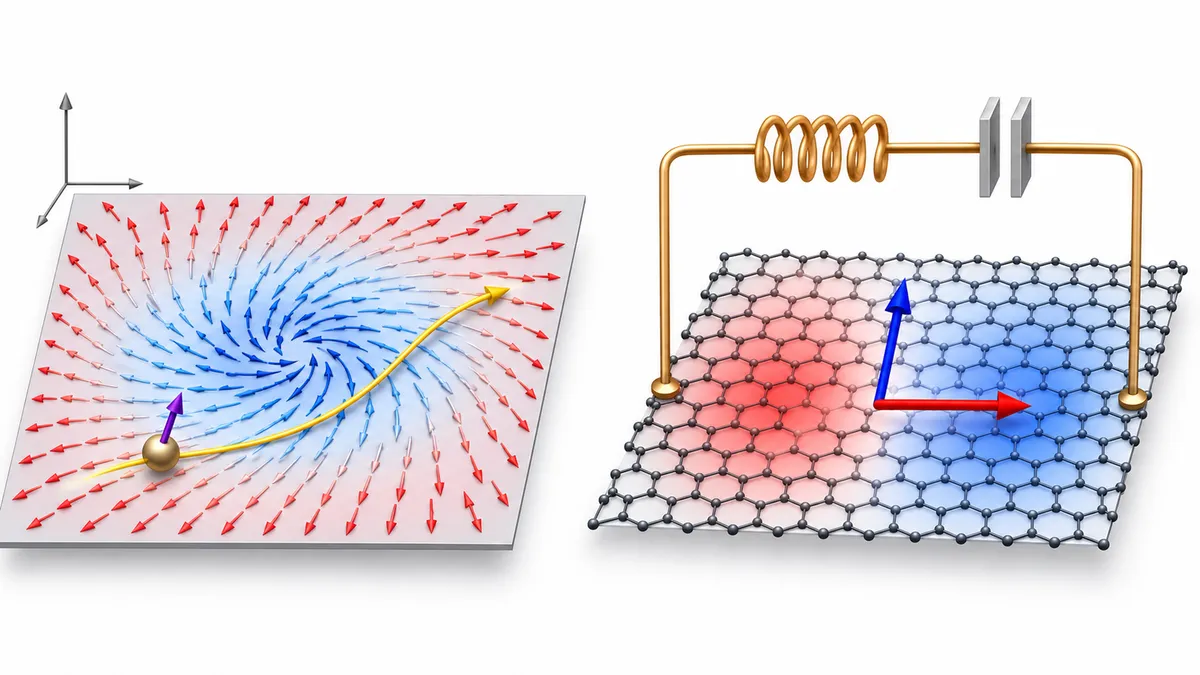
Separating fast quantum motion from slower dynamics simplifies many physics problems. But the fast subsystem may respond not only to the slower subsystem’s coordinates, but also to its velocity. Bernardo Barrera and colleagues develop a framework for that dependence and compare its predictions with numerical simulations.
Beyond coordinate-dependent states
The Born–Oppenheimer approximation describes systems whose components evolve on different timescales. Fast degrees of freedom—the variables describing the fast subsystem—are assumed to follow an instantaneous quantum eigenstate determined by slower coordinates. An energy eigenstate has a definite energy for the Hamiltonian, the operator describing the system’s energy.
This separation does not eliminate the influence of the fast subsystem. Its quantum geometry, describing how states change as parameters vary, affects the slower motion. One ingredient, Berry curvature, can generate a transverse force with the mathematical form of a magnetic Lorentz force.
In their preprint, “Kinematic Quantum Geometry,” the authors extend this description to states that depend on both slow coordinates and their velocities. They address situations where ordinary Born–Oppenheimer states change too rapidly along a trajectory for the fast subsystem to keep following them.
Building motion into the states
The researchers construct a Hamiltonian in a frame moving with the ordinary Born–Oppenheimer basis. It includes an additional velocity-dependent term accounting for the effect of that motion on the fast variables. Its eigenstates define their kinematic Born–Oppenheimer states.
The geometry of these states occupies an expanded parameter space containing coordinates and velocities. Besides curvature involving two coordinates, it contains mixed curvature linking a coordinate to a velocity. In the resulting equation of motion, this mixed curvature changes the relation between force and acceleration, acting as a velocity-dependent effective mass tensor. A tensor allows that response to differ with direction.
The authors derive effective dynamics using a time-dependent variational principle, which approximates evolution within a chosen family of states. They compare predictions with coupled numerical equations: the fast variables evolve quantum mechanically, while the slow variables move classically and experience forces from the quantum subsystem.
Distinguishing radial inertia from transverse deflection
The first example is a spinful particle moving through a fixed magnetic texture—a field whose direction changes with position. Its direction rotates with distance from the origin but remains in one plane.
For the branches studied, ordinary Born–Oppenheimer theory gives constant energy surfaces and zero spatial Berry curvature. Without an external force, it therefore predicts free motion.
In the kinematic description, radial motion tilts the spin out of the texture’s plane. Mixed curvature modifies radial inertia without changing the mass governing azimuthal acceleration. Under a constant radial force, the excited, parallel-spin branch accelerates faster than the ordinary prediction, while the antiparallel branch accelerates more slowly. At large radial speed, the correction decreases and the bare mass is recovered.
Spatial curvature has an additional requirement: it is proportional to azimuthal velocity, with a coefficient that depends on radial velocity and distance from the origin. Purely radial motion can tilt the spin and exhibit mixed curvature, but its spatial curvature vanishes. With azimuthal motion, spatial curvature contributes a transverse force that, together with the kinematic energy surface, controls trajectory deflection.
For the trajectory illustrated in the paper, a low-velocity expansion substantially overestimates deflection. The full kinematic equation closely follows the numerical reference. This is a model comparison, not an experimental observation.
Graphene feeds back on a circuit
The second example couples doped, massless graphene to an LC circuit containing inductance and capacitance. Two circuit fluxes serve as slow coordinates; their time derivatives are voltages, which determine electric fields in the graphene.
In the ordinary description, local Berry curvature vanishes for this graphene model. In the kinematic description, the electric field changes the electronic states and induces curvature.
Mixed curvature modifies the circuit’s effective capacitance, producing an additional oscillation-frequency shift beyond the ordinary Born–Oppenheimer prediction. Another curvature contribution generates current perpendicular to the electric field—a Hall response.
The induced curvature has a dipolar pattern, with oppositely signed regions. Its coupling to the displaced electronic distribution produces a nonlinear Hall current. Because the curvature pattern is itself field-induced, this response appears at third order in the electric field rather than second order. The circuit calculations assume collisionless dynamics, with scattering slow compared with the oscillation timescale.
Conditions and remaining limits
The framework does not cover arbitrary rapid motion. The fast subsystem must still follow the kinematic states with little transition between them. Large velocities can satisfy this condition when the moving-frame Hamiltonian varies sufficiently slowly and acceleration remains small. In the radial-texture example, radial position dependence disappears in that frame, allowing large radial speeds under sufficiently weak forcing.
The approach also neglects effects associated with correlated velocity fluctuations, including energy corrections and induced interactions captured by a related moving Born–Oppenheimer framework. Those omissions matter when the relevant fluctuations are substantial. Incorporating transitions between kinematic states to describe dissipation remains future work.
The preprint offers a conditional unification: altered inertia, circuit capacitance and nonlinear Hall response can arise from one motion-dependent quantum geometry. Its evidence consists of analytical derivations and numerical model comparisons, not a reported experimental demonstration.
- kinematic quantum geometry
- Born–Oppenheimer approximation
- Berry curvature
- effective mass
- graphene
- nonlinear Hall response
- quantum-classical dynamics