TRANSMISSION // 2611.13085v1
Entanglement Along Time Distinguishes Two Ways to Be an Insulator
Source published
A theoretical preprint studies entanglement associated with a time interval at a fixed position in one-dimensional free-fermion systems. Its calculations distinguish clean gapless systems, band insulators and disorder-localized insulators, while revealing a strong dependence on time sampling.
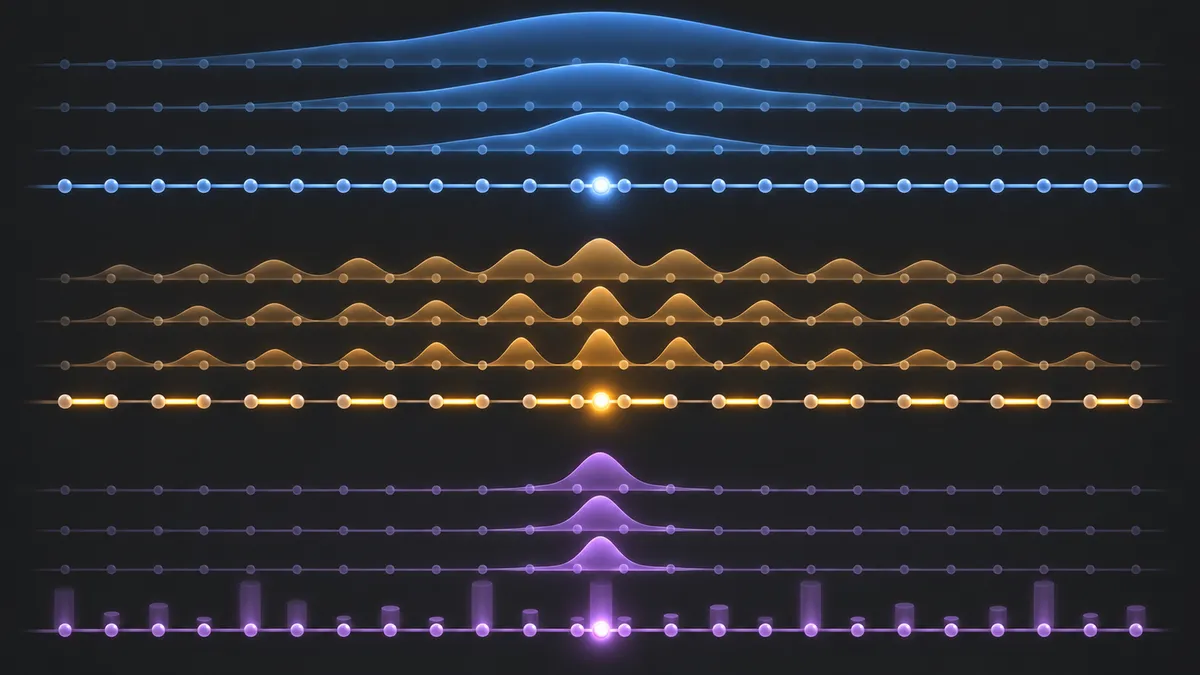
Entanglement is usually calculated by dividing a quantum system into spatial regions. Xinyu Sun, Bowei Liu, Joshua Yi and Biao Lian instead examine a subsystem defined through operators at one location over a time interval. Their preprint finds that this time-direction entanglement can distinguish insulating ground states whose spatial entanglement follows the same broad scaling rule.
Defining a subsystem through time
Conventional entanglement entropy measures quantum correlations between a subsystem and its complement. For a chain of particles, the subsystem might be a consecutive stretch of lattice sites. The authors investigate a different construction: a fixed site sampled repeatedly over a time interval.
These samples cannot simply be treated as independent copies of the site. Operators describing particle creation or removal at different times generally overlap in the quantum degrees of freedom they involve. The calculation must account for that overlap before defining an entropy.
The study uses free fermions: particles whose Hamiltonian contains hopping and on-site terms but no particle-particle interactions. In these models, a time-evolved particle operator remains a linear combination of the original operators. The researchers identify independent, orthonormal fermion modes spanning those combinations, then calculate ordinary entanglement entropy for the resulting subsystem. They call the quantity time-direction entanglement entropy, or TDEE.
Although the operators evolve, the physical state is a ground state of a time-independent Hamiltonian. The results therefore do not describe entropy produced by heating or by driving the system out of equilibrium.
Three distinct long-time behaviors
The authors compare three types of one-dimensional ground states. When the sampling interval becomes very small, they report different dependences on the total duration, T.
For clean, gapless fermions—systems without disorder or an energy gap at the boundary between occupied and empty states—the single-site entropy grows logarithmically. For the nonchiral fermion model considered, the coefficient multiplying the natural logarithm is 1/6, plus an additive constant. This is half the familiar spatial-interval coefficient, 1/3. The authors connect the difference to one occupation discontinuity at the Fermi energy in the temporal calculation, rather than two at opposite Fermi momenta in the spatial calculation.
For band insulators, an energy gap separates a filled band from an empty one. Their TDEE approaches a constant as duration increases. The paper calls this an area law: in this one-dimensional setting, entropy does not keep increasing with interval length.
For Anderson insulators, random on-site potentials localize particle wavefunctions. Numerical calculations instead show entropy decreasing at long durations approximately as an inverse power of T. The authors call this a sub-area law. Spatial entanglement, by contrast, follows an area law for both kinds of insulator.
Why sampling matters
The time between samples, denoted tau, is not an incidental numerical setting. At finite tau, even a band insulator can exhibit logarithmic growth or a volume law, meaning entropy proportional to duration.
For clean systems, the relevant parameters combine tau with the energy gap and band widths. Different energies can acquire the same evolution phase between successive samples, changing the occupied and empty contributions to the temporal subsystem. Consequently, a large TDEE growth rate at coarse sampling does not establish that the underlying ground state is gapless.
To explain these regimes, the authors use numerical correlation matrices and an analytical framework involving Toeplitz matrices, whose entries depend on the difference between their indices. Fisher–Hartwig asymptotics relate discontinuities in associated Fourier functions to logarithmic entropy terms. Parts of the analysis use simplified linear energy dispersions and translation-invariant approximations; some coefficient estimates are lower bounds rather than exact results for the lattice models.
Localization and declining entropy
For the disordered chains, the researchers average calculations over 500 random-potential realizations. At sufficiently weak localization, entropy initially grows roughly logarithmically, reaches a crossover and then decreases. The crossover sample count approximately tracks the localization length, a measure of how far a localized wavefunction extends.
Their interpretation is that operators at one site effectively access a limited nearby set of modes. As the temporal subsystem includes more of that set, less remains in its effective complement to contribute entanglement. Strongly localized examples show mostly the declining portion. The decay exponent depends on parameters, and finite system sizes affect the more weakly localized cases.
What remains uncertain
The continuum-time construction also requires care. The authors argue that an effective temporal subsystem stabilizes as sampling becomes finer, supported by calculations that discard modes with nearly zero overlap-matrix eigenvalues. Those eigenvalues are not exactly zero in the finite matrices, so this stabilization is an approximate, physically motivated claim rather than an unrestricted exact-rank result.
The work is a theoretical arXiv preprint, not an experimental demonstration. Extending its subsystem construction to interacting particles remains unresolved. Within the studied free-fermion models, its central result is that temporal entanglement depends on both the ground state and the Hamiltonian governing operator evolution, allowing it to separate two mechanisms of insulating behavior.
- quantum entanglement
- time-direction entanglement entropy
- free fermions
- Anderson localization
- band insulators
- quantum ground states
Related reading
Automatically matched by shared topic keywords. These links do not imply that the sources agree or establish a consensus.
A sharp limit on density fluctuations in free-fermion lattices
Source published
Shared keywords: free fermions
Quantum entanglement could build patterns that outlast it
Source published
Shared keywords: quantum entanglement
When does neutrino entanglement matter? Quantum simulations test the limits
Source published
Shared keywords: quantum entanglement
Entangled qutrits reach the quantum limit in a two-player hat game
Source published
Shared keywords: quantum entanglement
Linked quantum states retain an arithmetic fingerprint
Source published
Shared keywords: quantum entanglement