TRANSMISSION // 2611.13084v1
Uneven magnetic fields enable broadband amplification in a superconducting circuit
Source published
A preprint reports that spatial variations in magnetic field can help a superconducting microwave amplifier sustain three-wave mixing across a broad frequency range. Measurements and simulations support a mechanism in which the nonlinear interaction reverses sign along an otherwise uniform circuit.
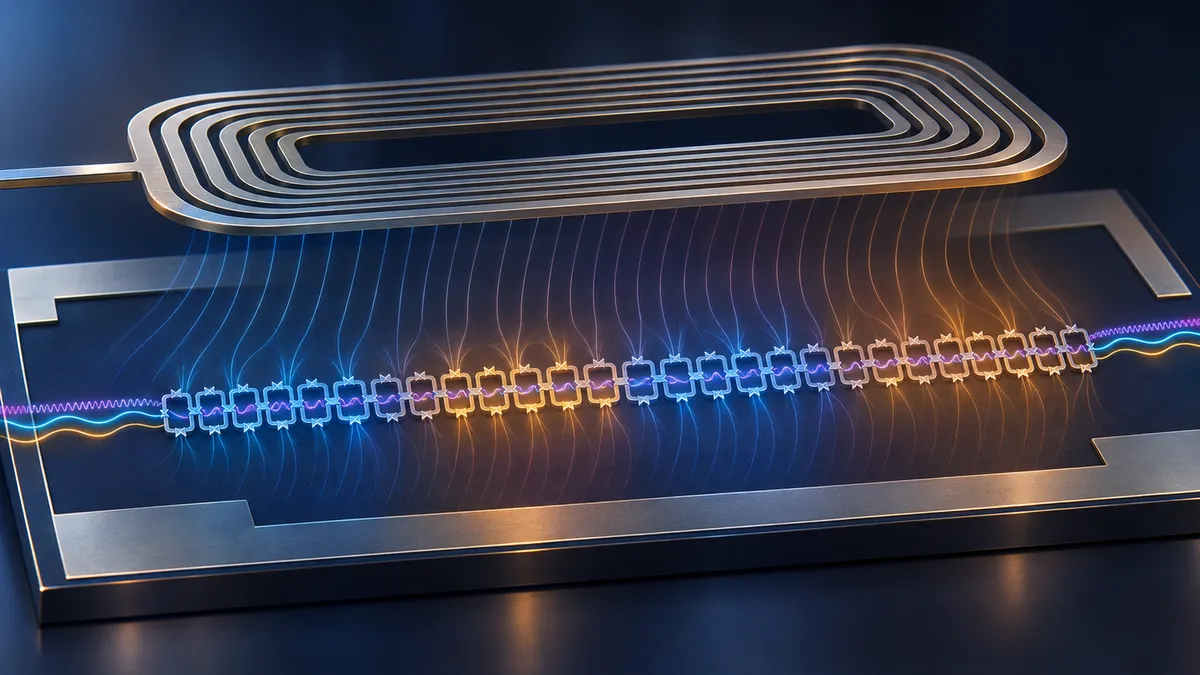
Superconducting microwave amplifiers must transfer energy from a strong pump into weak signals without letting their wave phases drift into an unfavorable relationship. Researchers report that an uneven magnetic field can help maintain amplification in a chain of identical superconducting elements, without adding dedicated phase-matching resonators.
Why phase matching matters
Weak microwave signals carry information in superconducting quantum circuits. Josephson traveling wave parametric amplifiers, or JTWPAs, strengthen these signals as they travel through a chain of nonlinear superconducting elements. Nonlinearity means the circuit’s response is not simply proportional to its excitation, allowing energy transfer between different frequencies.
That transfer requires a suitable relationship between the phases of the participating waves. Because different frequencies propagate differently, their relative phases can accumulate a mismatch along the circuit. Amplification generated in one region can then be canceled by interactions farther along the chain.
Many designs address this problem by adding resonators that modify how waves propagate. In their arXiv preprint, Daniil E. Bazulin and colleagues investigate a different approach: using a spatially varying magnetic field to change the nonlinear interaction along an otherwise uniform amplifier. The findings are reported as a preprint, not an established peer-reviewed result.
A uniform circuit under a nonuniform field
The device contains 912 superconducting nonlinear asymmetric inductive elements, known as SNAILs. Each combines Josephson junctions—connections between superconductors through thin insulating barriers—into a loop whose response can be tuned with magnetic flux. The chain follows a meandering path on a chip and contains no dedicated on-chip phase-matching structures.
The researchers cooled the device to approximately 15 millikelvin and applied magnetic bias using a superconducting coil. They measured microwave transmission with and without a strong pump, varying both pump power and magnetic flux.
Two amplification processes were examined. In three-wave mixing, one pump photon supplies energy to a signal photon and a companion idler photon. In four-wave mixing, two pump photons supply that energy. For amplification centered near 6 gigahertz, the experiments used a 12-gigahertz pump for three-wave mixing and a 6-gigahertz pump for four-wave mixing.
Amplification emerges at higher magnetic bias
At relatively small magnetic flux, the device showed four-wave-mixing amplification but no measurable three-wave-mixing gain, including at bias points expected to favor that process in an individual SNAIL.
The pattern changed as the bias increased. Four-wave-mixing gain weakened, while three-wave-mixing amplification emerged. With the 12-gigahertz pump, this occurred at flux offsets around six superconducting flux quanta and above. A flux quantum is the characteristic unit used to describe magnetic flux in superconducting circuits. The resulting amplification covered approximately 4–8 gigahertz.
Measurements with 10- and 11-gigahertz pumps showed that three-wave amplification began at lower flux offsets when the pump frequency was lower.
The team also tested two alternative explanations. Broadband measurements placed the device’s propagation cutoff near 18 gigahertz at zero magnetic field, already below the 24-gigahertz second harmonic of the 12-gigahertz pump. This argued against that harmonic being the loss channel responsible for suppressing low-field gain. They also found no flux-tunable resonance near the pump frequencies that could explain the behavior through pump reflection.
How the field changes the interaction
The magnetic field is not uniform across the chip. Besides the coil’s geometry, the superconducting ground plane redirects magnetic flux into openings and near edges, a process called flux focusing.
To estimate this variation, the researchers measured the phase accumulated by a weak signal traveling through the unpumped chain. They fitted those measurements with a simplified, two-dimensional Gaussian field profile. The fitted profile implies that SNAILs near the chain’s ends receive about 22 percent less flux than central elements. The inferred variation was much larger than expected from coil geometry alone.
At sufficiently high bias, these local flux differences produce regions where the three-wave-mixing interaction has opposite signs. Reversing the interaction at suitable positions allows successive regions to reinforce amplification despite propagation-induced phase mismatch. This is a form of quasi-phase matching; it does not require eliminating the underlying difference in wave propagation.
Two numerical models supported this interpretation. One retained only pump, signal and idler modes; the other included additional frequency-mixing products. Both reproduced the broad crossover and the dependence of amplification onset on pump frequency. Higher pump frequencies required finer regions of alternating interaction sign, reached at higher magnetic bias.
Noise and remaining uncertainty
Using a temperature-controlled microwave noise source and a calibration that included both signal and idler contributions, the researchers estimated average added noise above the standard quantum limit of 0.32 ± 0.27 photons for four-wave mixing and 0.45 ± 0.23 photons for three-wave mixing. They defined that limit as half a photon for the intended narrowband signal application.
The measurements and simulations support field-induced quasi-phase matching, but the spatial field profile was inferred through a simplified model rather than directly mapped. The reduced model also treats the two mixing processes separately and includes phenomenological losses. The work demonstrates an alternative design approach in this device; it does not establish that it outperforms resonator-based amplifiers or that removing resonators necessarily reduces noise.
- superconducting microwave amplifiers
- Josephson junctions
- three-wave mixing
- quasi-phase matching
- magnetic flux
- quantum noise
Related reading
Automatically matched by shared topic keywords. These links do not imply that the sources agree or establish a consensus.
What tiny superconductors need to become reliable quantum devices
Source published
Shared keywords: josephson junctions
Why an optically transparent medium can still carry quantum noise
Source published
Shared keywords: quantum noise
An exact theory explains the speed limits of measurement-driven quantum preparation
Source published
Shared keywords: quantum noise
Quantum junctions produce a different butterfly spectrum
Source published
Shared keywords: magnetic flux