TRANSMISSION // 2611.13082v1
Magnetic fields can weaken stellar waves—and help generate them
Source published
Simulations suggest that erasing some stellar gravity modes requires magnetic fields roughly ten times stronger than a commonly used linear estimate. The authors propose that magnetic stresses replenish waves even as the field attenuates them, complicating attempts to infer hidden stellar magnetism.
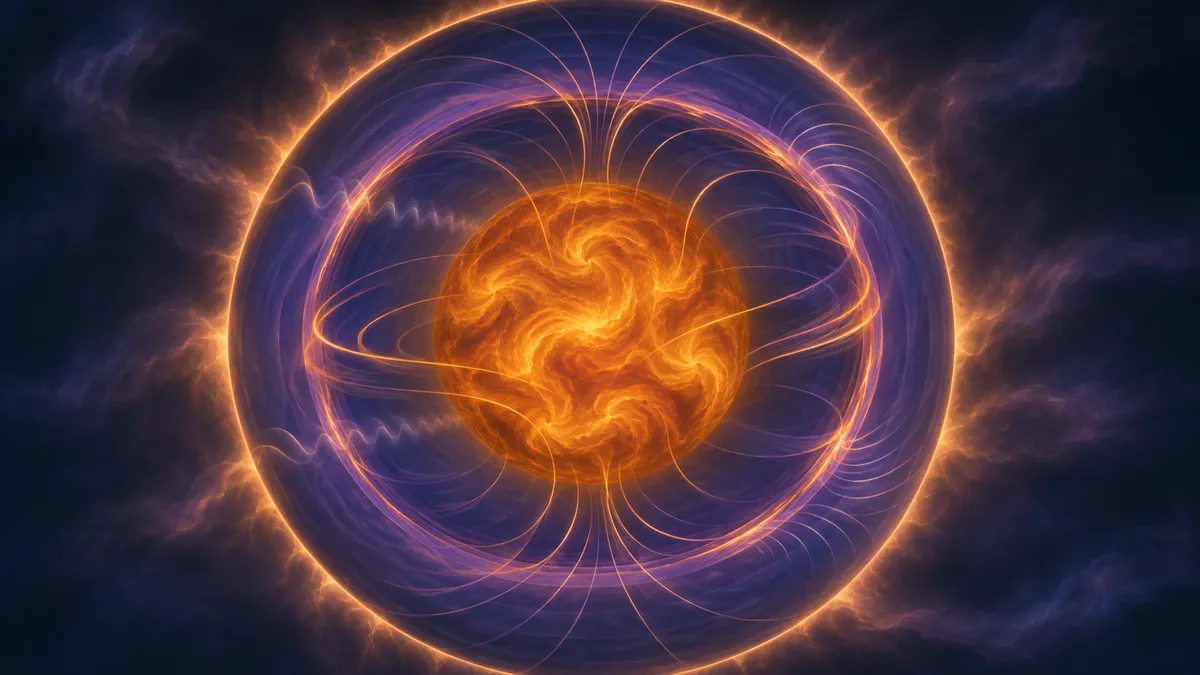
Missing stellar oscillations may not provide a straightforward measure of a star’s internal magnetic field. In an arXiv preprint, T. M. Rogers and colleagues report that magnetic fields can both reduce and enhance gravity-wave amplitudes, with complete suppression requiring substantially stronger fields than a widely used theoretical criterion predicts in their simulations.
Reading a star through its oscillations
Internal gravity waves travel through stably stratified regions of stars, where buoyancy provides a restoring force. These waves can form standing oscillations called gravity modes, or g-modes. Their frequencies and patterns help astronomers investigate otherwise inaccessible stellar interiors.
Magnetic fields complicate that picture. Waves distort magnetic field lines, and magnetic forces act back on the moving gas. Earlier linear calculations suggested that sufficiently strong fields could convert gravity waves into magnetic waves, preventing the reflections needed to establish standing g-modes. Astronomers have used related suppression criteria to estimate limits on internal field strengths.
Rogers and colleagues ask whether those criteria adequately describe an entire spectrum of waves interacting with an evolving field. Their preprint reports numerical experiments, not new stellar observations, and does not establish a peer-reviewed result.
Simulating generation as well as propagation
The researchers modeled an equatorial slice of a slightly evolved main-sequence star with twice the Sun’s mass. Their two-dimensional magnetohydrodynamic simulations followed the coupled behavior of conducting gas and magnetic fields, including nonlinear interactions.
Convection in the core generated a spectrum of waves that propagated into the surrounding radiative region. Unlike calculations centered on a single incoming wave, this setup allowed magnetic fields to affect both wave generation and subsequent propagation.
The team compared a nonmagnetic reference model with several imposed field configurations. Some fields connected the convective core to the radiative region; others were concentrated in narrow radial layers. Part of the imposed field was maintained throughout each simulation, while other components could evolve in response to the flow. Each simulation ran for at least 30 million seconds of modeled time.
Weaker does not mean erased
The authors found that increasing field strength generally reduced low-frequency wave amplitudes more strongly than high-frequency amplitudes. The change was gradual, rather than an abrupt disappearance at the threshold predicted by the linear criterion. Some higher-frequency modes became stronger, and certain localized fields enhanced amplitudes across much of the spectrum.
A key distinction is what counts as suppression. The authors defined “strong” suppression as both an amplitude reduction of at least a factor of ten and disruption of the mode’s gravity-wave structure. A mode could instead become weaker while retaining that structure.
For three localized models with the same field profile but different peak strengths, strong suppression extended to progressively higher frequencies. Peak radial fields of 500,000 gauss suppressed modes up to roughly 8–9 microhertz; 700,000 gauss reached about 10 microhertz; and one million gauss reached about 12 microhertz.
Comparing those strengths with the linear estimate at the field peaks gave ratios of approximately 9.5–10.3. The authors therefore identify a roughly tenfold correction for this particular comparison—not a demonstrated universal conversion factor for all stars.
A field can also supply waves
Why might stronger fields be needed? The authors propose that magnetic stresses partly replenish the wave motions being attenuated.
Their simulations contained both radial and azimuthal magnetic components. Oscillations of these components produce Maxwell stresses: stresses associated with the magnetic field that can drive fluid motion and generate waves. The calculated stresses support this proposed additional source of excitation.
Fields connected to the core also reduced convective velocities, weakening the motions that normally excite waves. Localized fields largely avoided that reduction in convective driving, making their wave-enhancing effects particularly apparent.
The explanation remains qualified. The authors acknowledge that their nonlinear simulations cannot trace exactly which stress drives each individual wave. Additional magnetic excitation is their proposed explanation for the higher suppression thresholds, rather than a separately isolated measurement of every energy-transfer pathway.
Limits on interpreting missing modes
The simulations are two-dimensional and cannot sustain their own dynamo, so the background field must be imposed. Their diffusivities also differ from stellar values. Tests with lower magnetic diffusivity produced similar suppression behavior in the examined models, but did not reach actual stellar conditions.
Thermal diffusion and radial resolution particularly constrain the lowest-frequency modes, near the range where suppression appears. The quantitative correction also rests on a limited set of field strengths; stronger or more sharply concentrated fields showed indications of magnetic instabilities that were not investigated in detail.
Finally, an observationally missing mode need not have lost its underlying wave structure: it may simply fall below a detection threshold. The authors argue that interpreting mode visibility requires accounting for excitation, attenuation and noise—not just whether a field exceeds a linear propagation threshold. Extending the numerical correction to red giants or other stars will require further investigation.
- asteroseismology
- stellar magnetic fields
- gravity modes
- magnetohydrodynamics
- stellar convection
- wave suppression
Related reading
Automatically matched by shared topic keywords. These links do not imply that the sources agree or establish a consensus.
How faithfully can astronomers map a star’s magnetic field?
Source published
Shared keywords: stellar magnetic fields
A nearby star system emits low-frequency radio waves—but what powers them?
Source published
Shared keywords: stellar magnetic fields
A white dwarf’s abrupt magnetic switch hints at compact atmospheric regions
Source published
Shared keywords: stellar magnetic fields
Changing red-dwarf winds could reshape magnetic links with nearby planets
Source published
Shared keywords: stellar magnetic fields