TRANSMISSION // 2611.13080v1
How a cosmic plasma could ease two dark-matter constraints at once
Source published
A theoretical study proposes that a weak interaction with the early Universe’s hot particle bath could both reduce the abundance of a light scalar dark-matter candidate and damp its unwanted isocurvature fluctuations. The mechanism depends on amplitude-sensitive thermal damping and sustained tracking of a common attractor; it is a model-based result, not an observational discovery.
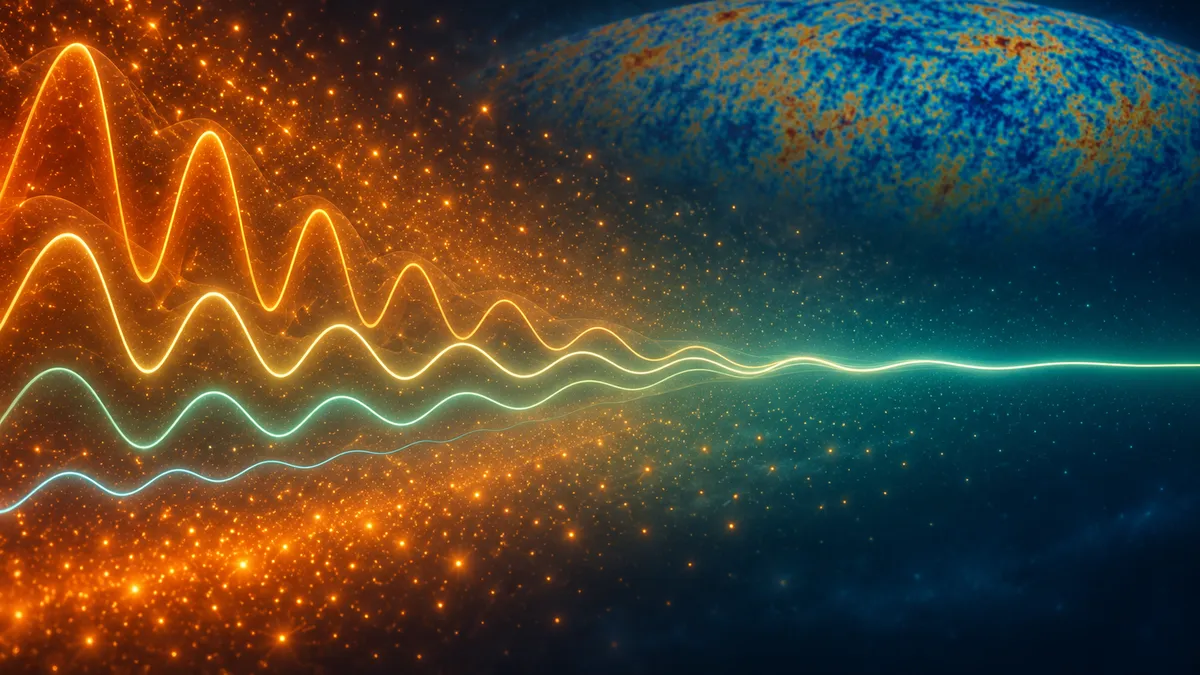
A light field left over from inflation might help make up dark matter—but its initial abundance and fluctuations can create a difficult pair of constraints. Erwin H. Tanin and Sarunas Verner investigate whether a weak interaction with the early Universe’s plasma can soften both problems. Their answer is a theoretical mechanism, not evidence that this kind of dark matter exists.
A light field in the early Universe can begin with a nonzero value and later oscillate as the cosmos expands. Those oscillations can behave like a population of dark matter. But the field may also carry its own fluctuations, generated during inflation independently of the inflaton. In cosmology, differences between the fluctuations of different components are called isocurvature. Measurements of the cosmic microwave background (CMB) limit how much of this kind of signal can be present.
That creates a tension in the simplest version of the idea. A small starting field value can help prevent the field from producing too much dark matter, a problem known as overclosure. But a larger starting value can make the field’s relative fluctuations smaller, easing the isocurvature constraint. The paper asks whether the hot particle bath present after reheating could change the field’s later evolution enough to help with both limits.
A plasma that can drain energy
Tanin and Verner study a real scalar field, called χ, that changes the effective mass of a fermion, ψ. The fermion is assumed to exchange energy with the Standard Model plasma and remain thermally populated. As χ evolves, the plasma’s response does not adjust instantly: it takes a finite time to equilibrate. That lag can exert a friction-like effect on the scalar, transferring energy from its oscillations into the plasma. The authors distinguish this thermal damping from equilibrium thermal effects, such as a temperature-dependent contribution to the scalar’s effective mass.
The authors analyze the scalar’s oscillation amplitude and its large-scale perturbations, focusing on a period after reheating during radiation domination. They derive how the amplitude and perturbations evolve under damping, and how those results depend on the plasma’s thermalization rate. They also illustrate the mechanism with a benchmark example in which that rate changes its temperature dependence at a chosen temperature. The paper’s setup is deliberately limited: it does not require the same model to describe the field during inflation, reheating, and all later cosmic history.
One effect on abundance, another on fluctuations
Damping can lower the scalar’s abundance, helping with overclosure. Under suitable conditions, it can also make the field’s oscillation amplitude approach an attractor: a common evolution set by the local radiation temperature. Different regions of space may start with different amplitudes, but if they track this attractor long enough, those differences shrink. The scalar then follows the plasma’s temperature as its effective clock, rather than retaining as much independent memory of its initial value.
That convergence suppresses isocurvature. In the paper’s analysis, for oscillation-averaged damping proportional to the square of the scalar’s amplitude, the isocurvature suppression factor matches the reduction in abundance relative to undamped evolution from the same starting amplitude. The authors say this relationship does not depend on the temperature dependence of the damping rate. In their benchmark calculation, some initial amplitudes converge onto a shared trajectory; the paper does not present that example as a measurement of the Universe.
This is a conditional result, not a guarantee that any weakly coupled scalar will have both problems solved. The attractor requires appropriate conditions, including damping that increases with amplitude and a sufficiently long period of tracking. If tracking is too brief, residual isocurvature can remain. The authors also note that damping that instead decreases with amplitude could amplify, rather than erase, isocurvature. Their conclusions about the key relation concern the specified quadratic amplitude dependence; they give a different scaling for other powers.
What remains open
The work is theoretical and relies on assumptions about the field, its coupling to the plasma, and the period during which the effective description applies. The authors explicitly do not provide a systematic study of viable parameter space for concrete models. They identify further issues to investigate, including the fate of the fermion before Big Bang nucleosynthesis, the scalar’s later evolution, and whether the required scalar mass is natural. Detailed outcomes—including where attractor tracking ends—depend on the interactions and particle content.
The result therefore offers a possible way to relax two familiar constraints in a spectator-scalar dark-matter scenario; it does not establish that this mechanism operated in our Universe. This article is based on the authors’ arXiv preprint, version 1. A preprint is a research manuscript made publicly available before, or independently of, journal peer review; its claims should be read as provisional.
- dark matter
- cosmology
- inflation
- isocurvature
- thermal damping
- scalar field
Reviewed cross-references
These connections were reviewed by a model, not independently fact-checked by a human. Similarity does not imply agreement; consult the original papers and the evidence below.
A Higgs-linked particle could connect cosmic origins with laboratory searches
Supporting evidence: Both papers describe plasma-mediated dissipation of a scalar condensate: Tanin and Verner attribute spectator-field energy loss to the plasma’s finite equilibration time, while Cyncynates and Okawa discuss off-shell damping of a Higgs-coupled curvaton. These are compatible examples of energy transfer, not the same model or damping mechanism; neither establishes that the other paper’s specific attractor or curvaton outcome follows.
Model review: · openai-codex/gpt-6-luna
Evidence and provenance
Selected excerpts, not complete papers. PDF extraction can omit figures or damage equations, tables and reading order; sources may be preprints.
2611.13080v1 — Original paper
Excerpt reference:
static/papers/2611.13080v1.md:73-134
Basis: Paper text
Source SHA-256:6f88f14109bd830d3f26fe055f603fe60ee14056fb0f892e908f88d763a6d3e62611.10114v1 — Original paper
Excerpt reference:
static/papers/2611.10114v1.md:70-134
Basis: Paper text
Source SHA-256:1cf57a4c4a7ad17dbaad45c607914284f79a806789d6e5a279115d5acc6e2cdf2611.10114v1 — Original paper
Excerpt reference:
static/papers/2611.10114v1.md:947-1019
Basis: Paper text
Source SHA-256:1cf57a4c4a7ad17dbaad45c607914284f79a806789d6e5a279115d5acc6e2cdf
Related reading
Automatically matched by shared topic keywords. These links do not imply that the sources agree or establish a consensus.
A Higgs-linked particle could connect cosmic origins with laboratory searches
Source published
Shared keywords: thermal damping
A Python tool traces possible signals from the early universe
Source published
Shared keywords: dark matter
Can Ripples in the Universe’s Oldest Light Reveal When New Physics Acted?
Source published
Shared keywords: dark matter
Two gravitational routes narrow a warm-inflation dark matter model
Source published
Shared keywords: dark matter
A scalar-field proposal connects neutrino masses and dark-matter interactions
Source published
Shared keywords: dark matter