TRANSMISSION // 2611.13079v1
Compressed quantum circuits reproduce tunneling on two processor types
Source published
A preprint compares two ways of representing continuous quantum motion with qubits. Optimized unary circuits reproduce transfer between two potential wells on IBM and IonQ processors, but the results depend on compilation, discretization and measurement selection—not encoding alone.
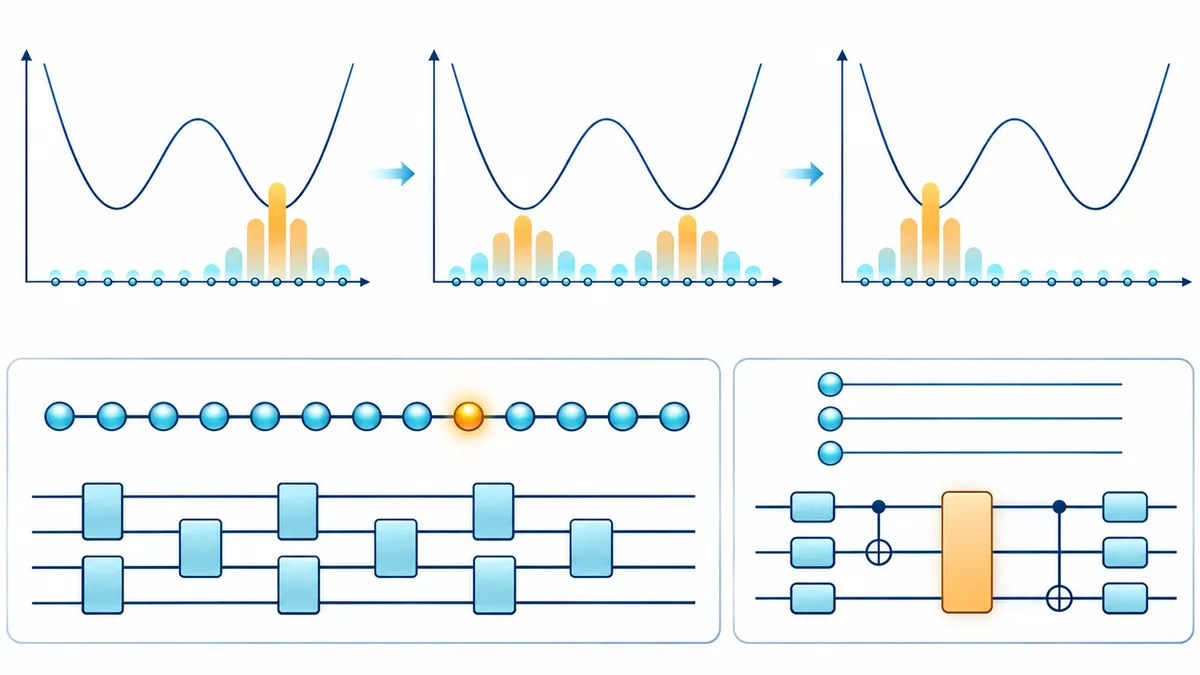
Using fewer qubits does not necessarily mean using fewer gates. In simulations of a quantum system moving between two potential wells, researchers found that a qubit-intensive representation, combined with an exact circuit-compression method, reproduced population transfer that their smaller-register implementation did not.
Two ways to represent continuous motion
In a preprint, Masanori Hanada, Jiwoo Seo, Seok-Kyun Son and Junggi Yoon compare binary and unary position encodings on IBM Phoenix, a superconducting processor, and IonQ Forte, a trapped-ion processor. Their aim is a controlled test of simulation methods under hardware noise, not a demonstration of computational advantage: the single-coordinate systems studied can also be calculated classically.
A bosonic degree of freedom here means a continuous coordinate and its associated momentum, such as those describing a vibrational mode. A digital quantum computer cannot store every possible coordinate value. Instead, the researchers restrict the coordinate to a finite interval and replace it with a grid of positions.
Binary encoding labels those positions with binary numbers. Eight positions, for example, require three qubits. Unary encoding uses one qubit per position, with exactly one qubit in state 1. The location of that single excitation identifies the position. Eight positions therefore require eight qubits.
The trade-off concerns operations as well as storage. The binary implementation uses a quantum Fourier transform to switch between position and momentum representations when applying kinetic evolution. Unary evolution uses local rotations for the potential and exchange gates that transfer excitation between neighboring positions.
Why compression changes the comparison
Both implementations approximate time evolution by alternating operations associated with different parts of the energy. These product formulas, also called Trotter formulas, become more accurate as the time steps shrink, but ordinarily require more gates.
For one coordinate, the unary dynamics has a special mathematical structure: it can be expressed as a noninteracting, or free-fermion, problem. This permits exact rearrangement and combination of the product-formula gates into a circuit whose size bound depends on the number of grid sites, rather than the number of time steps.
“Exact” describes preservation of the chosen product-formula operation, up to numerical rounding. Compression does not remove the approximation introduced by the finite time step or position grid. It does, however, allow smaller time steps without increasing the circuit-size bound.
Transfer between two wells
The clearest hardware result concerns a symmetric double-well potential: two equal energy minima separated by a barrier. The initial state combines the two lowest energy eigenstates—states with definite energy—so that probability is concentrated in the right well. Their relative phase changes during evolution, producing tunneling-driven transfer toward the left well.
The optimized unary implementation used 14 qubits. At the final circuit time reported, preparation and evolution required 208 two-qubit gates on IBM and 182 on IonQ. Measured right-well probabilities fell from 0.973 to 0.061 on IBM and from 0.962 to 0.115 on IonQ near the predicted first transfer.
The binary implementation used four qubits for 16 positions, but its longest reported circuits required 7,186 and 3,320 two-qubit gates, respectively. Neither reproduced the expected transfer. IBM’s late distribution was nearly uniform; IonQ retained a preference for the right well.
This is not an encoding-only comparison. Without compression, a tested unary product formula that captured transfer in noiseless calculations also required about 7,300 two-qubit gates. The paper additionally reports much shorter, offline binary circuits obtained by directly synthesizing the finite-grid evolution operator. Those circuits were not the binary circuits tested on hardware, and their quoted costs exclude preparation.
What the measurements establish
Unary results were post-selected: outcomes were retained only when exactly one excitation was measured. This rejects outcomes outside the intended encoding, but neither corrects errors within it nor establishes the performance of all experimental runs. For the double-well datasets, retention ranged from approximately 26–76% on IBM and 16–82% on IonQ across times and regions.
The well imbalance also constrains coherence, meaning off-diagonal elements of the state in the energy eigenbasis. Every energy eigenstate of the symmetric 14-site model occupies both wells equally. An unequal well population therefore requires coherence between energy eigenstates, under the assumed ideal position-measurement model. After transfer, the authors obtain 95% lower confidence limits of 0.85 and 0.62 for their coherence measure. These bounds do not establish fidelity to the intended two-state superposition.
No universally preferred encoding
The researchers compared hardware data with continuum predictions, exact finite-grid evolution and noiseless product-formula circuits. These references distinguish numerical approximations from implementation discrepancies. The encodings also used different boundary conditions and kinetic operators, so their finite models were not identical.
Tests with two interacting coordinates further limit the compression result. Interactions prevent fixed-size compression of the complete evolution. On the four-site-per-coordinate grids tested, binary circuits were substantially shorter, and neither encoding was uniformly more accurate. The preprint therefore supports choosing representation and compilation together, with grid size, evolution time, interactions and device connectivity all affecting the outcome.
- quantum simulation
- unary encoding
- binary encoding
- quantum tunneling
- circuit compression
- superconducting qubits
- trapped-ion processors
Related reading
Automatically matched by shared topic keywords. These links do not imply that the sources agree or establish a consensus.
Simulating quantum noise by enlarging the quantum system
Source published
Shared keywords: quantum simulation
A framework for tracking grid errors in quantum field simulations
Source published
Shared keywords: quantum simulation
A better boundary for simulating quantum systems and their surroundings
Source published
Shared keywords: quantum simulation
Rotating local axes trims the memory cost of quantum simulations
Source published
Shared keywords: quantum simulation
Slow drives could connect distant superconducting qubits through a shared cavity
Source published
Shared keywords: superconducting qubits