TRANSMISSION // 2611.13072v1
STARI plans a starlight handoff between two small spacecraft
Source published
A NASA-funded mission aims to transfer starlight between formation-flying CubeSats and guide it into an optical fiber. The authors report encouraging preliminary simulations, but integrated testing and an orbital demonstration remain ahead.
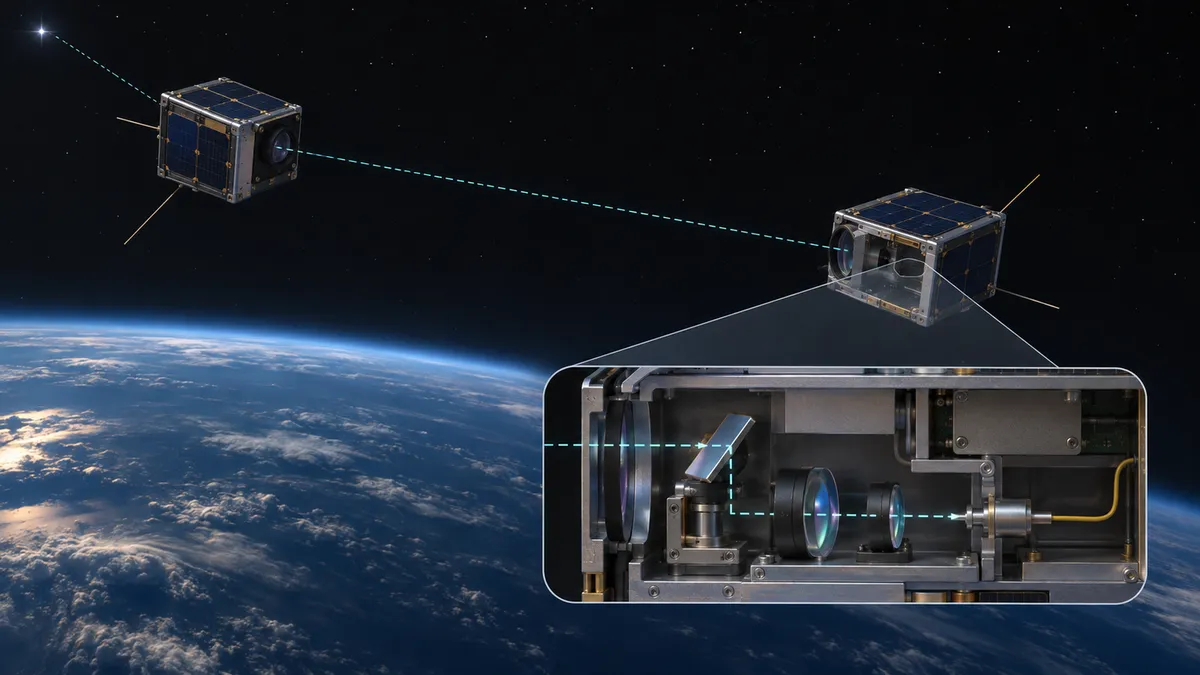
Future space telescopes could combine light collected by widely separated spacecraft. Before that becomes practical, engineers must show they can reliably pass faint starlight between moving satellites. John D. Monnier and colleagues describe STARI, a mission targeting launch in 2029 to test that essential operation.
A deliberately limited experiment
In their preprint, Monnier and colleagues present STARI—STarlight Acquisition and Reflection toward Interferometry—as a technology demonstrator, not a working interferometer. Its central task is to collect starlight on one spacecraft, reflect it toward another, and feed the received light into a single-mode optical fiber.
Interferometers coherently combine light collected at separated locations, using the distance between collectors to resolve finer detail than an individual telescope could. Future space-based versions could support studies of nearby Earth-like planets, including searches for atmospheric biomarkers. STARI would test some of the engineering needed for such observatories; it would not perform those planetary observations itself.
The mission deliberately leaves out the equipment needed to combine separate beams and precisely adjust their travel distances. That narrower scope lets the team concentrate on navigation, beam steering, optical coupling and autonomous coordination.
Passing light across an orbital formation
The current design uses two nearly identical, propulsive 8U CubeSats, each with an estimated mass of about 12 kilograms. The preferred orbit is approximately 500–600 kilometres above Earth. Planned operations would last at least six months, with extensions depending on spacecraft health and fuel.
The authors describe nominal starlight transfers across separations of 20–100 metres, with extended demonstrations beyond 175 metres. The overall concept reaches separations of up to 200 metres.
One spacecraft would collect the target star’s light and steer a narrow beam toward its partner. The receiving spacecraft would use its own steering mirror and focusing optics to inject that light into a single-mode fiber. A camera would measure the light emerging from the fiber, providing a direct record of how much starlight successfully passed through the system and how that amount changed over time.
Either spacecraft is intended to perform either optical role. The authors say this common design reduces vulnerability to some failures, although it increases development complexity.
Keeping the beam on target
The spacecraft would combine differential satellite-navigation measurements with images of visible LED beacons on their partner. Fast-steering mirrors would make fine optical corrections while propulsion adjusted the relative orbit.
A key feature is that the transmitting spacecraft’s camera would see both the target star and its partner’s beacon pattern in the same frame. Their relative positions would guide corrections without relying solely on the spacecraft’s absolute pointing accuracy.
The formation would also keep the line joining the spacecraft nearly perpendicular to the direction of the star. This limits the geometric difference in the distances incoming starlight travels to the two spacecraft—an important consideration for a future interferometer, even though STARI would not combine those beams.
Observing sequences would begin in a passively safe standby formation, move into an actively controlled observing configuration, and return to standby afterward. The design includes safe and escape modes for faults.
What the simulations suggest
The authors report preliminary simulations of the transmitting spacecraft’s tracking loop. Rather than assuming a single fixed pointing error, they model disturbances across different frequencies, drawing on reported pointing and vibration data from other CubeSats.
For a target star of visual magnitude about 2.5, their photon-budget calculation estimates roughly 6,000 detected photons in a 20-millisecond tracking exposure. Under the simplified simulation assumptions, a predictive controller reduces the residual tracking error along one axis to below one arcsecond in representative runs.
At a separation of 100 metres, one arcsecond corresponds to approximately half a millimetre of beam-position movement. That is smaller than the roughly two-millimetre centring allowance used in the study’s stable-coupling goal.
These are calculated results, not demonstrated flight performance. The authors explicitly describe them as an architecture-level consistency check rather than a final prediction.
What remains unproven
The next modelling steps must incorporate measured camera delays, optical losses, mirror response, beacon brightness, relative-orbit drift and spacecraft vibration. Small focus shifts, thermal gradients or lateral misalignments could sharply reduce the light entering the fiber.
Propulsion introduces another constraint: thruster impulses must be small and repeatable enough to maintain the formation without excessive disturbance. Hardware choices, thermal behaviour and autonomous operating sequences remain under development.
The baseline goals include repeated handoffs, stable operation at multiple separations and fiber-coupled brightness variations no greater than 40 percent root mean square over one-second intervals. These are success criteria, not achievements already reported.
The schedule described in the paper places fabrication in 2027, integration and environmental testing in 2028, and launch in 2029. If successful, STARI would provide flight evidence for one essential part of a future distributed observatory—not validation of a complete space interferometer.
- STARI
- space interferometry
- CubeSats
- formation flying
- starlight transfer
- single-mode fiber
- optical tracking
Related reading
Automatically matched by shared topic keywords. These links do not imply that the sources agree or establish a consensus.