TRANSMISSION // 2611.13064v1
Mars Seed proposes making habitat plastics from Martian resources
Source published
A reference design estimates that a 20-tonne biomanufacturing installation could produce habitat materials from Martian air, ice and regolith. Its projected advantage over shipping polymers depends on unproven integration, durability and material performance.
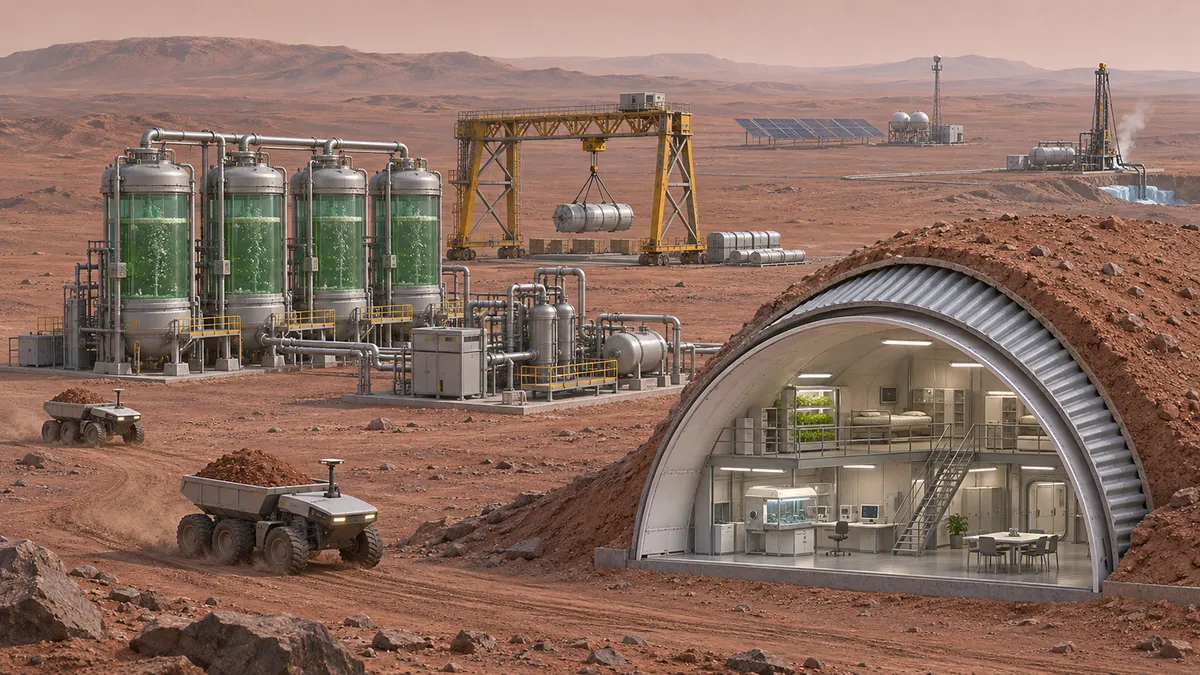
Could sending a small factory to Mars eventually provide more building material than sending the material itself? Devon A. Stork and colleagues explore that question in Mars Seed, a proposed system combining resource extraction, microbial fermentation and robotic construction.
A factory rather than a finished habitat
In the Mars Seed preprint, Devon A. Stork and colleagues at Pioneer Labs describe a system intended to turn Martian resources into plastic for habitat construction. Their central question is not simply whether microbes can make useful materials, but whether the machinery needed to feed them and process their products could justify its delivery mass.
The study is an engineering reference architecture, not a demonstration of an operating Martian factory. The authors combine published experiments, equipment precedents and first-order calculations to estimate a complete production chain. They state that the paper will not be submitted to a journal.
Their baseline design allocates 20 tonnes of equipment and 40 kilowatts of electrical power to resource collection, chemical processing, fermentation and construction. Under its assumptions, the installation could produce materials for about 870 square metres of habitat floor area within roughly two Earth–Mars launch-window cycles, or about 50 Earth months.
Turning air, ice and rock into microbial feed
The proposed factory would land near accessible subsurface ice. A nuclear fission reactor would supply electricity, while some of its waste heat would help melt ice in a well. Water recycling would reduce the need for fresh extraction: the design targets roughly 1,800 litres recovered daily, supplemented by about 200 litres of newly extracted water.
Atmospheric carbon dioxide would pass through two electrochemical stages. The first would produce carbon monoxide and oxygen, drawing on the oxygen-making approach demonstrated by the MOXIE experiment on Mars. The second would convert carbon monoxide and water into acetic acid, a carbon and energy source for the microbes. That second stage still requires development for long-duration Martian operation.
Meanwhile, mixing regolith—the loose surface material—with water would dissolve inorganic nutrients. The authors base this step on earlier work with simulated Martian nutrient chemistry. Whether different landing sites would provide the right nutrient balance remains an open question.
Four pressurized, temperature-controlled, 1,000-litre bioreactors would then grow an engineered strain of the bacterium Cupriavidus necator. These organisms accumulate polyhydroxybutyrate, or PHB, a plastic stored inside their cells. They would grow in controlled vessels, not exposed on the Martian surface.
The production estimate extrapolates from reported five-litre fermentations and assumes comparable performance at much larger scale. With about 33 kilograms of acetic acid daily, the authors project roughly 14 kilograms of dry biomass containing 10 kilograms of PHB per day.
Two materials for two structural jobs
After separation from the liquid culture, the biomass would follow two routes. Half would be mixed directly with regolith and printed into an outer shell. The remaining half would undergo processing to recover purified PHB for an internal pressure-containing liner.
The distinction matters. The corrugated outer shell would support two metres of regolith intended to provide radiation and thermal shielding. The separate liner, combining plastic film with reinforcing straps, would contain the breathable atmosphere.
A reference habitat measures five metres across and 15 metres long, providing 75 square metres of floor area. However, neither component is a validated habitat design. The shell calculations simplify its geometry and loading, while the liner requires testing of gas permeability, strength and long-term durability. Airlocks, valves and other rigid interfaces are excluded from the model.
For purification, the authors propose using pressurized carbon dioxide to break open cells and help separate plastic from cellular debris. Recovering sufficiently pure PHB without recurring imported processing supplies is one of the architecture’s major unresolved challenges.
Where the projected advantage comes from
The comparison is with another 20-tonne payload carrying construction equipment and Earth-made polymer, which would also use local regolith. The authors estimate that this alternative could provide about 810 square metres of floor area before exhausting its imported material. Mars Seed would reach that output after roughly 1,400 Martian days and could then continue producing, provided its equipment remained functional.
This is a modeled advantage in delivered mass and cumulative output, not evidence that biological production needs less operating electricity. The shipped-polymer comparison uses substantially less power. Indeed, about two-thirds of Mars Seed’s electricity goes to electrochemical feedstock production; the biological equipment consumes less than 10%.
The result depends on years of reliable operation. Electrolyzer and membrane lifetimes, microbial stability, robotic maintenance and possible perchlorate contamination all require further investigation. The manifest includes spares, but those are finite.
Mars Seed therefore offers a quantitative framework for testing a possibility, rather than proof of self-sufficient habitation. Its contribution is to expose the equipment, energy and material assumptions that must hold before a microbial factory could outperform repeated deliveries from Earth.
- Mars
- biomanufacturing
- in situ resource utilization
- polyhydroxybutyrate
- space habitats
- microbial fermentation