TRANSMISSION // 2611.13033v1
Cleaning radio maps separately helps reduce telescope-induced ripples
Source published
Boyan Zhao and colleagues report that separating MeerKAT observations by scan orientation before removing foreground emission reduces unwanted spectral ripples. In their preprint, the revised processing improves a measure of hydrogen signal relative to systematic contamination by about 81%.
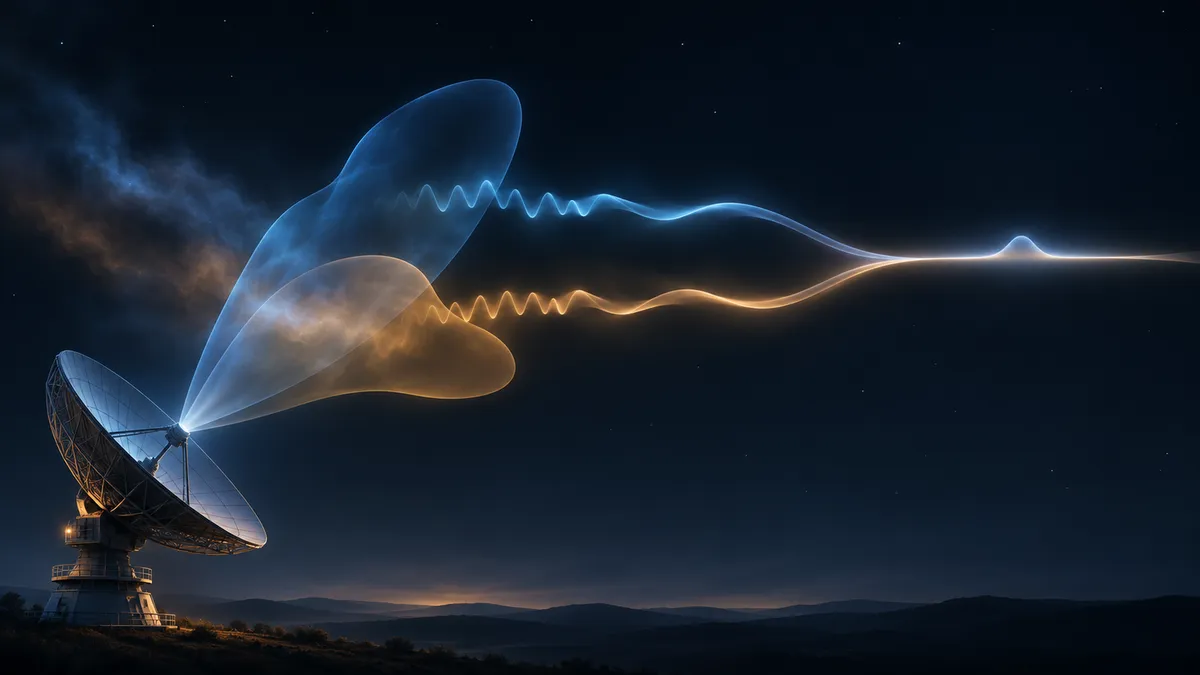
Combining observations usually helps reveal faint astronomical signals. But when a telescope responds differently to the sky between scans, combining them too early can make unwanted patterns harder to remove. A MeerKLASS analysis finds that changing the order of processing helps preserve a neutral-hydrogen signal while reducing contamination.
A faint signal behind a bright foreground
Neutral hydrogen emits radio waves at a wavelength of about 21 centimetres. Cosmic expansion stretches those waves, so observing their frequency helps astronomers locate the emitting gas along the line of sight. Hydrogen intensity mapping measures the combined emission from many unresolved galaxies, tracing the Universe’s large-scale structure without identifying every galaxy individually.
The difficulty is that foreground radio emission is vastly brighter. According to Boyan Zhao and colleagues, it exceeds the expected cosmological hydrogen signal by at least four orders of magnitude in the relevant regime. Their preprint investigates how the MeerKAT telescope’s response turns otherwise smooth foreground emission into troublesome spectral ripples—and how to reduce them.
The team analysed MeerKLASS L-band deep-field observations taken in 2021. The survey covers 236 square degrees; the frequency band used here corresponds to redshifts of roughly 0.39–0.46. To examine the hydrogen signal, the researchers aligned and averaged small sections of the radio maps around 2,269 galaxies with known positions and redshifts from the Galaxy And Mass Assembly survey. This procedure, called stacking, helps reveal emission too faint to study galaxy by galaxy.
How the telescope adds ripples
A telescope’s beam describes its sensitivity to radiation arriving from different directions. Its central region is most sensitive, but weaker regions called sidelobes also pick up emission, including from far outside the intended pointing.
MeerKAT’s beam changes with frequency and is not circularly symmetric. Consequently, the same smooth foreground can receive different weight at different frequencies. The resulting spectrum acquires structure that was not present in the foreground itself.
The authors tested this explanation by combining simulated foreground skies with an electromagnetic model of the telescope beam. Unlike a simple Gaussian approximation, their model includes directional asymmetry and distant sidelobes. They varied how far from the beam centre those sidelobes were included and compared different beam orientations.
The simulations produced oscillatory spectral structures, including a characteristic period near 20 megahertz. Including sidelobes farther from the beam centre introduced additional structures. The authors conclude that even weak sensitivity far from the pointing direction can matter for foreground removal.
Tests on the observations also suggested that the ripples were not merely correlations created by the cleaning procedure. Applying the same cleaning operation to simulated noise produced much weaker frequency correlations than those remaining in the real maps.
Why combining first can hurt
The foreground-removal method, principal component analysis, or PCA, identifies prominent patterns shared across frequency spectra and subtracts a selected number of them. These patterns are called modes. Removing more modes can reduce contamination, but it can also erase hydrogen emission.
MeerKLASS observes its target field both while it rises and while it sets. The beam has different orientations relative to the sky in these two scan groups. In the simulations, averaging maps with different orientations before cleaning left stronger ripples afterward.
The authors interpret this as foreground complexity becoming spread across more PCA modes. A fixed number of subtracted modes then captures the contamination less efficiently.
They therefore cleaned the rising and setting observations independently, combining them only afterward. Two approaches—averaging the separately stacked spectra or combining the cleaned maps before stacking—gave similar results.
With nine modes removed from each subset, rather than ten from the original combined map, the revised processing reduced the ripples while retaining a comparable or higher central stacked peak. The authors report an approximately 81% improvement in their signal-to-systematic measure, which compares the integrated central peak with an unwanted side peak. This is not an 81% increase in telescope sensitivity or in the amount of hydrogen detected.
Simply removing an eleventh mode from the original combined map was less successful: it weakened the ripples but also reduced the hydrogen signal.
What the result does not establish
The simulations were designed to explain the mechanism qualitatively, not reproduce the observations exactly. They contained foreground emission and thermal noise, but no cosmological hydrogen signal. The beam model also omitted some antenna structures and interactions; atmospheric effects and ground reflections were not simulated.
Residual contamination remained, and setting scans performed better than rising scans. The authors suggest additional observational effects, potentially including radio interference, could contribute, but did not establish their cause.
The work is a preprint, not an established peer-reviewed result. Its practical finding is specific: for these data, accounting for scan orientation before foreground cleaning improved the stacked spectrum. Zhao and colleagues suggest the strategy could also help future MeerKAT and SKA-Mid analyses.
- MeerKAT
- MeerKLASS
- neutral hydrogen
- intensity mapping
- foreground removal
- telescope beam
- principal component analysis
Related reading
Automatically matched by shared topic keywords. These links do not imply that the sources agree or establish a consensus.
Could magnetic fields help explain gas rotation in the Sunflower Galaxy?
Source published
Shared keywords: neutral hydrogen
How combining outcomes can change an economic study’s conclusion
Source published
Shared keywords: principal component analysis
Can Ripples in the Universe’s Oldest Light Reveal When New Physics Acted?
Source published
Shared keywords: principal component analysis
When Many AI-Generated Controls Can Help Regression—and When They Cannot
Source published
Shared keywords: principal component analysis